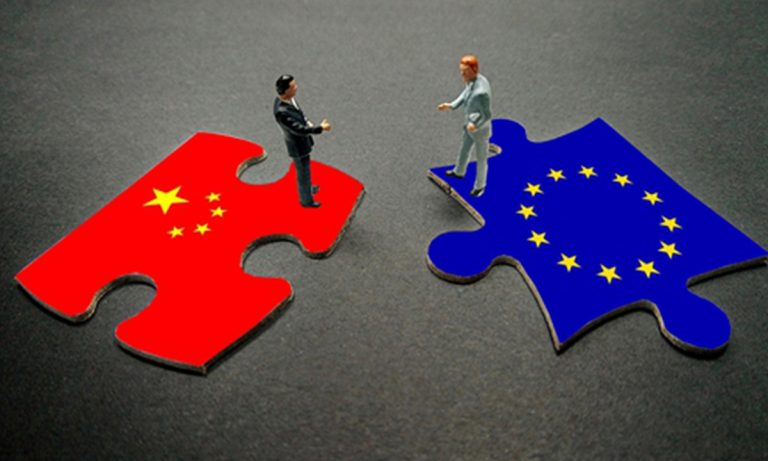
A five-nation coalition within the European Union is pushing Brussels toward its most aggressive posture on China trade in years. On May 24, a paper signed by Spain, France, Italy, the Netherlands, and Lithuania landed in Brussels demanding a far tougher trade regime against China, calling for faster emergency tariffs, broader safeguards, and new anti-circumvention powers, ahead of a key European Commission debate on May 29. French President Emmanuel Macron has gone further, suggesting the bloc adopt measures modeled on Washington’s Section 301 tariffs. The irony is considerable: the same leaders who condemned US tariffs as “bullying” and “illegal” are now reaching for the same playbook. Whether this represents principled industrial policy or competitive panic dressed up in strategic language is a question Brussels cannot afford to get wrong.
The numbers driving the alarm are real enough. Europe received its first full-year bill for the 2025 US-China trade war in the form of a 360 billion-euro deficit with Beijing, up 18% from the prior year, as the EU imported 559.4 billion euros worth of Chinese goods while exporting just 199.6 billion euros. Blocked from the US market by high tariffs, Chinese exports flooded Europe, with Chinese goods to the EU surging nearly 15% between November 2024 and November 2025. The numbers look alarming in isolation. In context, they tell a more complicated story.
The Deficit That Hides the Profits
The headline trade deficit figure is the most cited, and also the most misleading, metric in this debate. Rolf Langhammer, a researcher at the Kiel Institute in Germany, told reporters that the deficit reflects declining European export competitiveness more than a flood of unwanted Chinese goods, adding that “trade suppresses inflation and leads to real income gains for EU consumers.” That distinction matters enormously because the policy remedies for each diagnosis are completely different.
Nearly half of China-EU trade consists of intermediate goods — Chinese semi-finished products that European manufacturers purchase, upgrade, and then sell globally at considerable margins. The dip in Chinese EV exports to Europe following tariff imposition was “replaced by a fourfold surge in plug-in hybrid and hybrid electric vehicle exports from China not covered by the duties,” suggesting that tariff measures tend to shift trade flows rather than reduce them. Meanwhile, the EU continues to maintain a trade surplus with China in services, amounting to 21.3 billion euros in 2025. Intellectual property licensing, financial services, and professional fees from China represent tens of billions more in European earnings that never appear in the goods trade statistics. The real picture is closer to: the deficit is in China, while the profits are in Europe.
Germany’s refusal to sign the five-nation paper is telling. As the EU’s largest economy and its most trade-exposed industrial power, Berlin understands better than most that a retaliatory cycle with Beijing would cost it far more than it would gain. China dominates the rare-earth and critical-mineral supply chains Europe’s green and defense industries cannot function without, giving Beijing a lever Brussels cannot easily match, meaning any tariff escalation risks a counter-strike on the very inputs Europe is trying to secure.
Europe’s Own-Goal on Competitiveness
The case that China is destroying European industry runs into an awkward problem: Europe has been doing a credible job of that itself. EU electricity prices for energy-intensive industries in 2025 continued to be on average roughly double the prices in the United States and more than 50% higher than in China and India, according to the International Energy Agency. Years after the energy price crisis, investment in electrification remains stalled and the competitiveness gap with third countries widened, with electricity costs in Europe continuing to be structurally high and volatile, contributing to plant closures, reduced output, and delayed decarbonisation investments.
The Draghi report on EU competitiveness delivered a damning verdict on these structural failures last year, noting that EU companies face electricity prices two to three times higher than in the United States and natural gas prices four to five times higher. These are not problems caused by Chinese trade policy. They are the product of Europe’s own strategic misjudgment on Russian energy dependency, its slow and fragmented regulatory machinery, and chronic underinvestment in research and development. The EU’s industrial competitiveness continues to weaken as it loses ground to China and the US in several areas, including deployment of infrastructure and innovation.
Tariffs cannot fix any of this. The WTO director-general warned in February that China’s record trade surplus risks triggering fresh protectionist barriers worldwide, but also cautioned that rebalancing must come through structural reforms, not trade barriers. When the US initiated its own trade war against China, the costs of increased tariffs were largely borne by American companies and consumers, while global supply chains absorbed the disruption without the promised reshoring materializing at scale.
The Fork in the Road
Trade Commissioner Maroš Šefčovič has vowed to “fight tooth and nail for every European job,” and the Commission has promised new defensive tools by September. But Europe is caught between three forces it cannot fully reconcile: a domestic industry demanding protection, a Beijing threatening retaliation it can deliver, and a Washington pushing the bloc to decouple faster than its own economy can bear.
The May 29 Commission meeting will not resolve that tension. What it can do is clarify which direction Brussels is leaning. A measured approach — targeting genuinely subsidized sectors with proportionate, WTO-consistent tools while deepening dialogue on market access — leaves the door open to a functional trade relationship. An escalatory approach modeled on Section 301 closes that door without guaranteeing anything better on the other side.
The EU’s significant growth downgrade is largely due to weaker goods exports, while competitive pressures from trading partners, particularly China, are amplified by the stronger euro. Adding a self-inflicted trade war to those headwinds would be a peculiar definition of industrial strategy. Europe’s real challenge is not figuring out how to penalize China — it is figuring out how to compete again.
Original analysis inspired by the Global Times Editorial Board from Global Times. Additional research and verification conducted through multiple sources.