Category: China

Armored vehicles and military troops in a parade.

China’s Governance Model: Discipline Meets Long-Term Vision

This analysis explores the core tenets of China’s governance framework, examining how the synergy between disciplined institutional oversight and long-range strategic planning drives the nation’s development trajectory. We discuss the role of anti-corruption campaigns in maintaining state integrity, the adaptability of the economic model, and the underlying civilization-state logic that prioritizes collective national outcomes over short-term political cycles.

Read More »
Silhouette of a Chinese military officer in front of the official emblem of the People's Republic of China.

Xi’s Harshest Military Sentences Set the Stage for Bigger Purges

This analysis examines the escalation of Xi Jinping’s military purge, marked by unprecedented sentencing for former defense ministers. We explore how evolving political rhetoric—shifting from corruption charges to accusations of “disloyalty”—has systematically dismantled the PLA’s operational leadership. The article evaluates the resulting degradation in military readiness, the risks of intelligence-stifling feedback loops, and the broader implications for Xi’s vision of absolute institutional control.

Read More »
A U.S. Navy warship sailing past commercial cargo container ships in a maritime chokepoint.

Hormuz Proved Chokepoints Can Be Weaponized. Asia Is Next.

This analysis explores the systemic vulnerability of global maritime chokepoints, highlighted by the recent closure of the Strait of Hormuz. We examine how drone technology and insurance market manipulation create catastrophic economic risks, with specific focus on Asia’s critical passages. The piece evaluates the geopolitical implications for China, the United States, and the intensifying competition over secondary trade corridors.

Read More »
Alternating flags of China and Russia displayed at a summit.

Xi and Putin Unite Against Golden Dome at Beijing Summit

This analysis explores the strategic consolidation between Moscow and Beijing during the recent Beijing summit, where both leaders condemned the U.S. “Golden Dome” missile defense initiative. As energy ties deepen—driven by the disruptions of the ongoing Iran war—we examine how this anti-hegemonic alignment seeks to reshape the global security architecture while highlighting the growing structural asymmetry of the Russia-China relationship.

Read More »
Vladimir Putin speaking at a podium with Russian and Chinese flags in the background.

Why US Pressure Keeps Pushing Moscow and Beijing Closer

This analysis explores the resilience of the Sino-Russian partnership, arguing that Western pressure has inadvertently solidified their cooperation. By examining the shift from ideological alignment to a partnership built on shared threats—and analyzing the failure of recent U.S. “wedge strategies”—we highlight why Moscow and Beijing view their collaboration as an indispensable strategic necessity, even amidst growing economic asymmetries and localized frictions.

Read More »
TV news broadcast showing Donald Trump and Xi Jinping shaking hands.

Indo-Pacific Allies Rethink Security After Trump’s Taiwan Gamble

This analysis explores the growing crisis of confidence among U.S. Indo-Pacific allies following recent shifts in Washington’s Taiwan policy. As traditional deterrence mechanisms face strain, key partners like Japan and South Korea are accelerating defense transformations and reconsidering long-standing nuclear restraint policies, signaling a profound shift in regional security architecture.

Read More »
US President Donald Trump waving from the doorway of Air Force One while officials on the tarmac watch.

Why Delaying Taiwan’s Arms Sales Weakens Deterrence

This article criticizes the decision to hold Taiwan’s $14 billion arms package in abeyance as trade leverage with Beijing. Despite Taipei passing a crucial $25 billion defense budget, treating approved defensive hardware as a negotiating token weakens cross-Strait deterrence and risks inviting severe strategic miscalculation from a modernizing Chinese military.

Read More »
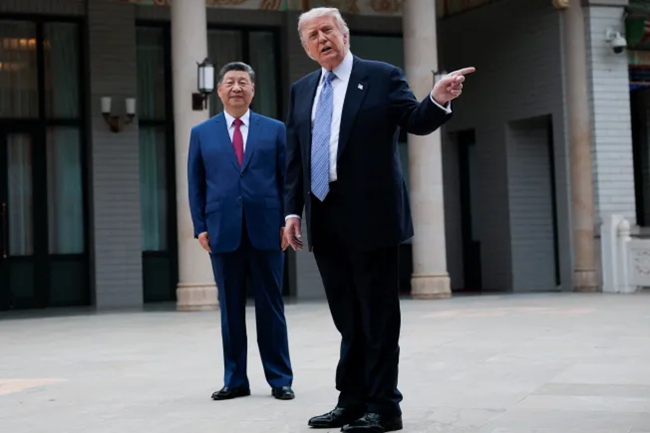
Chinese President Xi Jinping and US President Donald Trump walking together indoors during a diplomatic summit in Beijing.

Trump’s Beijing Summit Signals a New US-China Power Balance

This analysis evaluates the strategic implications of the May 2026 Trump-Xi summit in Beijing. Signaling a breakdown of the traditional unipolar framework, the meeting underscored Washington’s implicit recognition of China as a co-equal power, as global supply chain realities and Middle East entanglements reshape the bilateral balance of power.

Read More »
Small desktop flags of Russia and China standing crossed against a soft, light-colored background.

Putin’s 25th Visit to China Tests Beijing’s Balancing Act

This article analyzes Vladimir Putin’s 25th presidential visit to China, arriving immediately after Donald Trump’s departure from Beijing. While the leaders target energy deals like the Power of Siberia 2 pipeline, the summit highlights China’s strategic tightrope walk as an indispensable power broker managing ties with both Washington and Moscow.

Read More »
Chinese President Xi Jinping speaking at a podium during the Beijing Summit with a prominent orange background displaying Beijing China.

Beijing’s Double Summit Rewrites the Power Triangle

This analysis explores the geopolitical significance of Xi Jinping hosting the American and Russian presidents back-to-back in Beijing. Breaking from historical Cold War dynamics, China now occupies the center of this unequal power triangle, balancing massive Western commercial ties with an existential energy partnership with a sanctioned, anxious Moscow.

Read More »
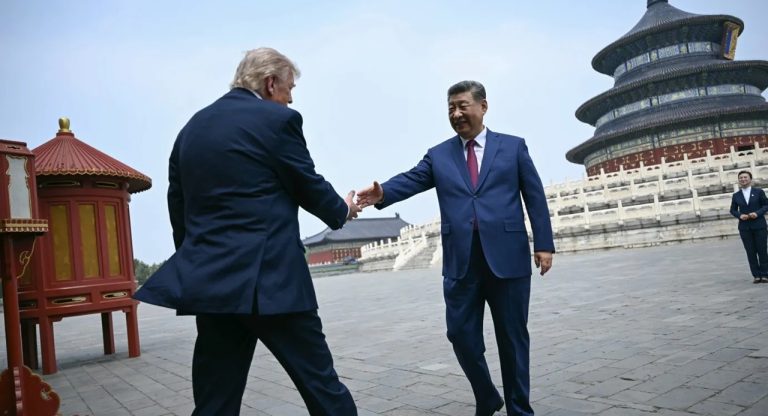
Donald Trump and Chinese President Xi Jinping standing side by side in a large stone courtyard with the Temple of Heaven in Beijing visible in the background.

Trump’s China Visit Shows Beijing’s Strategic Confidence

This analysis evaluates Donald Trump’s high-profile visit to Beijing, highlighting the contrast between American economic objectives and China’s push for strategic equality. While yielding commercial agreements on agriculture and aircraft, the summit left core geopolitical friction points—including Taiwan, Iran, and technology supply chains—unresolved, signaling a temporary pause rather than a settlement.

Read More »
Donald Trump walking alongside international diplomats and officials on a tarmac at night, surrounded by security and government personnel.

Taiwan’s Strategic Bet After Trump’s China Visit

This analysis examines the strategic dilemma facing Taipei following Donald Trump’s recent Beijing summit with Xi Jinping. Trump’s remarks outlining boundaries on U.S. support highlight the transactional nature of Washington’s deterrence policy, underscoring Taiwan’s need to maintain a disciplined defense strategy without triggering a cross-Strait conflict.

Read More »