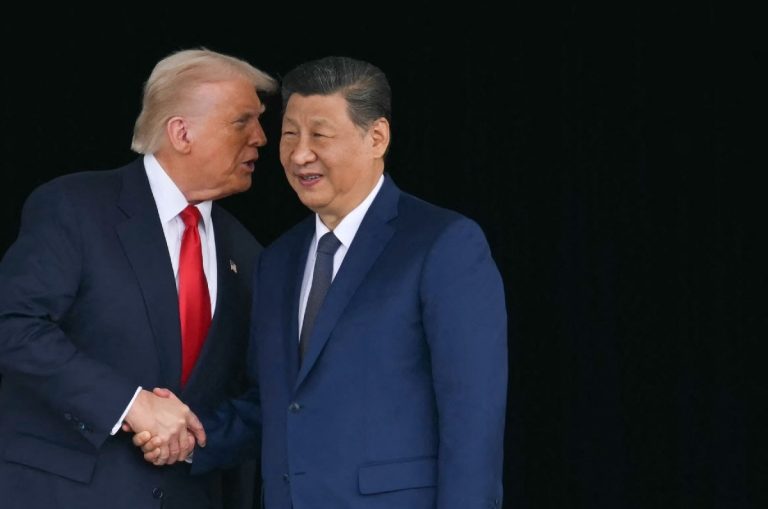
The timing of Senator Tammy Duckworth’s arrival in Taipei on Monday was not coincidental. She is the first US senator to visit the island since Donald Trump sat down with Xi Jinping in Beijing in May — a meeting that produced one of the most alarming statements on Taiwan in recent American diplomatic memory. In a Fox News interview immediately after leaving China, Trump called US arms sales to Taiwan “a very good negotiating chip” in relations with Beijing, and confirmed he was holding a $14 billion arms package “in abeyance” pending his read of Chinese behavior. That formulation broke with decades of US policy. It alarmed Taipei. And it sent Duckworth onto a plane.
“It really is critical to not yield even an inch to President Xi,” Duckworth told Foreign Policy before departure. The senator — an Iraq War combat veteran who lost both legs when her Black Hawk helicopter was hit by a rocket-propelled grenade — framed the trip in blunt national security terms: Taiwan’s semiconductor production and the Taiwan Strait’s role as a critical shipping corridor make the island’s continued autonomy a direct American economic and strategic interest, not a favor to a distant partner.
What Trump Said in Beijing — and What It Meant
Xi told Trump during their May meeting that the Taiwan question is “the most important issue in China-US relations” and warned that mishandling it could produce “clashes and even conflicts.” Beijing’s readout was characteristically direct. Trump’s public response — volunteering that arms sales were a negotiating chip before any journalist had asked — went further than any modern American president had gone in publicly linking Taiwan’s defense to transactional bargaining with China.
Under what are known as the Six Assurances — the informal commitments Washington has maintained since 1982 — the US agreed not to consult Beijing on arms sales to Taiwan and not to set a date for ending them. Trump’s comments cut directly across that framework. The State Department’s Michael DeSombre told Congress in late June that the arms sale “did not depend on China” and that there had been “no deviation” from long-standing US policy. A senior administration official separately told Foreign Policy that Trump had approved an $11.1 billion package in December 2025 — the largest in history — and would make a further determination “in a fairly short time.” That combination of record arms sales and public hedging has produced precisely the uncertainty Taipei fears most.
China’s response to the December 2025 package was swift: military drills near Taiwan launched eleven days after the announcement. Beijing has consistently used large arms sales as a trigger for exercises designed to signal that the cost of US support will be paid in regional tension. The pattern is well established. What is less established is whether the current administration views that cost as acceptable or negotiable.
The Semiconductor Argument Duckworth Is Making
Duckworth’s trip carries an economic dimension that is designed to make the national security case in language Washington’s current leadership tends to respond to more readily than values-based appeals. The average American car contains hundreds of chips, most of them manufactured in Taiwan. TSMC alone produces over 90% of the world’s most advanced semiconductors. Any military disruption to Taiwan’s production would cascade through American manufacturing, defense supply chains, and consumer electronics in ways that no domestic stockpile could quickly offset.
Taiwan’s importance to the global semiconductor supply chain is impossible to overstate. The island produces over 60% of global semiconductor output and over 90% of advanced chips. Duckworth has been pushing for Taiwanese companies to make direct investments in US manufacturing — a track that runs parallel to the CHIPS Act framework — and her meetings with Taiwan’s economy minister and defense minister are both part of that pitch.
This framing — Taiwan as supply chain anchor rather than democratic symbol — is a deliberate translation of the strategic argument into the terms that resonate in the current political environment. It will not satisfy everyone. But it may be more durable.
A Bipartisan Floor Under an Uncertain Policy
Duckworth was careful to note that support for Taiwan “is bipartisan” and that some of her Republican colleagues share her unease. That observation matters. Congress has historically served as a floor under Taiwan policy when executive branch signals have been ambiguous — the Taiwan Relations Act of 1979 legally obligates the US to supply Taiwan with defensive weapons regardless of any particular president’s preferences on dealmaking.
The Trump administration approved that $11.1 billion package last December precisely because the statutory obligation is hard to avoid. The question being tested now is whether Trump treats the Taiwan Relations Act as a ceiling — fulfilling the minimum legal requirement while treating everything above it as leverage — or as a baseline from which American commitment continues to grow. Duckworth’s visit is an argument for the second interpretation, made in person, in Taipei, at a moment when the island is watching Washington very closely for signals about which way that question is going to be resolved.
Original analysis inspired by John Haltiwanger from Foreign Policy. Additional research and verification conducted through multiple sources.
By ThinkTanksMonitor