Category: Cartoon

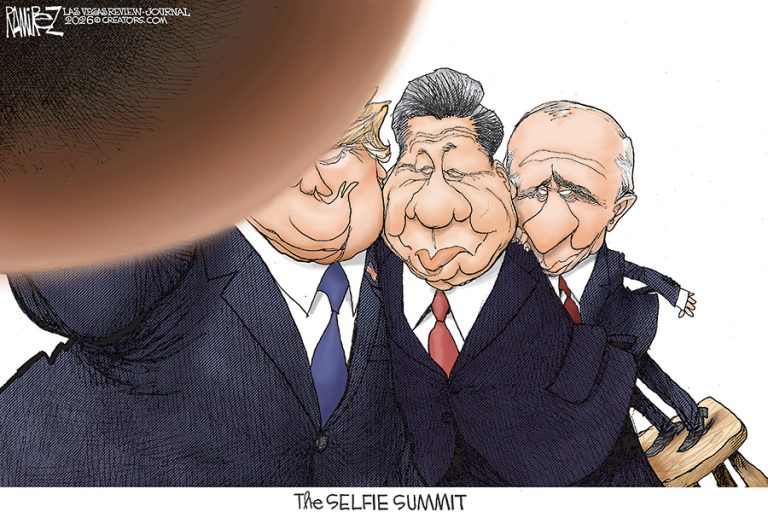
The Selfie Summit

Analysis: The cartoon depicts President Donald Trump snapping a smartphone selfie while his own oversized thumb blocks his face, leaving Chinese President Xi Jinping smiling squarely in the center of the frame as a diminutive Vladimir Putin stands on a wooden step-stool behind Xi’s shoulder. Through this visual hierarchy, Ramirez critiques Washington’s preference for theatrical diplomacy over substantive strategy, illustrating how U.S. missteps elevate Beijing’s global stature. The imagery captures the emerging multipolar reality in which China commands the diplomatic center while Russia operates as a visibly junior partner.
Read More »

Editorial cartoons for Monday, November 23

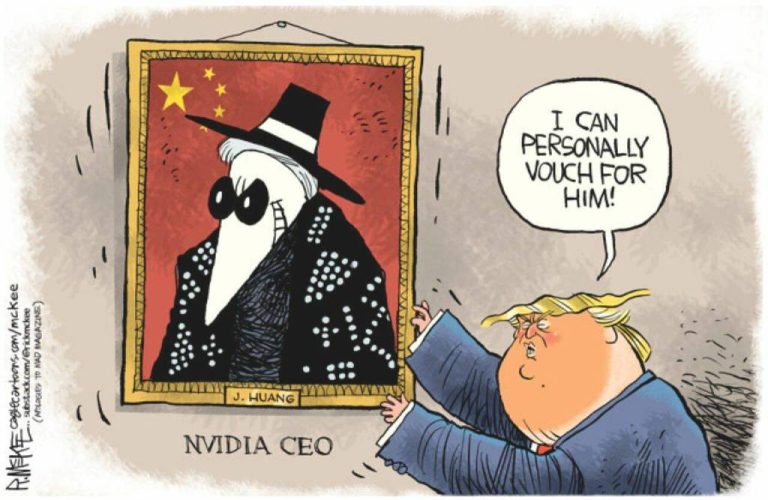
Analysis: The cartoon depicts a framed portrait labeled “J. HUANG” and “NVIDIA CEO” showing a Spy vs. Spy-style black-clad figure with a pointed beak, dark sunglasses, and wide-brimmed hat against a Chinese flag, while Donald Trump gestures toward it declaring, “I CAN PERSONALLY VOUCH FOR HIM!” By blending Cold War espionage imagery with China’s flag, McKee critiques executive intervention that restored Huang despite congressional probes into Nvidia chip smuggling and alleged intelligence ties. It highlights the growing tension between political dealmaking and national security governance at the center of global AI competition.

Read More »

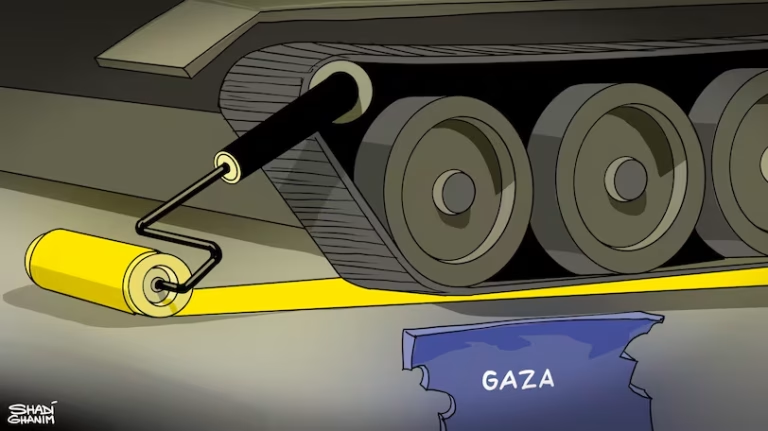
Shadi’s take on Israeli tanks crossing the ‘yellow line’ into central Gaza

Analysis: Depicting Israeli tanks rolling across the “yellow line”—the military demarcation boundary established under the Gaza ceasefire framework—the cartoon visually highlights the steady erosion of agreed truce limits on the ground. Its underlying message criticizes the normalization of incremental Israeli military advances into central Gaza while diplomatic negotiations over withdrawal and disarmament remain stalled. In a broader strategic context, this visual commentary reflects regional skepticism toward US-backed ceasefire enforcement and underscores the persistent risk of renewed full-scale escalation.

Read More »

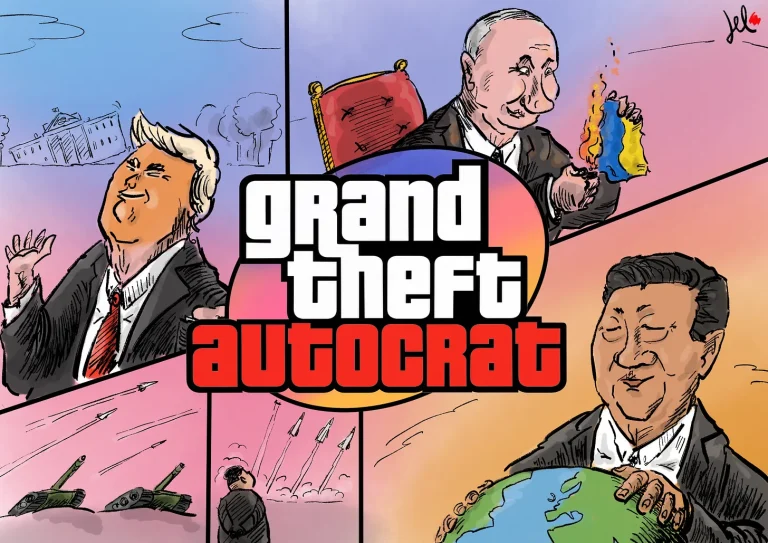
Grand Theft Autocrat

Analysis: Framing a satirical “Grand Theft Autocrat” logo inside comic-book panels of caricatured world leaders, Del Rosso draws a sharp parallel between Vice City’s virtual lawlessness and real-world geopolitical impunity. As the cartoonist notes, while gamers trigger instant police responses in fiction, state leaders openly evade international legal accountability—echoing the Shenzhen summit’s joint pushback against the International Criminal Court. It matters because it captures widespread public cynicism toward a multipolar order where great-power realpolitik increasingly sidelines global legal norms.

Read More »

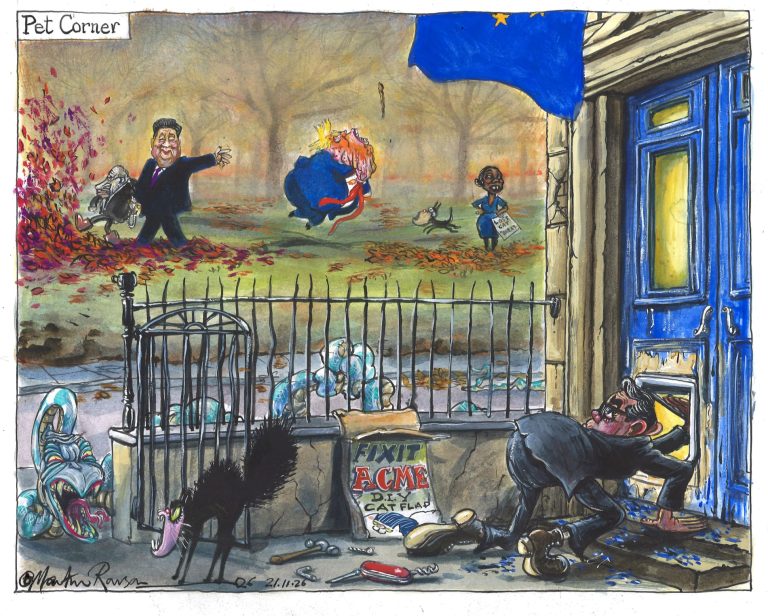
Martin Rowson on the summits in Shenzhen and Brussels – cartoon

Analysis: Visually, Rowson depicts Xi Jinping walking Vladimir Putin on a lead while tossing Donald Trump a bone, contrasted with British politician Andy Burnham sneaking through a cat flap beneath an EU flag while glancing back at Nigel Farage portrayed as a snake. The cartoon’s strategic angle strips away diplomatic pageantry to argue that Beijing now dictates the terms of great-power alignment, reducing Moscow to a junior partner and Washington to a transactional supplicant. It matters because it captures Europe’s acute vulnerability—sidelined from Shenzhen’s power-brokering while internally fractured over its own continental security and economic reset.

Read More »

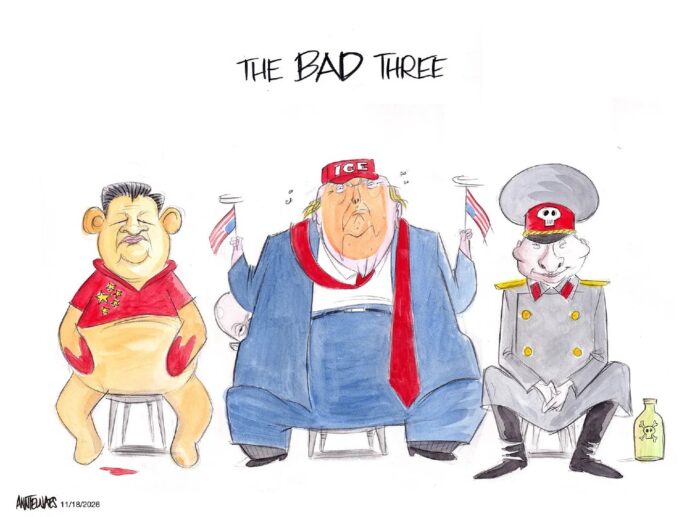
Coverage of the Trump-Xi-Putin summit understates Trump’s susceptibility

Analysis: Visually, the cartoon portrays Xi Jinping as a Pooh-like bear in a red starred shirt, Donald Trump in a red “ICE” cap and oversized suit holding tiny U.S. flags, and Vladimir Putin in a Soviet-style military coat with a skull-and-crossbones cap beside a bottle of poison, all seated side by side on small stools. The imagery underscores the critique that the Shenzhen summit elevates personal strongman theater over substantive diplomacy, leaving smaller nations and democratic allies vulnerable to spheres-of-influence bargaining. By casting the trio as “The Bad Three,” Telnaes highlights how U.S. participation normalizes revisionist powers while signaling the erosion of Washington’s traditional rules-based leadership.

Read More »

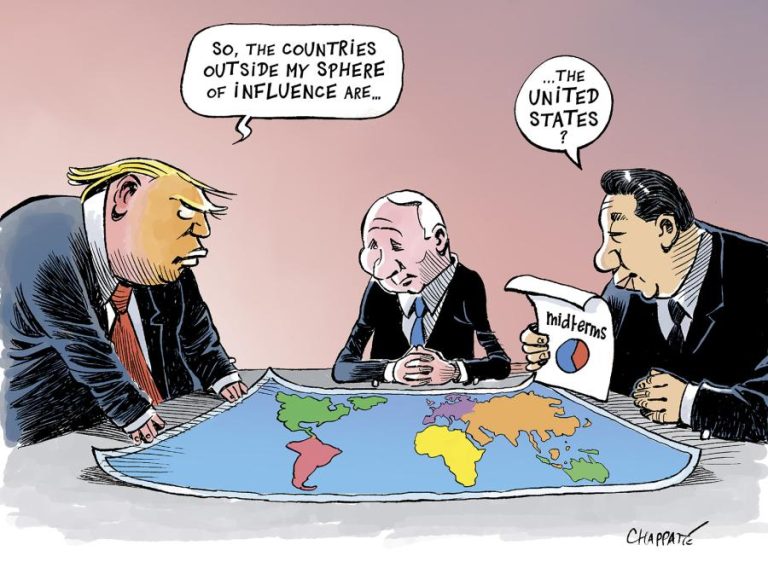
When Trump, Putin and Xi meet

Analysis: Published in Le Temps on the day of the Shenzhen trilateral, this cartoon (viewable at the source link) situates the meeting between Donald Trump, Vladimir Putin, and Xi Jinping at the intersection of U.S. post-midterm domestic constraints, ongoing war negotiations, and shifting global power dynamics. Categorized across Chappatte’s Trump II, Putin’s War, and China in Cartoons series, the piece reflects European concern over how great-power bargaining among Washington, Moscow, and Beijing could reshape international peace and security architecture without European participation. It matters as a sharp Swiss editorial lens on the strategic risks of transactional multipolar diplomacy.

Read More »

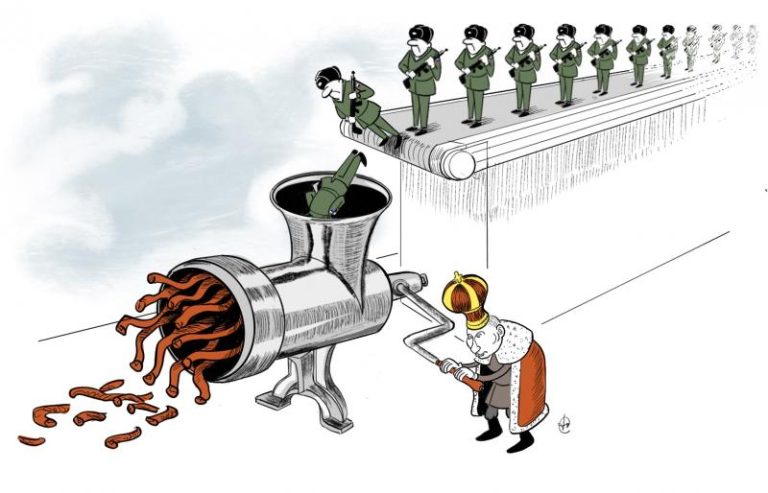
Beef Putin

Analysis: Visually, the cartoon portrays Vladimir Putin dressed in emperor’s clothing while feeding his own soldiers into an oversized meat grinder, underscored by the caption noting over 400,000 Russian military fatalities in Ukraine. By fusing imperial imagery with industrial slaughter, Tobler critiques the Kremlin’s willingness to absorb catastrophic human losses to sustain attrition warfare. It matters because mounting demographic and military strain shapes Moscow’s negotiating leverage ahead of great-power talks in Shenzhen and highlights the internal costs of Russia’s prolonged campaign.

Read More »

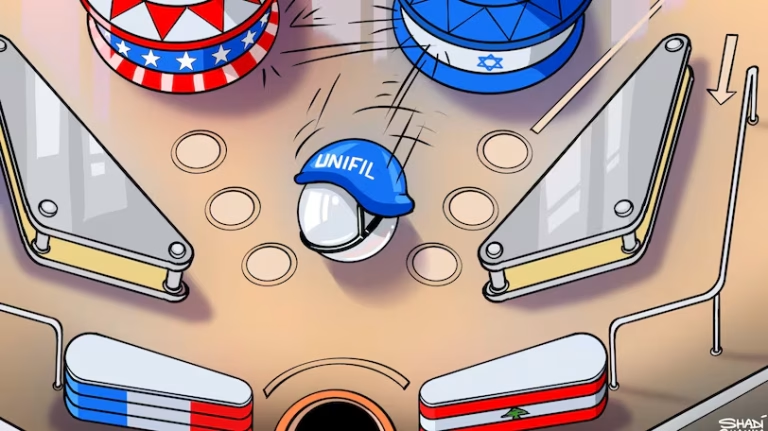
Shadi’s take on the uncertain future of UN peacekeepers in Lebanon

Analysis: Published by The National on November 17, 2026, Shadi Ghanim’s cartoon visually frames the endangered mandate of UNIFIL peacekeepers caught between Israel’s refusal to accept international monitoring, Hezbollah’s border presence, and diplomatic efforts led by France and Lebanon (note: exact graphical details are not rendered in text-only retrieval). The cartoon accompanies Israeli UN envoy Danny Danon’s declaration that Israel trusts only its own soldiers ahead of UNIFIL’s scheduled December 31, 2026 expiration, following the Security Council’s August 2025 termination vote. It highlights how the collapse of multilateral peacekeeping mechanisms risks leaving a dangerous security vacuum along the Israel-Lebanon frontier.

Read More »

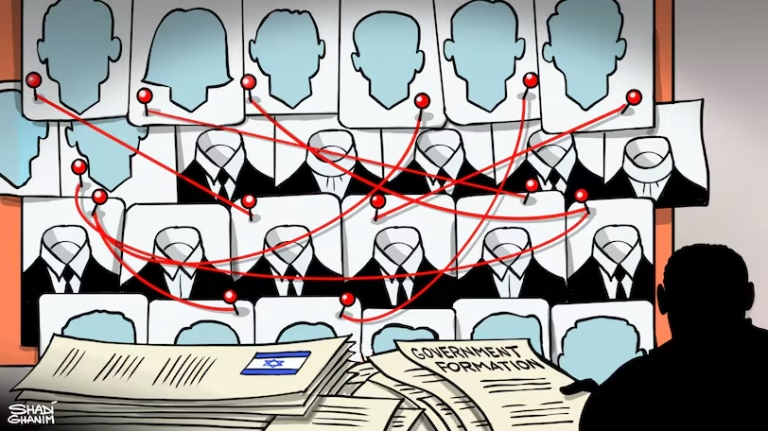
Shadi’s take on attempts to form a new Israeli government

Analysis: Published in The National on November 16, 2026, this editorial cartoon by Shadi Ghanim targets the political impasse gripping Israel following the October 27 Knesset elections (the full visual panel is hosted directly at the source link). By framing the coalition-building scramble as a central spectacle of Israel’s internal crisis, the cartoon underscores how deep factional divisions between rival blocs undermine coherent national policymaking at a moment of acute regional escalation. It matters because it captures regional skepticism toward Israel’s political stability and highlights how domestic paralysis shapes Tel Aviv’s strategic posture.

Read More »

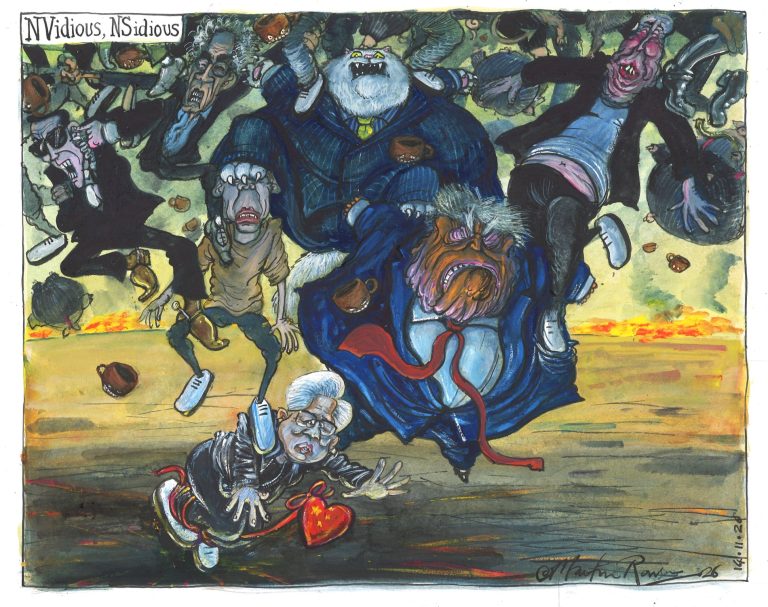
Martin Rowson on the downfall of Nvidia’s Jensen Huang – cartoon

Analysis: Published in The Guardian, Martin Rowson’s editorial cartoon targets the intersection of personal scandal, corporate concentration, and great-power intelligence rivalry following Jensen Huang’s exit from Nvidia. (Note: the specific visual composition could not be directly inspected from the image-only page.) Strategically, the piece captures growing Western anxiety that concentrated “tech-bro” oligarchies controlling critical AI semiconductor infrastructure represent systemic national security liabilities when exposed to foreign intelligence operations and geopolitical competition with China.

Read More »

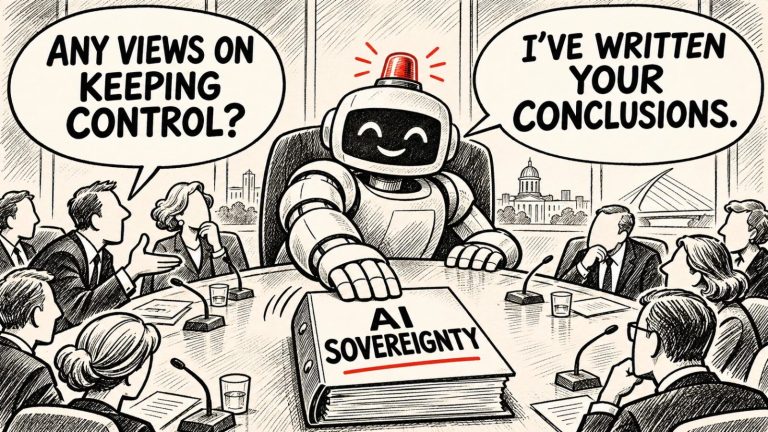
Under control? — Daily cartoon, 13 November 2026

Analysis: Visually, the cartoon portrays anonymous European summit officials seated at a conference table asking, “Any views on keeping control?” while a robot calmly slides a completed report titled “AI Sovereignty” across the table, replying, “I’ve written your conclusions.” Published to coincide with the November 13 EU leaders’ summit in Dublin, the piece satirizes the gap between European regulatory rhetoric and actual technological dependence. It matters because it captures Europe’s structural dilemma as it attempts to assert digital sovereignty amid U.S. and Chinese dominance in frontier AI.

Read More »