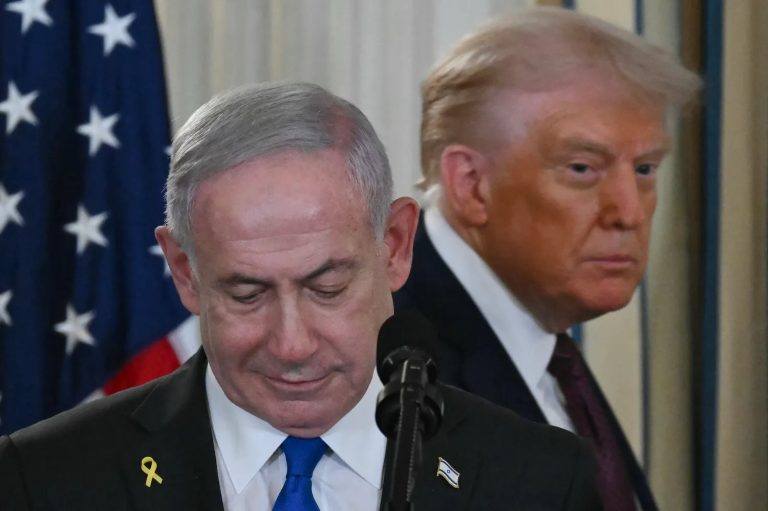
No American president has ever said publicly about an Israeli prime minister what Donald Trump declared last week: that Netanyahu “will do whatever I want him to do” on Iran. The statement was not a slip. It was a deliberate public assertion of dominance over an ally whose political survival has become increasingly dependent on Washington’s approval. As US-Iran negotiations move toward a formal memorandum of understanding, Trump’s leverage over the Israeli prime minister is hardening into something Netanyahu cannot easily absorb — a deal he did not shape, cannot stop, and will be forced to live with heading into October elections.
The Anatomy of Netanyahu’s Trap
Netanyahu’s political position has been quietly deteriorating since the war began. His inability to deliver a decisive outcome against Hezbollah, Hamas, or Iran has sharpened domestic criticism and narrowed his coalition options. Trump currently polls more favorably inside Israel than Netanyahu himself, a reality that gives Washington an unusual degree of political leverage over Jerusalem. The historical precedent is instructive. In 1991, President George H.W. Bush withheld housing loan guarantees from Prime Minister Yitzhak Shamir over settlement construction, a decision that contributed directly to Shamir’s electoral defeat in 1992. The mechanism was simple: when an Israeli prime minister appears to have lost Washington’s backing, his political coalition fragments. Netanyahu knows this and is governing accordingly.
The emerging Iran deal presents him with a structural problem he cannot resolve. Based on the framework taking shape, the Islamic Republic will remain politically intact, the regime will survive without conditions for regime change, and Iran will have demonstrated that it can close the Strait of Hormuz and expose the vulnerability of Gulf states at will. Tehran has emerged from a devastating US-Israeli bombing campaign with its negotiating position intact and a new asymmetric weapon it can deploy in any future confrontation. For Netanyahu, who staked his legacy on the argument that he alone could manage the Iranian threat, this is a politically catastrophic outcome dressed in diplomatic language.
Once the Strait of Hormuz reopens and the US naval blockade is removed, the blame game will begin immediately. Netanyahu’s allies will argue that Washington lacked the will to finish what it started. Trump will insulate himself by pointing to Israeli overreach, particularly in Lebanon, as the factor that complicated the endgame. Trump has already demonstrated his willingness to override Netanyahu when Israeli actions threaten American diplomatic objectives — he forced a halt after Israel bombed Hamas leadership in Doha, and he will not tolerate a repeat.
Lebanon: A Second Front Going Wrong
Lebanon compounds Netanyahu’s difficulties in ways that are both military and diplomatic. Hezbollah rebuilt selectively during the eighteen-month ceasefire, developing fiber-optic guided drone systems that cannot be jammed electronically and that have been hitting Israeli military convoys with consistent accuracy. The Lebanese government has shown more diplomatic backbone than before, including willingness to meet Israel directly under US auspices, but it lacks the capacity to forcibly disarm Hezbollah regardless of its political intentions. Meanwhile, Israel’s ongoing ground operations in the south and mass evacuation orders covering hundreds of thousands of Lebanese civilians have placed Beirut in an impossible position — unable to defend Hezbollah publicly, unable to endorse Israeli military operations, and watching its territory occupied by a force that shows no defined withdrawal timeline.
Iran has insisted throughout negotiations that any agreement with Washington covers Lebanon explicitly. Trump called Netanyahu on Monday and pressed him to halt strikes around Beirut after Tehran suspended indirect talks in protest. That call is a preview of what a final deal will require. If Iran makes a ceasefire in Lebanon a condition of signing the memorandum of understanding, Trump will force compliance. Netanyahu will have no institutional mechanism to resist.
The Abraham Accords expansion that Trump has attached to the Iran framework — demanding that Saudi Arabia, Qatar, and Pakistan normalize relations with Israel as part of the regional realignment — adds rhetorical cover without adding substance. Gulf states will not formalize ties with a government annexing the West Bank and occupying Lebanese territory. As a diplomatic mechanism it is fantasy. As political armor for Trump against domestic critics, it may be just functional enough to serve its purpose. Netanyahu enters October carrying a war he cannot end, a deal he cannot shape, and a patron who has already signaled his willingness to make him the scapegoat for whatever falls short.
Original analysis inspired by Aaron David Miller and Daniel C. Kurtzer from Foreign Policy. Additional research and verification conducted through multiple sources.
By ThinkTanksMonitor