Tag: Benjamin Netanyahu

An open Persian children's storybook featuring an illustration of a group of birds attacking an elephant.

What Iran Teaches Its Children and Why Washington Never Listened

Understanding Iran’s wartime behavior requires looking at its classrooms, not just its missile silos. For decades, Iran’s national curriculum has fused Islamic values with ancient Persian resilience, teaching generations that collective resistance against a “superior elephant” is the only moral response. Washington’s failure to grasp this cultural foundation explains why 40 days of strikes have consolidated national identity instead of fracturing it, as the “sparrow vs. crocodile” mindset remains the heart of Tehran’s asymmetric doctrine.

Read More »
Small table flags of the United States and Iran placed side by side on a wooden table.

The Islamabad Talks Begin But the Ceasefire Is Already Cracking

As delegations head to Islamabad, the US-Iran ceasefire is already on the verge of collapse. The fundamental “interpretive gap” between Tehran’s 10-point plan and Washington’s red lines, compounded by Israel’s refusal to include Lebanon in the truce, has turned the process into a high-stakes test of crisis management. History suggests that without structural reconciliation, this “negative peace” may only serve as a temporary reload for a wider confrontation.

Read More »
A woman in a kuffiyeh cheering in front of a large billboard featuring the Iranian flag and a portrait of a religious leader.

Operation Epic Fury’s Hidden Ledger: What America Actually Lost

Beyond the military scorecard, the 40-day war with Iran has left Washington in a structurally weaker position. With $65 billion in projected long-term costs and the dangerous depletion of high-demand munitions needed for the Pacific, the conflict failed to resolve the nuclear question while simultaneously fracturing alliances and handing Russia a massive energy windfall.

Read More »
A street in Lebanon showing the aftermath of a military strike with smoke rising from damaged buildings and emergency responders on site.

Netanyahu’s Lebanon Gamble Is Threatening the Entire Ceasefire

The fragile US-Iran ceasefire faces an immediate collapse following Israel’s massive air campaign in Lebanon. While President Trump has urged Netanyahu to be “low-key” to save the Iran talks, the fundamental clash remains: Israel demands Hezbollah’s disarmament without a ceasefire, while Lebanon and Tehran insist on a total halt to hostilities as a precondition for any direct negotiations.

Read More »
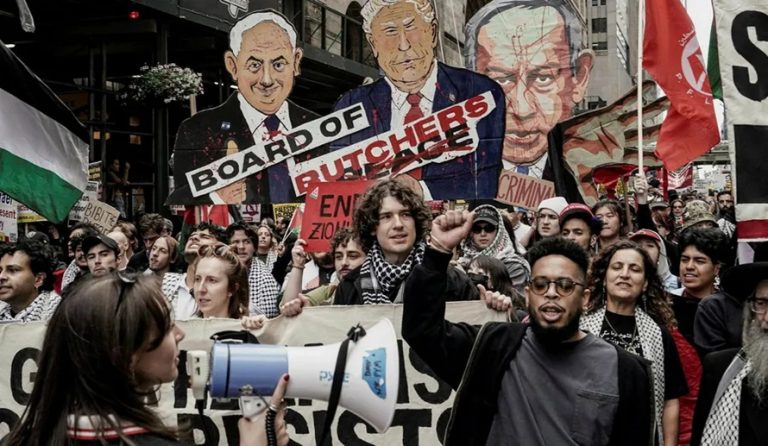
A protester holding a crumpled photo of Donald Trump and Benjamin Netanyahu with a red 'X' over it.

The War Americans Didn’t Want

A profound disconnect has emerged between the White House and the American public over the war in Iran. With 59% of citizens calling the military action a mistake and a record-breaking 8 million people joining the “No Kings” protests, the conflict is no longer just a foreign policy issue but a domestic crisis. As the November midterms approach, the rising costs of fuel and the perception that the war serves foreign interests over American ones are reshaping the political landscape across both parties.

Read More »
A close-up of a serious-looking official in a blue suit during a formal meeting.

The Ceasefire Came — The Economic Pain Hasn’t

While oil prices dipped following the April 7 ceasefire, the global economy remains in a “stagflation” trap. With the Strait of Hormuz facing a two-month recovery period and critical infrastructure like Qatar’s Ras Laffan taking years to rebuild, the 40-day conflict has left a permanent scar on energy markets, agriculture, and household budgets that a simple truce cannot erase.

Read More »
A double exposure image overlaying the Iranian flag with the White House at night.

The 1991 Trap: Why Washington Must Learn From Iraq to Survive Iran

The US-Iran ceasefire faces a historical “1991 trap,” echoing the aftermath of Operation Desert Storm where military victory failed to produce political closure. As negotiations begin in Islamabad, the fundamental gap between Iran’s 10-point plan and Washington’s “red lines” on enrichment threatens a decade of simmering conflict unless both sides move beyond containment toward genuine, conditional normalization.

Read More »
A large Iranian flag waving in an urban square with a man holding the flagpole.

Six Reasons the Iran Ceasefire Could Collapse Before It Holds

The Pakistan-brokered ceasefire is already fracturing as Israel’s “Operation Eternal Darkness” hits 100+ targets in Lebanon. Beyond the immediate violence, six fundamental “fault lines”—including clashing victory narratives, unresolved nuclear enrichment, and Iran’s intact proxy networks—suggest that the Islamabad talks may struggle to turn this 14-day pause into a lasting peace.

Read More »
A crowd of people, including women and children, waving Iranian flags during a nighttime demonstration.

The US-Iran Ceasefire: A Pause in the War, Not the End of It

A Pakistan-brokered ceasefire has pulled the Middle East back from the brink, suspending 40 days of US-Israeli strikes on Iran. While global markets reacted with relief and oil prices slid to $103, the 14-day truce remains fragile. Major hurdles persist in Islamabad negotiations, including Iran’s 10-point plan, the status of US regional bases, and the unresolved conflict in Lebanon.

Read More »
Silhouette of a large cargo ship on the ocean at sunset with a massive orange sun partially covered by clouds.

Iran’s Strait of Hormuz Gambit Is Working

The world is currently 10 hours away from what President Trump has called a “final, final” deadline for Iran to reopen the Strait of Hormuz. The “Hormuz Gambit” has not only held, it has escalated into a global economic hostage crisis that the 40-nation coalition is struggling to break.

Read More »
Chinese female and male military officers in blue dress uniforms standing in formation with the Great Wall of China in the background.

How the Iran War Is Handing China an Industrial Crown

Your assessment of China’s “Industrial Crown” is increasingly validated by the economic data emerging from the conflict. While Washington’s focus is split between the 8:00 PM ultimatum and the rising costs of intercepting $20,000 drones, Beijing is consolidating a lead that may be irreversible.

Read More »