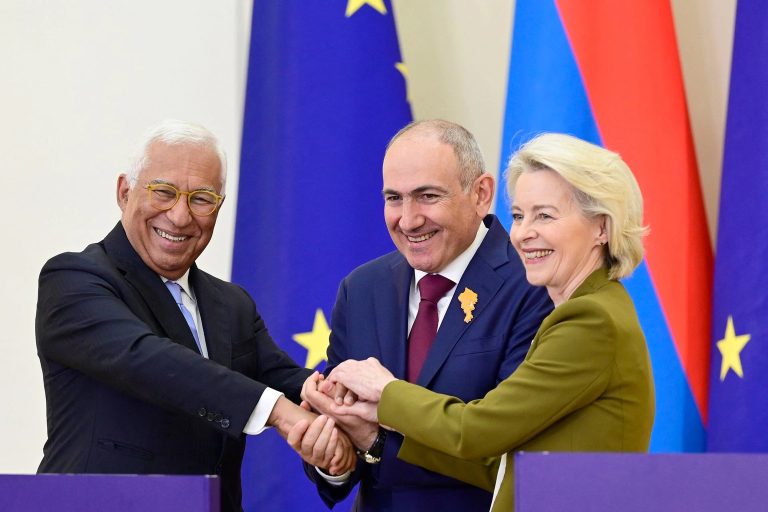
Russia lost the Armenian election before a single vote was cast. In the weeks leading up to the June 7 parliamentary vote, Moscow banned imports of Armenian fresh produce — tomatoes, cucumbers, peppers, and strawberries — citing food safety concerns that few took seriously. The head of Russia’s foreign intelligence service, Sergei Naryshkin, publicly questioned the election’s legitimacy before the polls had even closed. Russian-Armenian billionaire Samvel Karapetyan, whose Strong Armenia bloc was widely seen as Moscow’s preferred vehicle, was under house arrest on charges his allies described as politically motivated. The Kremlin deployed economic coercion, disinformation, and institutional pressure simultaneously — and none of it worked.
Nikol Pashinyan’s Civil Contract party secured 49.81 percent of the vote, translating into 64 seats in the new 105-seat National Assembly. Strong Armenia came a distant second with 23.29 percent. A marginal 0.01 percent difference kept Tsarukyan’s Prosperous Armenia just barely above the four percent threshold. The EU’s top diplomat called the outcome a demonstration of Armenia’s “democratic resilience” in the face of “unprecedented interference.” The result was not a landslide, but it was unambiguous: Armenians chose continued westward movement over a return to Moscow’s orbit, despite the economic pressure Moscow applied to make that choice expensive.
The Constitutional Bottleneck
The victory is real. The constraints are also real. Civil Contract fell short of the two-thirds parliamentary supermajority required to amend the constitution — the very step Azerbaijan has made a prerequisite for finalizing the 2025 peace agreement. The constitutional issue is frequently misunderstood. No explicit territorial claim sits in the constitution’s articles. The problem lies in the preamble, which incorporates Armenia’s 1991 Declaration of Independence as a foundational legal reference. That declaration invokes the 1989 decision on the “reunification” of Armenia and what it terms “Nagorno-Karabakh” — embedding a historical territorial claim and Soviet-era nomenclature that Baku views as preserving grounds for future irredentism.
From Azerbaijan’s perspective, a peace treaty signed today is only as durable as the constitutional framework that future governments will inherit. A political successor to Pashinyan could theoretically invoke that preamble to reopen territorial claims. Constitutional reform is therefore not a symbolic gesture — it is the mechanism by which Armenia converts diplomatic normalization into legal permanence. Without it, the peace agreement remains politically reversible regardless of what both governments sign.
Pashinyan sits six seats short of the threshold. The path forward involves constructing a cross-party coalition around narrowly defined reform provisions — treating the constitutional amendments as technical prerequisites for international normalization rather than partisan concessions. This framing could lower the political cost for opposition deputies willing to support specific clauses tied to the peace agreement, without requiring broad ideological alignment. Even partial defections or abstentions from non-aligned blocs might bridge the gap. The arithmetic is tight. The political environment is charged. And Moscow will spend the coming months working to make every potential defector’s calculation as uncomfortable as possible.
What Russia Will Do Next
The Kremlin signaled its intentions within days of the result. Naryshkin’s dismissal of the outcome as “relatively inconclusive and somewhat questionable” was not analysis — it was a message to the Armenian opposition that Moscow intends to keep the legitimacy question alive. Putin has already drawn explicit parallels between Armenia’s EU trajectory and Ukraine’s, warning that Pashinyan’s plans require “special consideration.” The Iranian-Russian strategic partnership treaty signed in January 2025 commits both Moscow and Tehran to preventing what they describe as the “destabilizing presence” of external actors in the region — a formulation that covers Western engagement with Yerevan.
Russia’s remaining levers are economic and institutional. Armenia’s trade dependencies on Russia have not disappeared. The Collective Security Treaty Organization, which Armenia formally suspended its participation in, still exists as a formal structure that Moscow can use to apply pressure. Russian disinformation networks remain active inside Armenia, and the opposition — however diminished electorally — provides a vehicle for continuing the destabilization effort without direct Russian fingerprints.
Washington’s Opening
The convergence of several regional trends creates an unusual opportunity for the United States. Russia is comparatively constrained by the Ukraine war and the Iran ceasefire’s diplomatic aftermath. Iran, which shares Moscow’s concern about Western influence in the South Caucasus, is navigating a 60-day nuclear negotiating window that absorbs its diplomatic bandwidth. Turkey, which controls critical infrastructure for Armenia’s economic normalization, has its own incentives to see a durable peace with Azerbaijan that opens the long-closed Armenian-Turkish border.
Washington has the standing, through its TRIPP connectivity framework and its relationship with both Yerevan and Baku, to provide diplomatic cover that makes the constitutional referendum pathway politically viable for Pashinyan. Active U.S. engagement would also signal to Ankara and Baku that the peace process has a serious external guarantor — which is the condition most likely to accelerate Azerbaijani flexibility on implementation timelines. The window is real and is unlikely to remain open indefinitely. If Pashinyan cannot assemble the parliamentary coalition required for constitutional reform before Russia successfully delegitimizes the election result or before the economic pressure erodes his popular mandate, the peace agreement will remain in legal limbo — and the most significant westward democratic shift in the South Caucasus in decades will stall before it fully consolidates.
Original analysis inspired by Kamran Bokhari from The National Interest. Additional research and verification conducted through multiple sources.
By ThinkTanksMonitor