The US-Israeli campaign against Iran has done far more than damage facilities and disrupt leadership structures in Tehran. It has shattered the comfortable assumption that American military bases and defense systems could fully shield Gulf partners from retaliation. As powers across the region absorb the economic shocks and strategic surprises of recent months, they have begun building alternative channels for coordination that could reshape alignments for years to come.
Iranian strikes on energy infrastructure, including facilities in Qatar that temporarily cut liquefied natural gas exports by nearly a fifth, drove home an uncomfortable truth. Hosting US forces does not insulate countries from the costs of wider conflict. Instead it can turn them into targets, pushing governments to quietly seek alternatives while maintaining essential ties with Washington. This shift has gained momentum as traditional guarantees proved less reliable than advertised.
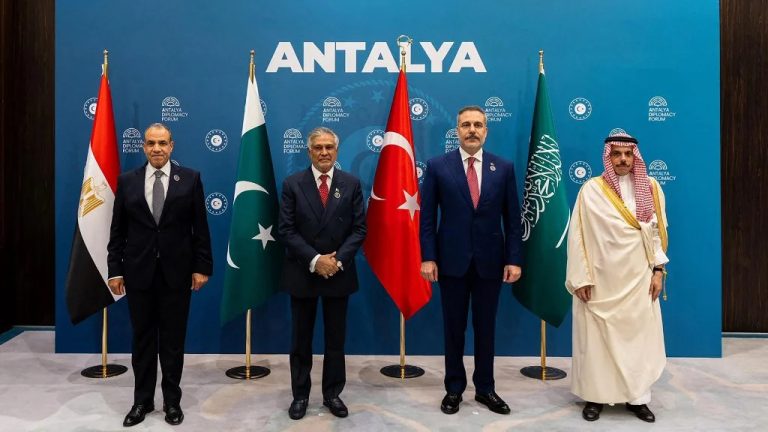
Foreign ministers from Egypt, Saudi Arabia, Turkey and Pakistan have met repeatedly since the fighting eased, gathering in Riyadh, Islamabad and Antalya to explore closer political and security ties. These conversations reflect a pragmatic recognition of complementary strengths. Saudi Arabia brings financial weight, Turkey advanced defense production, Egypt strategic depth and population, while Pakistan contributes military experience and nuclear deterrence. Together they offer a foundation for reducing dependence on any single external patron.
Past rivalries complicate rapid progress. Tensions over Qatar, Libya and the Muslim Brotherhood still color relations between Ankara, Riyadh and Cairo. Leaders understand that deep mistrust cannot vanish overnight. Yet repeated crises have prompted closer consultation than many expected, focused less on formal alliances than on practical crisis management and selective cooperation.
Israel has moved in a different direction, reviving and expanding its old periphery strategy with new partners and tools. Ties with the United Arab Emirates now span maritime security, technology sharing and infrastructure projects that extend well beyond the Abraham Accords. India has become central to this effort through the I2U2 format and ambitious corridor plans linking Asia to Europe via Israeli ports. Greek and Cypriot cooperation provides a Mediterranean counterweight to Turkish influence, while developments in Ethiopia and Somaliland reflect growing attention to Red Sea shipping lanes.
Flexible Networks Take Shape
India alone absorbed roughly 34 percent of Israeli arms exports between 2020 and 2024, cementing its place as a key customer and strategic collaborator. These relationships blend defense cooperation with economic ambition and shared concerns about maritime routes. Houthi actions during earlier phases of regional fighting only sharpened Israeli focus on the Horn of Africa and southern approaches to the Red Sea. The result is an arc of partnerships stretching from the Indian Ocean to the Eastern Mediterranean.
Egypt, Saudi Arabia and Turkey view aspects of this network, particularly activity around the Horn, as potential challenges to their own interests. Yet rigid bloc thinking does not capture the current reality. States frequently cooperate on specific issues while competing elsewhere. Egypt continues to value Emirati investment even as it coordinates more closely with Riyadh. Turkey has repaired economic relations with Abu Dhabi despite broader differences. These overlapping and sometimes contradictory ties create a fluid environment where alignments shift according to immediate needs rather than permanent loyalties.
The conflict accelerated trends already visible before the first strikes. Gulf governments never planned to abandon Washington, but they now insist on additional insurance against future shocks. Regional powers increasingly treat security as something assembled from multiple sources rather than guaranteed by one. Competition over energy routes, supply chains and maritime access will likely intensify as these networks evolve.
What emerges will not resemble the clear-cut alliances of the past. Instead the Middle East appears headed toward a patchwork of flexible partnerships that form and reform around concrete problems. Success will depend on whether leaders can manage mistrust and short-term thinking enough to deliver practical results. The war on Iran did not create these dynamics, but it has made them impossible to ignore.
Original analysis inspired by Ahmed Mawlana from Middle East Eye. Additional research and verification conducted through multiple sources.
By ThinkTanksMonitor