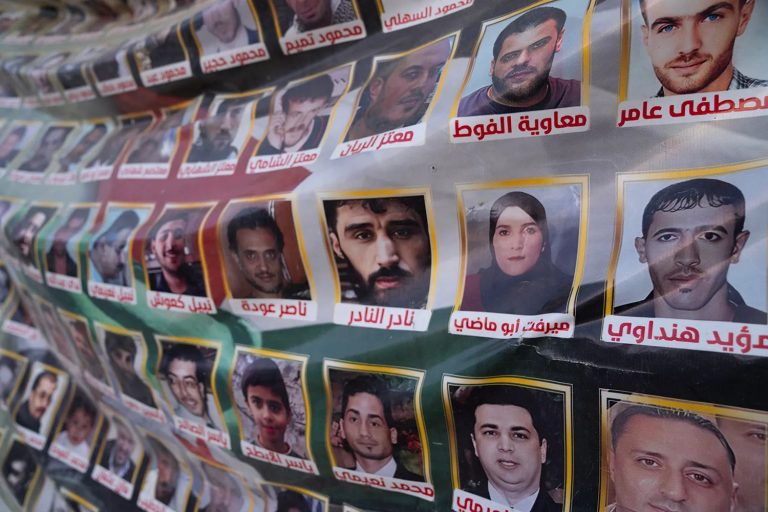
When Syrian authorities captured Amjad Youssef — filmed on video in 2013 herding 41 bound and blindfolded civilians to a pre-dug pit before executing them — residents of the Damascus suburb of Tadamon celebrated in the streets. The footage was unambiguous. So was the demand that followed from families across Syria: execute him, and everyone like him. The calls for the death penalty are not rooted in vengeance alone. They reflect four decades of impunity, mass graves still being excavated, and families who cannot bury sons and daughters they cannot find.
But the demand creates a specific and devastating trap. The UN’s Independent Institution on Missing Persons in Syria, the body that holds the key to identifying the tens of thousands who vanished into Assad’s prisons, operates under rules that prohibit cooperation with states that apply the death penalty. Evidence it collects on victims cannot be used in a Syrian court that executes convicted prisoners. The International Commission on Missing Persons, which has the DNA testing technology needed to identify remains at 66 suspected mass grave sites, faces parallel constraints. If Syria executes perpetrators before international forensic cooperation is secured, it may permanently foreclose the only realistic path to identifying the dead — and the families demanding executions are often the same families desperately searching for missing relatives.
What the First Trials Revealed
Syria’s transitional justice process formally began in April with the trial of Atef Najib, a cousin of Bashar al-Assad who commanded the security branch that helped spark the 2011 uprising. The indictment charges him with overseeing the arrest and torture of children in Daraa for writing anti-Assad graffiti on school walls — the arrests that catalyzed the uprising after 13-year-old Hamza al-Khatib was detained, tortured, and returned to his family as a mutilated corpse. Seventy-five plaintiffs have lined up to testify. Najib has denied the charges.
The case has symbolic weight, and for families like the Khatibs, the sight of a regime official shackled in a courtroom carries genuine dignity. But the structural problems surrounding the trial reveal how far Syria’s justice architecture has to travel. The Syrian penal code does not specifically include crimes against humanity, war crimes, or command responsibility — the precise categories needed to prosecute systemic atrocity rather than individual acts. The government does not yet have a functioning legislature capable of passing the laws required. Many Assad-era judges have fled or been removed. The presiding judge in the Najib case, Fakhr al-Din al-Aryan, was himself sentenced to death in absentia by the Assad regime after defecting in 2013 and only returned from exile after Assad fell. The machinery of justice is being assembled while it is simultaneously being used.
The Youssef case illustrates the danger of speed without strategy. A recorded interrogation released by the Syrian Interior Ministry showed Youssef claiming sole personal responsibility for the Tadamon executions. Critics immediately recognized what that framing achieves: it insulates the chain of command above him. Youssef is more valuable alive before an independent court, capable of exposing the broader network that ordered, enabled, and concealed the massacres, than as a symbol of swift retribution who takes the institutional secrets with him. Early excavation findings at Tadamon suggest as many as 200 busloads of people were brought to the site from checkpoints over more than a decade — a systematic operation that cannot be explained by one man’s personal decisions.
The Immunity Deals Closing Accountability Doors
The tension between popular justice and strategic accountability is further complicated by deals the new government has quietly struck with powerful figures from the old order. Fadi Saqr, the former commander of the National Defense Forces militia that was created to support Assad during the civil war, reportedly worked with the interim government to mediate with former regime loyalists after Assad’s fall. Human rights organizations have linked him to the chain of command responsible for the Tadamon massacre. Saqr has denied involvement, claiming he assumed command after the killings. No charges have been filed.
These arrangements reflect a governing reality: the new administration needs information, stability, and cooperation from former regime figures to consolidate authority. The intelligence traded for immunity may serve short-term security goals. The long-term cost is a justice process that appears to target executioners while shielding those who gave the orders — precisely the pattern that has undermined transitional justice in comparable post-conflict settings from Rwanda to Bosnia.
The scale of what awaits is almost impossible to absorb. Syria’s largest suspected death site, at Qatifa north of Damascus near a former military base, may hold the remains of 100,000 systematically murdered people. Remains arrive at identification centers in conditions designed to defeat recognition — decomposed, burned, buried in layers with tires set alight between them. The UN estimates that more than 100,000 people were forcibly disappeared during the civil war. Identifying them will take decades even with full international forensic support. Without it, the families searching for answers about the missing will wait indefinitely.
The Extradition Wall
The death penalty creates a specific and immediate obstacle to bringing perpetrators back to Syria for trial. Nearly all European countries prohibit extradition to states where defendants face execution. German courts are currently prosecuting five men for the siege of Yarmouk in the first prosecution anywhere to treat the deliberate starvation of civilians as a war crime. Syria wants such trials on Syrian soil — where victims’ families can attend, witness accountability in person, and reclaim some sense of dignity after years of impunity. That goal is legitimate and important. But if Syria executes defendants in domestic trials, European courts will not send perpetrators currently in custody abroad. Assad himself sits in Russia, which will not extradite him regardless of what legal standards Syria establishes.
The choice facing Ahmad al-Sharaa’s government is not between justice and impunity — it is between two different visions of what justice requires and who it is ultimately for. Families who know where their children are buried want to watch those responsible hang. Families who cannot find their children need the forensic cooperation that a death penalty forecloses. Both sets of families have suffered the same regime. Their needs are not compatible under the current legal framework, and the government has not yet found a way to honor both simultaneously.
Original analysis inspired by Deborah Amos from Foreign Policy. Additional research and verification conducted through multiple sources.
By ThinkTanksMonitor