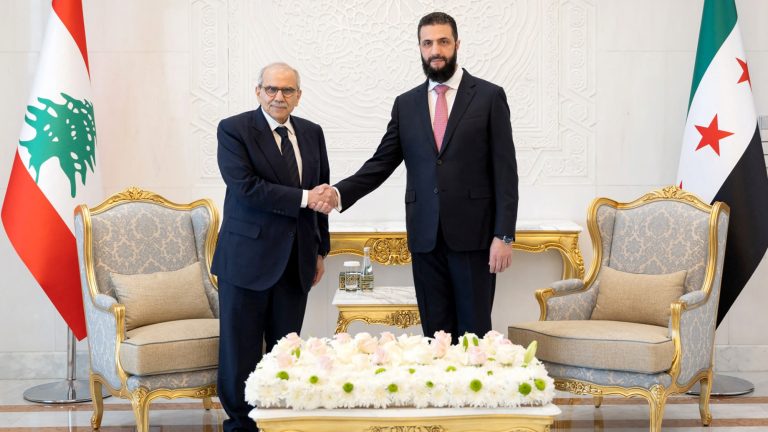
Donald Trump’s suggestion that Ahmad al-Sharaa’s Syria could take on Hezbollah in Lebanon if Israel “can’t do the job without killing everyone else” landed with a thud across regional capitals. The idea revived a question the Middle East revisits whenever Lebanon enters crisis: can Damascus play the stabilizing role it played in 1976? The short answer is no — and the reasons go well beyond political will or diplomatic positioning. Syria today lacks the institutional architecture, military cohesion, and regional legitimacy that made the original intervention possible. What Trump described as a potential surgical solution is, in practice, a state being asked to project power abroad before it has consolidated authority at home.
The 1976 comparison deserves a closer look precisely because it is so frequently invoked. Syrian forces entered Lebanon that year not as a unilateral gambit but as the product of a dense web of regional bargains and international understandings. The intervention was formally requested by Lebanese President Suleiman Frangieh and was quietly [suspicious link removed] by Washington, Riyadh, and Paris, who shared an interest in preventing Lebanon’s civil war from metastasizing into a broader regional crisis. It was later legitimized through the Arab Deterrent Forces under the Arab League’s umbrella — a layer of political cover that mattered as much as the military dimension. And it was executed by a Syrian army that was cohesive, professionally structured, and commanded by a leadership with both domestic consolidation and international recognition following the 1973 war.
The State That Does Not Yet Exist
None of those conditions apply to Syria today. The current Damascus administration is still navigating a transitional moment with no broad national consensus, no fully functioning legislative structure, and no settled social contract. External backing from Washington, Ankara, and Doha provides diplomatic oxygen but cannot substitute for internal legitimacy — which experience consistently shows must be built from within. Syria’s immediate priorities are existential: rebuilding shattered institutions, managing economic collapse, and addressing the social fractures that more than a decade of conflict has hardened into permanent features of the political landscape. A leadership still working to consolidate authority within its own borders is not positioned to commit resources, political capital, and military capacity to a mission outside them.
The military picture is even less favorable. The Syrian army that entered Lebanon in 1976 operated with a clear command structure and a coherent doctrine. Today’s formations are the product of a long, fragmented war — an amalgam of factions that once operated as distinct armed groups, including elements with documented links to networks that the United States and the European Union still designate as terrorist organizations. Efforts to weld these strands into a single national force remain partial and uneven. Reports of violations during operations along Syria’s coast and in Suwayda have kept accountability questions live, complicating any attempt to present these formations as a disciplined force capable of sustained cross-border operations. Without a unified command structure and broad public confidence, the military lacks the foundation that external intervention requires.
Lebanon Is Not Asking
The Lebanese context has also moved in ways the 1976 analogy cannot accommodate. That intervention had internal Lebanese traction — a formal presidential request and support from key political forces who preferred Syrian stabilization to the alternative. Today, no comparable invitation exists. Across Lebanon’s fractured political spectrum, the period of Syrian tutelage is remembered as a chapter to be avoided regardless of one’s position on Hezbollah, sectarian identity, or regional alignment. Lebanese Prime Minister Nawaf Salam and President Joseph Aoun have emphasized coordination between institutional frameworks, not a transfer of security responsibility to Damascus.
The regional environment offers equally little space. No major Arab state is advocating for a renewed Syrian military presence in Lebanon. The Turkish factor adds another layer of constraint: Ankara’s deep military and political investment in northern Syria means any move by Damascus toward Lebanon would immediately collide with Turkish red lines, Iranian interests, and Hezbollah’s own strategic calculations. What begins as a limited step could widen rapidly, pulling in actors already embedded across the same theater and deepening sectarian tensions that extend into Syria and Iraq.
The interim U.S.-Iran memorandum has already begun recalibrating regional assumptions. If the 60-day framework produces a more durable settlement, the strategic environment shifts away from confrontation and toward managed influence — reducing the urgency of the initiatives, including Syria’s supposed Lebanon role, that emerged under conditions of heightened tension. Hezbollah’s position would be renegotiated within that framework, not dismantled by a neighboring state that lacks the capacity to attempt it.
Trump’s instinct to outsource the Lebanon problem to Damascus reflects a broader pattern in his foreign policy: identifying a regional actor to absorb costs that Washington is no longer willing to carry. The instinct may be politically understandable. The problem is that the actor in question is not ready, Lebanon has not asked, and the regional conditions that made the 1976 model work have not reassembled themselves. Power is bounded by geography — and in Syria’s case, it is bounded first by the unfinished work of rebuilding a state.
Original analysis inspired by Bassam Abu Abdallah from The Cradle. Additional research and verification conducted through multiple sources.
By ThinkTanksMonitor