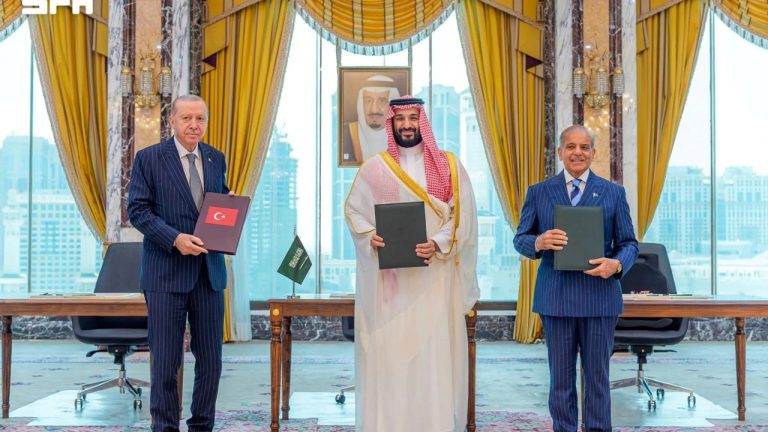
Saudi Arabia, Turkey, and Pakistan have created a new layer of Middle Eastern security cooperation outside the traditional framework built around Washington. The three countries signed the Mecca Joint Defence Agreement, committing themselves to treat an armed attack on one as an attack on all. The pact does not mean Riyadh or Ankara has abandoned the United States. It does show that powerful regional states increasingly want security arrangements they can shape themselves rather than relying on a single outside guarantor.
Turkey has described the commitment as technically similar to NATO Article 5, though military assistance would still require consultation among the three governments. The partners also plan political and military coordination at senior levels, joint exercises across land, sea, air, and cyber operations, and cooperation in drones, electronic warfare, artificial intelligence, and weapons production. These provisions suggest that Mecca is intended to become an institution rather than remain a symbolic declaration.
A hedge rather than a break with Washington
The clearest evidence against viewing the agreement as an immediate replacement for the United States comes from Saudi Arabia itself. Riyadh and Washington signed a Strategic Defense Agreement under President Donald Trump, with Saudi Arabia continuing to describe the United States as its primary strategic partner. Washington also expanded defense cooperation through a massive weapons package and long term military support.
Turkey presents an even clearer example of overlapping alliances. Only weeks before the Mecca agreement, NATO leaders meeting in Ankara reaffirmed their collective defense commitment, with Turkey remaining a central member of the alliance and possessing its second largest military. Ankara therefore is not choosing between NATO and a regional pact. It is building additional channels through which it can expand influence beyond the Euro Atlantic system.
This model may increasingly define regional politics. Instead of fixed camps, governments can maintain American security ties while developing independent relationships that give them more room to respond when Washington’s priorities change.
Regional powers want more control
Saudi calculations have been shaped by years of uncertainty over whether outside allies would intervene during a major crisis. The kingdom now faces missile, drone, maritime, and infrastructure threats while also trying to protect the economic transformation associated with Crown Prince Mohammed bin Salman. Reuters reported that Riyadh views new regional coalitions as a way to strengthen deterrence without becoming trapped in a wider war.
Yet the Mecca pact already shows the limits of collective defense language. Houthi attacks continued shortly after its creation without triggering Turkish or Pakistani military intervention. That suggests the agreement currently offers political solidarity and strategic coordination more readily than an automatic military response. Its real strength will depend on whether the three governments eventually convert broad promises into shared planning, command structures, and credible commitments.
Iran’s reaction also complicates the idea of a simple anti Iranian bloc. Tehran publicly welcomed greater regional responsibility for security and said it had no reason to fear the agreement if it was not directed against Iran. For Saudi Arabia, this ambiguity may be useful. The pact can signal stronger deterrence without requiring Riyadh to openly define Tehran as the alliance’s permanent enemy.
From American primacy to overlapping alliances
The Mecca agreement therefore matters less because it replaces American power than because it reduces Washington’s monopoly over regional security organization. The United States still provides capabilities, technology, intelligence, and military reach that the new pact cannot easily reproduce. But Saudi Arabia, Turkey, and Pakistan are demonstrating that regional governments no longer want Washington to be the only architect of their strategic relationships.
What emerges may not be a clean division between an American bloc and a competing Middle Eastern alliance. A more likely outcome is an interconnected system in which states belong to several security arrangements at once and shift their reliance between them according to the crisis. If the Mecca pact survives its first serious tests, it could mark the beginning of a Middle East where the United States remains powerful but no longer sets the rules alone.