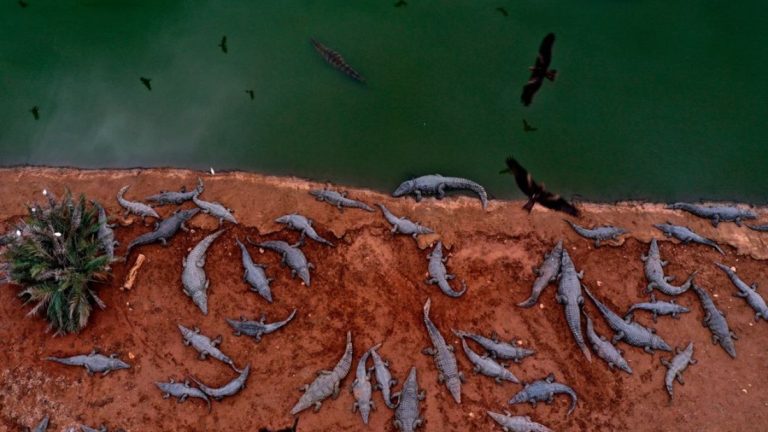
A plan to place Nile crocodiles around part of an Israeli prison holding Palestinian detainees sounds closer to political satire than corrections policy. Yet work on the project at Ketziot Prison moved far enough for crews to begin digging before a court intervened. National Security Minister Itamar Ben Gvir presents the idea as a security measure and deterrent. Its significance, however, reaches beyond the animals themselves, because it comes amid a sustained effort to impose harsher conditions on Palestinian prisoners.
Israeli officials confirmed that excavation had begun around a security wing at Ketziot, one of the country’s largest detention facilities for Palestinian security prisoners. The National Security Ministry allocated about 21 million shekels for the pilot project and related infrastructure. Before construction could advance, Environmental Protection Minister Idit Silman reclassified Nile crocodiles in a way intended to permit their use by the prison system, despite objections from environmental officials.
From security measure to political message
The proposal fits Ben Gvir’s broader approach to incarceration. Long before the crocodile project, he openly described restrictions on prison bakeries, showers, and dental treatment as part of a tougher policy toward security prisoners. His argument is straightforward: people convicted of terrorism should receive only what the law strictly requires, rather than conditions he portrays as privileges.
That approach has repeatedly collided with judicial and humanitarian scrutiny. Israel’s Supreme Court ruled that Palestinian detainees must receive enough food to maintain basic living conditions after rights groups challenged prison diets. Months later, Reuters reported continuing accounts of severe hunger and weight loss among released detainees. The Israel Prison Service rejected allegations of systematic starvation and said it operates according to professional standards and court rulings.
The number of people affected is substantial. Data compiled from Israel Prison Service figures records more than 9,000 Palestinians held on security grounds at the end of 2025, including thousands in administrative detention or held under other forms of detention without a criminal sentence. Israeli authorities say many detainees are connected to armed organizations or security threats, while rights groups argue that the scale and conditions of detention require much stronger oversight.
Courts push back on prison policy
Judicial intervention has expanded beyond food. Israel’s Supreme Court recently ordered the restoration of International Committee of the Red Cross visits to Palestinian prisoners, striking down restrictions introduced after the Hamas attack of October 2023. International monitors have also raised allegations involving torture, degrading treatment, inadequate medical care, and detention conditions that may violate international standards. Israel has disputed broad claims that abuse represents official prison policy.
The crocodile project has now encountered its own legal obstacle. A Jerusalem court temporarily froze the plan after the animal rights organization Let the Animals Live challenged the legal mechanism used to authorize the reptiles. The case focuses primarily on wildlife law and animal welfare rather than the rights of prisoners, but the intervention has stopped the most extraordinary element of Ben Gvir’s prison agenda for the moment.
That distinction helps explain why the proposal carries such political weight. Crocodiles are unlikely to determine whether Ketziot remains secure. Walls, surveillance, guards, intelligence, and modern prison design already perform that function. Their greater value is symbolic: they communicate severity to detainees while signaling toughness to voters.
The debate therefore concerns more than an unusual security experiment. It reflects a larger struggle over whether punishment should remain constrained by legal standards even during war and national trauma. Israel has legitimate obligations to prevent prison escapes and manage detainees accused or convicted of serious violence. But when cruelty itself becomes part of the political message, the boundary between security policy and public spectacle becomes increasingly difficult to defend.
Original analysis inspired by Yoav Litvin from The New Arab. Additional research and verification conducted through multiple sources.