Tag: Israel

UAE’s OPEC Exit Targets Iran’s War Economy

The UAE has announced its exit from OPEC effective May 1, 2026, signaling a major shift in Gulf energy politics. Abu Dhabi plans to increase oil production, aiming to weaken Iran’s revenue base during escalating regional tensions. The move could reshape OPEC dynamics and global energy markets.

Read More »
A hand-drawn sign on a chain-link fence with a heart and an atom symbol, reading "Fordo is our heart," near a military facility.

The Nuclear Double Standard Fueling the Iran War

The strike near Dimona on March 22, 2026, has crystallized a long-standing debate over the “nuclear double standard” in the Middle East. While Washington justifies Operation Epic Fury as a necessary measure to prevent Iranian nuclear proliferation, critics point to the immunity granted to Israel’s unacknowledged arsenal as evidence of a fundamentally asymmetric global order.

Read More »
A horizontal conceptual digital art piece featuring a hooded figure on the left, a red map of Iran in the center, and a detailed bronze Chinese dragon head on the right, all set against a background of digital binary code and a faded Israeli flag.

Beijing Builds a Digital Great Wall to Shield Iran From Mossad

China is no longer treating Israeli covert operations inside Iran as a distant regional issue. For Beijing, the recent wave of sabotage, assassinations, and radar penetrations has revealed a new model of warfare — one that blends cyber infiltration, internal disruption, and precision strikes. And because Iran sits at the heart of China’s Belt and Road energy corridor, Beijing now sees Iranian vulnerability as Chinese vulnerability.

Read More »
Two high-ranking political and religious leaders, Recep Tayyip Erdogan and Ali Khamenei, sitting in armchairs and smiling during a formal meeting, with the Iranian flag and a portrait of Ruhollah Khomeini in the background.

Ankara’s Iran Mediation Serves a Broader Ottoman-Era Ambition

Turkey’s mediation between the US and Iran reflects a long-term strategy to expand its regional influence, manage security risks, and assert a neo-Ottoman leadership role, even as credibility gaps and geopolitical rivalries limit how far Ankara’s ambitions can translate into real diplomatic authority.

Read More »
A man with a white beard, wearing a black turban and glasses, speaking into two microphones and pointing his finger.

Why Military Coercion Against Iran Risks a Regional Catastrophe

In early February 2026, the Persian Gulf sits at a knife-edge. The “Oman Talks,” which began on February 6, represent a desperate diplomatic attempt to avert a third Gulf War. While Washington views its “Armada” and the recent capture of Venezuela’s Maduro as leverage to force a total Iranian capitulation, Tehran views the same events as an existential threat that demands unconstrained asymmetric retaliation.

Read More »
A person seen from behind, carrying a rifle across their shoulders and wearing ammunition belts, looking at the sea.

Somaliland and the Scramble for Red Sea Dominance

In early 2026, the Red Sea corridor is undergoing a profound structural shift following Israel’s formal recognition of Somaliland on December 26, 2025. This move shattered a 34-year diplomatic stalemate and has effectively birthed a new “Middle Power Axis” in the Horn of Africa.

Read More »
A man in a dark suit and red tie speaking at a podium with Canadian flags in the background.

Canada’s Middle Power Rhetoric Collides With Gaza Reality

This analysis examines the growing disconnect between Prime Minister Mark Carney’s “middle power” rhetoric and Canada’s policy on Gaza as of early 2026. While Carney utilized the Davos 2026 platform to signal a new era of diplomatic “honesty,” critics argue that Canada’s continued use of arms-export loopholes and its response to the current nominal ceasefire highlight a systemic failure to apply international law consistently.

Read More »
Three men in formal suits standing behind transparent lecterns featuring the flags of Cyprus, Israel, and Greece during a press conference.

Eastern Mediterranean Defense Bloc Reshapes Regional Security

This report analyzes the rapid consolidation of the Israel-Greece-Cyprus trilateral partnership into a robust Eastern Mediterranean defense bloc as of early 2026. What was once an energy-focused cooperative has shifted into a “structural strategic alignment,” characterized by massive arms deals and institutionalized military coordination.

Read More »
A diverse group of professionals in business suits sitting around a long wooden conference table in a modern boardroom.

When Boardrooms Replace Diplomacy: Private Governance and the Collapse of International Law

In January 2026, the traditional multilateral system founded in 1945 has faced its most direct challenge yet: the formalization of “Boardroom Diplomacy.” Under the newly established Board of Peace (BoP), conflict resolution is shifting from the halls of the United Nations to a private-equity-style governance model that prioritizes commercial viability, “pay-to-play” membership, and technocratic management.

Read More »
Two men in formal attire standing in a modern hall, looking at a large architectural model of a city.

The Changing Dynamics of Middle Eastern Alliances: A Battle Between Abrahamic and Islamic Coalitions

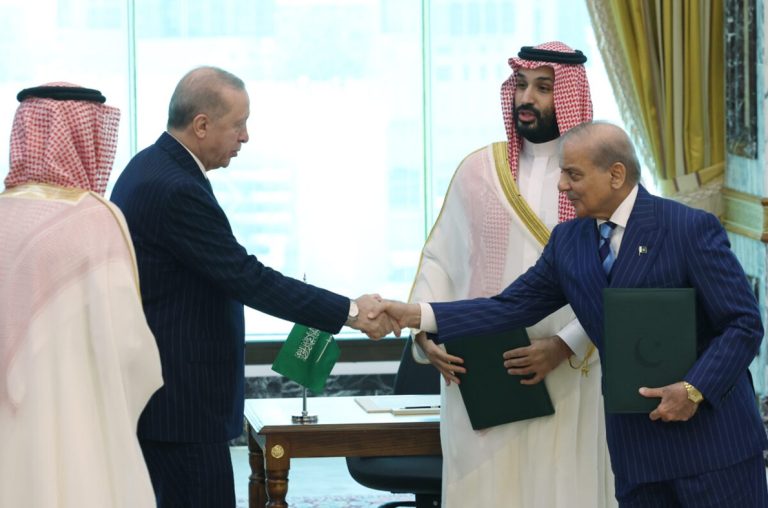
In early 2026, the Middle East has moved beyond the simple “Sunni vs. Shia” binary. Instead, the region is now fractured into two competing ideological and strategic blocs: the Abrahamic Coalition—focused on secular-leaning economic integration and high-tech defense—and the Islamic Coalition, which prioritizes sovereign statehood, Islamic solidarity, and a more cautious distance from Israel.

Read More »