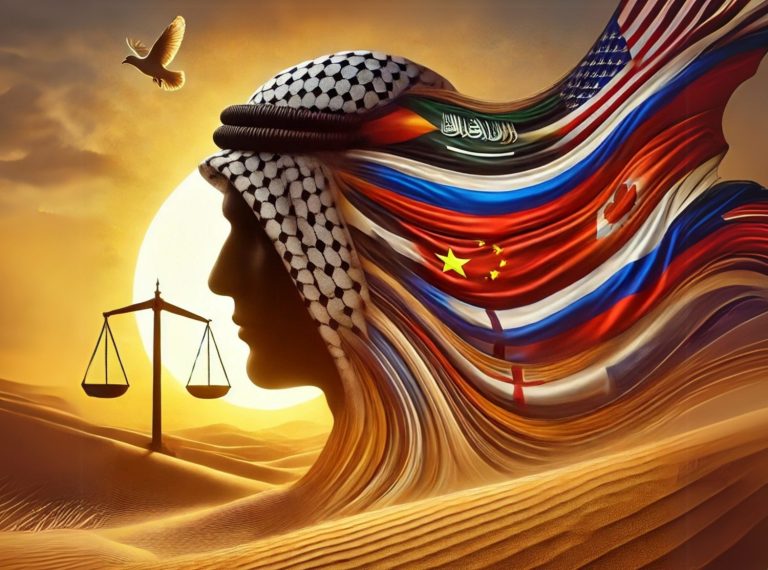
The word “illegal” has never been used more frequently in the Middle East. It has also never mattered less. Gaza has been declared a site of genocide and collective punishment by multiple international bodies. The ICJ has ruled Israel’s occupation of Palestinian territory unlawful. The ICC has issued arrest warrants against Israeli leaders. U.S. strikes on Iran have been denounced as violations of the UN Charter. Iranian attacks on Gulf states have been condemned as breaches of sovereignty. Yet the fighting continued across every front until a fragile ceasefire framework paused — not ended — the cycle. Condemnation has become the background noise of a region that has learned to ignore it.
This is not a failure of international law in principle. It is a failure of political will to convert legal language into political consequences. The ICJ can indicate provisional measures but cannot implement them without state cooperation. The ICC can issue warrants but depends entirely on member states to execute them. The Security Council can adopt resolutions, but each one passes through a veto architecture that reflects strategic alliances rather than legal principle. The result is a system that speaks constantly and acts selectively — generating an ever-growing archive of condemnations that have failed to stop a single strike, invasion, or annexation.
When Law Becomes a Weapon, Not a Restraint
The deeper problem is structural. International law was designed to function as a shared restraint — a framework that forces actors to ask what they are prohibited from doing, even in war. What is happening across the Middle East is something different. Law has shifted from a shared restraint into a language of accusation. Washington and Jerusalem frame their operations as deterrence and self-defense. Tehran frames its responses as reactions to aggression. Gulf states condemn Iranian strikes as violations of sovereignty. Each party reaches for legal vocabulary to indict adversaries and legitimize its own conduct — not to impose limits on itself.
This transformation carries a specific danger. When all parties invoke illegality while continuing operations, the term loses its immediate political weight. It accumulates in statements and emergency sessions without changing battlefield calculations. Legal inflation follows the same logic as monetary inflation: when “illegal” circulates everywhere but is backed by insufficient enforcement, its purchasing power in the political marketplace collapses. Each new condemnation adds to the historical record — which matters for long-term accountability — but does almost nothing to prevent the next strike.
Gaza illustrates the contradiction most clearly. The territory has been destroyed under the continuous shadow of ICJ proceedings, UN warnings, and international condemnation. The legal architecture was present throughout. The enforcement mechanism was not. Lebanon shows the same pattern: ceasefires declared, violations documented, military operations continued. A ceasefire that does not actually cease fire becomes another form of diplomatic vocabulary detached from reality. The region now has agreements that coexist with daily attacks, resolutions that coexist with escalation, and condemnations that coexist with territorial expansion.
Selective Enforcement Destroys Credibility
The problem is not Western double standards alone, though those are real and corrosive. The United States and several European governments have consistently shielded Israel from meaningful Security Council consequences while condemning Iranian violations of Gulf sovereignty — a selectivity that damages both their credibility and the legal principles they publicly defend. But the pattern is also regional. States across the Middle East invoke international law most forcefully when they are the victims and most quietly when partners or allies bear responsibility. Sovereignty becomes inviolable in one context and negotiable in another. Civilian protection becomes urgent in one war and secondary in the next.
This is not to suggest that all actors are equivalent. The scale and nature of violence in Gaza, Lebanon, Iran, and the Gulf are not the same. But the political logic is consistent: legality is invoked to strengthen one’s position, not to accept limits on one’s own power. The ICC’s arrest warrants for Israeli officials have not produced a single arrest. The ICJ’s provisional measures have not halted operations in Gaza. The Security Council resolutions on Lebanon have not ended Israeli strikes.
Gulf states that have long relied on sovereignty, U.S. security guarantees, and international law as their primary protection discovered during the war that those frameworks failed to stop Iranian missiles from reaching their infrastructure. A system unable to protect civilians in Gaza cannot reliably protect Gulf terminals either.
Connecting Condemnation to Consequences
Rescuing international law from irrelevance requires a specific shift: legal condemnation must be systematically connected to political costs. When an actor violates international humanitarian law, the response must include arms restrictions, targeted sanctions, formal investigations, reparations mechanisms, and enforceable ceasefire architecture — not only press statements. The ICC’s legitimacy depends on states treating its warrants as binding obligations rather than optional suggestions. The ICJ’s authority depends on states refusing to supply weapons to parties under active provisional measures orders. Neither condition currently applies with any consistency.
The 60-day window created by the U.S.-Iran framework presents a specific test case. If the ceasefire collapses — through Israeli strikes in Lebanon, Iranian violations, or a breakdown in nuclear negotiations — and the international response again defaults to condemnation without consequence, the lesson drawn by every actor in the region will be the same: the cost of illegal action is a statement. That lesson has already been learned and is being acted on. Reversing it requires states to stop treating illegality as a formula for press releases and start treating it as a trigger for enforceable response.
International law is not dead. Its conventions, courts, and norms still define the architecture of obligation and the language of responsibility. What is dying is the political order’s willingness to operationalize what the law says. The Middle East does not need more declarations that wars are unlawful while those same wars continue. It needs a political environment in which declaring something illegal actually changes the cost of doing it. Until that condition exists, the region will remain trapped in its most dangerous contradiction: conflicts condemned by nearly everyone, and halted by almost no one.
Original analysis inspired by Dr. Luciano Zaccara from The New Arab. Additional research and verification conducted through multiple sources.
By ThinkTanksMonitor