The post-war international economic order was built on a set of principles that most governments treated as permanent architecture: open markets, rule-based trade, multilateral institutions, and the collective pursuit of mutual benefit. Those principles are now under attack from both ends of the geopolitical spectrum simultaneously. Donald Trump’s second administration has dismantled decades of US trade policy, withdrawn from key multilateral commitments, and signaled that American participation in international economic cooperation is now conditional on transactional returns. China, meanwhile, has never fully aligned its trade, industrial subsidy, and exchange rate practices with the open-market principles it nominally endorses. A new Chatham House report argues that the countries caught between these two disrupting giants can no longer afford to wait. They need to build something new.
The proposal is a permanent “third pole” in the global economy — a standing alliance of market-oriented economies committed to preserving open trade, investment rules, and cooperative governance in the largest economic space achievable without either Washington or Beijing. The core would be the European Union and the twelve members of the Comprehensive and Progressive Agreement for Trans-Pacific Partnership, with the door open to aligned major economies including Brazil, South Africa, and South Korea. The combined economic weight of that grouping would be substantial enough to sustain credible trade and investment frameworks independently of US or Chinese participation — not a replacement for global multilateralism, but a foundation from which to defend it while the two largest economies pursue their own agendas.
What the Trump Shock Has Actually Done
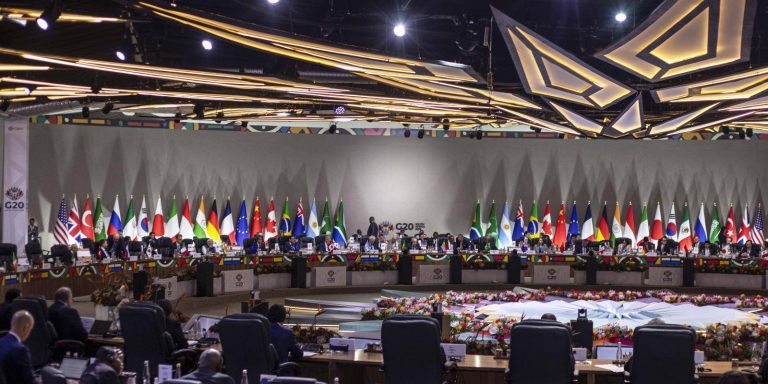
The immediate economic damage from Trump’s second-term policies has been less severe than many economists initially projected, partly because markets adapted faster than expected and partly because the full cumulative effect of the policy suite takes time to materialize. But the structural damage to institutional credibility is already irreversible in important ways. The US effectively boycotted the G20 leaders’ summit in Johannesburg in November 2025. Washington has withdrawn support from the net-zero transition, international monetary stability frameworks, and global poverty elimination commitments. Average US tariffs on imported goods have risen to levels not seen since the 1930s.
The disruption of Middle East oil and gas supplies following the US-Israeli attack on Iran has added an energy dimension that amplifies every other economic pressure. Countries that built their trade and investment strategies around American institutional engagement are now discovering that the framework they planned around no longer reliably exists. The Chatham House report is direct about the trajectory: it is likely only a matter of time before the full suite of Trump policies reduces trend growth and economic stability not just in the United States but across the wider global economy.
Why Variable Geometry Is Not Enough
The conventional response from middle powers has been to pursue what analysts call variable geometry — issue-by-issue coalitions assembled around specific objectives, from climate finance to digital trade standards to development lending. That approach has produced real outcomes on specific files, but it has a structural ceiling. Coalitions assembled around single issues dissolve when the issue is resolved or when the political calculus shifts in participating capitals. They cannot sustain the kind of cumulative institutional weight needed to preserve trade and investment frameworks under sustained pressure from two major economies simultaneously pulling in opposite directions.
A permanent third pole is different in kind, not just degree. It would have a standing institutional identity, a defined membership with shared commitments, and the capacity to develop its own trade agreements, investment standards, and financial governance frameworks without requiring US or Chinese participation at every step. The EU already provides a model of how a large, diverse grouping of economies can maintain binding commitments to open markets and rules-based trade while defending itself against coercive commercial practices. The CPTPP demonstrates that ambitious trade liberalization is achievable without American participation. Combining the two, with strategic additions, would produce a grouping large enough to set standards that others would need to engage with.
The Risks Are Real but Manageable
The report does not minimize the obstacles. Prospective members remain tied to the United States through military alliances that complicate economic independence. Washington has already demonstrated a willingness to treat economic realignment as a political provocation deserving retaliation. China would view a permanent rules-based economic bloc explicitly structured around principles it rejects as a strategic challenge. Neither reaction should be underestimated.
But the alternative — continued dependence on institutions that one major power is actively dismantling and another consistently undermines — is also a choice, and an increasingly costly one. The window for establishing something durable before the institutional erosion becomes irreversible is narrowing. Countries that move quickly will shape the architecture. Countries that wait for Washington to return to multilateralism or Beijing to embrace open-market principles may find that the architecture has already been built around them.
Original analysis inspired by Creon Butler from Chatham House. Additional research and verification conducted through multiple sources.