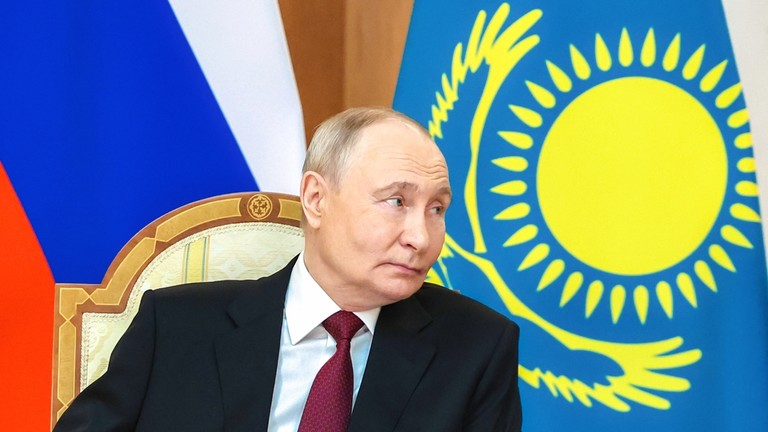
Vladimir Putin’s state visit to Kazakhstan last week was the kind of diplomatic event that demands close reading. On the surface it was a celebration of bilateral warmth, complete with fighter jet escorts, honor guards, and a joint statement codifying a “comprehensive strategic partnership.” Beneath the ceremony, however, the visit doubled as a geopolitical statement delivered at a moment when Moscow’s hold on the former Soviet space is being challenged more openly than at any point since the USSR’s collapse.
Kazakhstan: A Reliable Partner, Not a Vassal
The agreements signed in Astana covered nuclear energy, transport digitalization, financial monitoring, industrial cooperation, and education — fifteen documents in total, forming what analysts describe as a roadmap for the next phase of bilateral integration. Tokayev estimated that Russia and Kazakhstan are currently working on 177 joint projects valued at almost $53 billion. Bilateral trade reached approximately $28 billion in 2025 and is expected to exceed $30 billion by 2030. These are not the numbers of a relationship under serious strain.
Yet Kazakhstan pursues a deliberately multi-vector foreign policy, simultaneously deepening ties with China, Turkey, the EU, and the United States. Kazakhstan has repeatedly said it will not violate Western sanctions, and in that context, references to coordinating sanctions management in bilateral statements are best treated as diplomatic language for managing disruption to trade and payments. Moscow understands this calculus. Kazakhstan is also investing in the Middle Corridor, the trans-Caspian trade route that bypasses Russian territory entirely, as Astana tries to turn the route into a more predictable logistics system — a development that directly weakens one of Russia’s long-standing advantages in controlling east-west overland corridors.
This is not defection. It is the careful maneuvering of a medium power that shares a 7,500-kilometer border with Russia and cannot afford confrontation, while also diversifying away from dependence on any single partner. The relationship works precisely because both sides accept its transactional nature.
Armenia: Where Moscow’s Tools Are Backfiring
Armenia is a different story entirely, and a far more uncomfortable one for the Kremlin. Russia recalled its ambassador to Yerevan for consultations in the days before Armenia’s June 7 parliamentary elections, a dramatic diplomatic escalation that followed weeks of economic coercion. Over the past month, Moscow restricted the import of Armenian produce, flowers, mineral water, and alcoholic products, in what increasingly looks like a coordinated pressure campaign ahead of the vote.
The pressure reflects a deeper panic. Armenia’s government began questioning Russia’s role as its security guarantor after independence, and Moscow’s inaction during Azerbaijani offensives led Yerevan to suspend participation in the CSTO, the Russian-led military alliance, in 2023. Since then, Prime Minister Nikol Pashinyan has identified EU membership as an explicit foreign policy goal, finding genuine receptiveness in Brussels. Donald Trump even publicly endorsed Pashinyan ahead of the election.
Putin’s response has been a mix of economic threats and historical warnings. At the Astana summit, Putin invoked what he called the “Ukrainian scenario” to warn Armenia against pursuing closer EU ties. Moscow also threatened to cancel a 2013 bilateral agreement guaranteeing Armenia duty-free access to natural gas and oil, though Pashinyan dismissed the energy threats, arguing that EU membership would eventually bring in far more money than Armenia would lose.
The irony is that Moscow’s coercion is accelerating the very drift it seeks to reverse. Armenian officials have repeatedly accused Russia of failing to protect the country during fighting with Azerbaijan over Nagorno-Karabakh, which Baku retook in 2023. For much of the Armenian public, the security guarantee that once justified Moscow’s primacy no longer exists. Economic threats from a partner that failed to deliver on its core promise carry limited persuasive weight.
The Long Game
The deeper question raised by both cases is not whether Russia is losing influence, but whether it retains the right tools to exercise it. In Kazakhstan, economic interdependence and geographic proximity sustain a relationship that serves both parties. In Armenia, those same tools have been deployed as blunt instruments and are visibly failing. New generations across the post-Soviet space are making choices shaped less by Soviet-era ties and more by where they see their own futures. No amount of trade agreements or ambassador recalls can fully override that generational shift. The coming years will test whether Moscow can adapt its approach before more of its neighborhood follows Armenia’s trajectory.
Original analysis inspired by Timofey Bordachev from RT. Additional research and verification conducted through multiple sources.