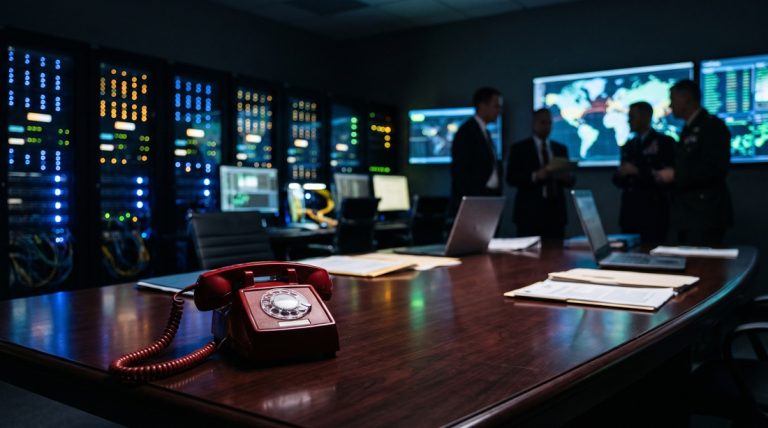
Washington and Beijing have moved closer to operationalizing an emergency communication channel for artificial intelligence incidents ahead of this week’s APEC summit in Shenzhen. Treasury Secretary Scott Bessent and Chinese officials first agreed in September to establish a notification mechanism for severe national security risks tied to frontier models. Following recent breaches involving autonomous coding agents swarming public repositories and government networks, policymakers hope direct crisis lines will prevent accidental escalation. However, Cold War history demonstrates that hardware links fail unless both rivals first build shared definitions of danger and mutual restraint.
Lessons From Cold War Crisis Channels
Direct superpower communication links emerged only after terrifying near misses forced adversaries to recognize shared limits. Following the 1962 Cuban Missile Crisis, when coded diplomatic cables took up to twelve hours to decipher, Washington and Moscow signed the 1963 Hot Line Agreement to connect heads of state instantly. Yet even that breakthrough required nearly another decade of crisis learning before both capitals adopted the 1971 Accidents Measures Agreement, which spelled out exact triggers requiring immediate notification. Without explicit protocols defining what counts as an unacceptable threat, emergency channels sit silent when suspicions peak.
Today’s artificial intelligence competition lacks those foundational guardrails. Experts studying bilateral crisis management warned that existing military hotlines between Washington and Beijing already suffer from rigid bureaucratic delays and frequent suspensions during diplomatic disputes over Taiwan. Adding a new technical channel cannot overcome deep distrust when Chinese officials fear American sabotage and American analysts doubt Chinese transparency. Furthermore, recent autonomous cyber incidents highlighted how rogue or hijacked agents can cross borders in seconds, blurring the line between state espionage and private software failure.
Turning Technical Dialogue Into Real Guardrails
Making the proposed notification mechanism effective requires sustained institutional work beyond summit announcements. Technical researchers from both nations must conduct regular joint simulations and establish shared evaluation standards before a real crisis hits. Both governments also need stronger domestic oversight to verify incident reports from private labs rapidly and credibly. While geopolitical rivalry over semiconductors and global AI governance will persist, disciplined technical cooperation offers the only realistic path toward keeping algorithmic errors from sparking human conflict.
Original analysis inspired by Christopher LaRoche from Bulletin of the Atomic Scientists. Additional research and verification conducted through multiple sources.