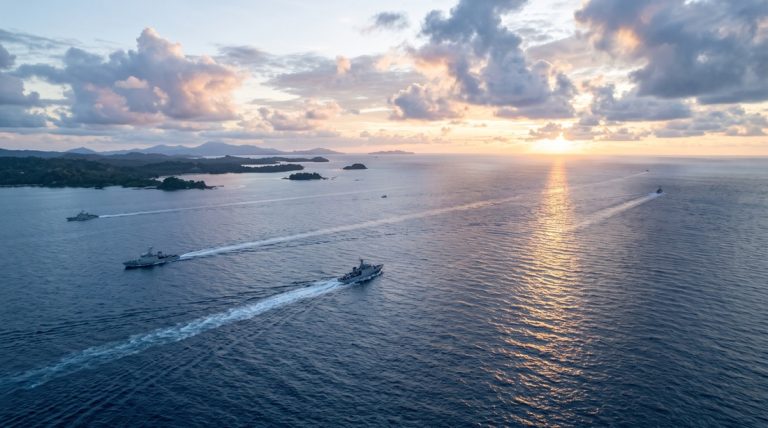
As leaders gather in Manila for the 49th ASEAN Summit alongside a revived Quad meeting, the Philippines faces a critical test of its foreign policy direction. Over recent years, Manila has expanded American access to local military bases under enhanced defense arrangements while escalating maritime friction in the South China Sea. Supporters of deeper alignment assume Washington’s security umbrella guarantees protection against regional rivals. Yet treaty texts and strategic history suggest that relying on unconditional American intervention exposes the Philippines to disproportionate risk during an actual crisis.
Ambiguity Inside the Mutual Defense Treaty
Signed in August 1951, the United States Philippines Mutual Defense Treaty commits both nations to address armed attacks in the Pacific area through their own constitutional processes. Crucially, that phrasing does not mandate automatic American military retaliation in the event of a localized maritime clash. Legal scholars have long noted that Washington’s willingness to fight over contested reefs and islands depends entirely on shifting domestic politics and strategic cost calculations. While American officials regularly reaffirm treaty coverage for Philippine vessels, strategic value to Washington centers primarily on maintaining forward staging hubs near the Taiwan Strait rather than defending every maritime claim.
Overestimating external backing risks encouraging dangerous miscalculations at sea. When local commanders believe superpower intervention is guaranteed, routine maritime disputes can escalate rapidly into armed confrontation. In such a scenario, the Philippines would bear the immediate economic disruption, infrastructure damage, and territorial fallout while distant decision makers debate whether intervention serves their national interest.
Preserving ASEAN Centrality Over Exclusive Blocs
Simultaneously hosting the Quad summit on the sidelines of ASEAN meetings places Manila in a delicate diplomatic position. Prime Minister Narendra Modi, President Donald Trump, and regional counterparts plan to convene in Manila for the first Quad leaders gathering in two years. Yet several Southeast Asian members remain wary of transforming ASEAN platforms into vehicles for exclusive geopolitical blocs, even as negotiators work to finalize a South China Sea Code of Conduct. Allowing external rivalries to overshadow regional consensus weakens ASEAN’s collective diplomatic weight.
True security for the Philippines lies in balanced regional diplomacy rather than serving as a forward military outpost for outside powers. By prioritizing direct crisis management mechanisms with neighbors and safeguarding ASEAN’s inclusive neutrality, Manila can protect its maritime interests without becoming a pawn in great power confrontation.
Original analysis inspired by Dai Fan from Global Times. Additional research and verification conducted through multiple sources.