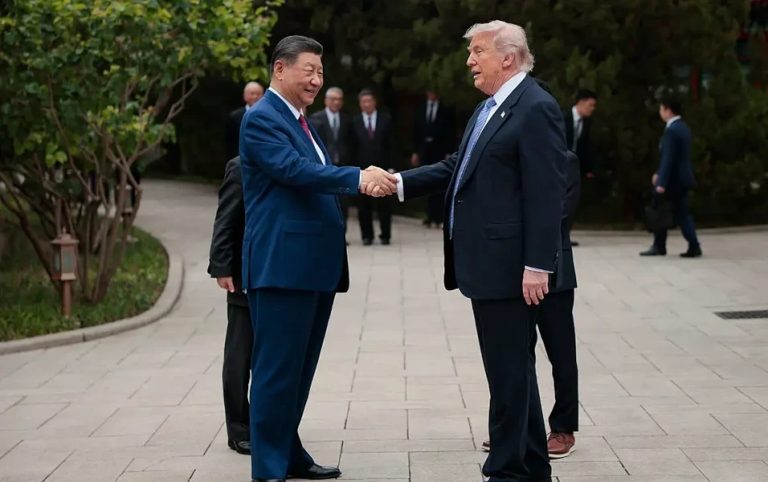
The Trump administration has paused a $14 billion arms package to Taiwan that had been in the pipeline for years, covering advanced fighter aircraft, submarines, and missile defense systems that Taipei had spent considerable political capital securing legislative approval to purchase. Secretary of State Marco Rubio has insisted that US policy on Taiwan remains fundamentally unchanged. But the freeze, combined with Trump’s public description of Taiwan’s security as a “negotiating chip” in conversations with Beijing, represents something that no amount of diplomatic language can obscure: Washington is telling Xi Jinping that decades of bipartisan American commitment to Taiwan’s defense are now subject to renegotiation based on Trump’s personal relationship with the Chinese president.
Xi’s position on Taiwan has never been ambiguous. Beijing views the island as unfinished business from the Chinese civil war — the essential remaining element of what Xi calls national rejuvenation. Under his leadership, the People’s Liberation Army has invested heavily in developing the capacity to seize Taiwan by force, conducting increasingly provocative military drills in the air and waters around the island that have become routine rather than exceptional. Taiwan has never been under PRC jurisdiction — a fact that Beijing acknowledges implicitly even while contesting it rhetorically. What the arms freeze signals to Beijing is that sustained economic and diplomatic pressure on Washington can produce the kind of policy movement that decades of PLA provocations alone could not.
What Taiwan Actually Represents Strategically
The case for Taiwan’s defense has never rested solely on democratic solidarity, though that dimension is genuine and matters to the bilateral relationship. Taiwan sits at the center of the Western Pacific’s first island chain, which limits PLA Navy access to US territories in the second island chain and through which the world’s most critical commercial shipping routes flow. It is America’s fourth-largest trade partner. It produces the vast majority of the world’s most advanced semiconductors — the components that underpin both military systems and the artificial intelligence infrastructure that Washington has identified as a primary competitive battleground with Beijing.
Japan, South Korea, and the Philippines — all US treaty allies — sit directly adjacent to Taiwan and watch American policy decisions through the lens of their own security calculations. Each has faced sustained Chinese diplomatic and military pressure in recent years. What they observe in the Taiwan arms freeze is a data point about American reliability — specifically, whether Washington’s security commitments can be revised downward when a bilateral economic or diplomatic relationship with Beijing creates political incentives to do so.
The Six Assurances and the Reagan Precedent
The Trump administration’s decision to consult Beijing on the arms package directly violates one of the Six Assurances that the Reagan administration made to Taipei in 1982 — specifically, the pledge that Washington would never consult with Beijing on arms sales to Taiwan. That commitment was not arbitrary. It reflected a straightforward strategic logic: asking an adversarial power whether it approves of defensive arms being provided to the entity it threatens is structurally incoherent. The assurance held across Republican and Democratic administrations for over four decades because the logic remained sound regardless of who held the White House.
Taiwan’s President Lai Ching-te took Washington’s 2025 National Security Strategy at face value, aligning Taipei’s defense and economic priorities closely with American interests, securing hundreds of billions in technology investment commitments, and expending significant domestic political capital to win legislative approval for the defense spending increases needed to finance the arms package now frozen. He is now exposed in precisely the way that Trump’s own National Security Strategy warned against — a democratic partner that aligned with US interests facing mockery from political opponents who warned against trusting Washington.
Several members of Congress from both parties have begun drafting bipartisan legislation to codify the Six Assurances into law, recognizing that executive-level commitments require statutory reinforcement when the executive treats them as negotiable. Whether that legislation advances before the midterms — and whether Trump would sign it if it did — remains unclear. What is clear is that the arms freeze has produced exactly the outcome the Six Assurances were designed to prevent: Beijing demonstrating that sustained pressure on Washington can move US Taiwan policy in ways that four decades of consistent bipartisan commitment had successfully resisted.
Original analysis inspired by Jonathan Fritz and Michael Clark from American Progress. Additional research and verification conducted through multiple sources.