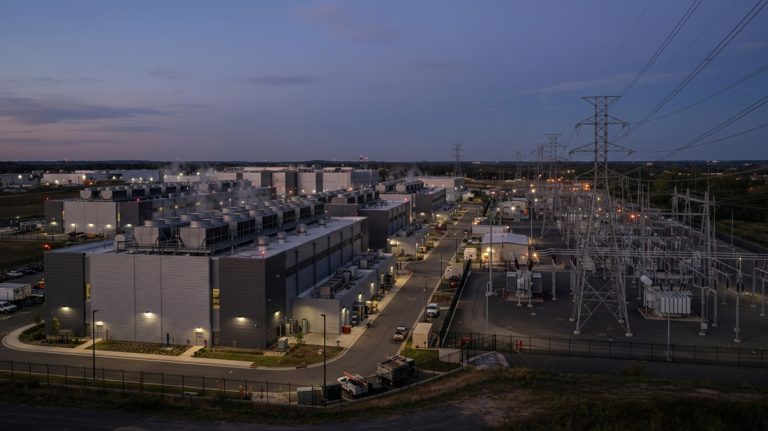
As technology firms race to build the physical backbone of artificial intelligence, the electricity, water, and land required by data centers increasingly determine which nations can compete. Unlike conventional server farms that rely on air cooling and central processing units, modern AI facilities pack thousands of specialized graphics processors into racks that demand continuous power and direct liquid cooling. The International Energy Agency projected in its global assessment that data center electricity demand will more than double to roughly 945 terawatt hours by 2030. Because wind and solar installations alone cannot guarantee uninterrupted baseload power around the clock, developers are turning back to natural gas and nuclear plants while local communities push back against rising utility bills.
Resource Strains and Rising Community Backlash
The physical footprint of computing infrastructure has turned obscure industrial parks into flashpoints over local water and power supplies. A United Nations University study warned that global AI water consumption could equal the annual domestic needs of 1.3 billion people by 2030, as massive facilities draw up to five million gallons daily for evaporative cooling. Meanwhile, S&P Global analysis found that 43 percent of data centers worldwide already operate in regions facing high water stress, including 38 percent in the United States and roughly 60 percent in China. Carbon emissions are climbing alongside water demand, with Microsoft reporting a 25 percent emissions jump in fiscal year 2025 despite its pledge to become carbon negative by 2030.
Financial pressures compound these environmental concerns as major cloud providers pour unprecedented capital into hardware. Alphabet, Amazon, Meta, and Microsoft collectively plan roughly 725 billion dollars in capital expenditures for 2026, relying increasingly on debt financing even as broad productivity gains remain uneven. The United Nations Economic Commission for Europe noted that developers can construct large computing campuses within two to five years, whereas expanding electrical transmission lines often takes more than a decade. That mismatch leaves regional grids strained and forces municipalities from rural Michigan to Northern Virginia to weigh promised tax revenues against higher residential power rates and air pollution risks.
Diverging Strategies From Washington to Beijing
National governments have adopted starkly different playbooks to manage this infrastructure boom. In July 2025, President Donald Trump signed an executive order directing federal agencies to expedite permits and extend loans, grants, and tax incentives for major AI facilities. Private companies still dictate where American centers cluster, concentrating heavily in Virginia, Texas, and Georgia while contending with a fragmented patchwork of state regulators and aging transmission lines. By contrast, China has pursued centralized spatial planning through its East Data, West Computing initiative, which targets renewable sources for over 80 percent of electricity in western computing hubs, even though semiconductor export controls continue to limit its access to advanced processors.
Gulf Ambitions and Asian Grid Limits
Wealthy Gulf monarchies are leveraging sovereign funds to position themselves as indispensable global AI hubs. The United Arab Emirates launched Stargate UAE alongside OpenAI in 2025 as a flagship cluster, though regional conflict with Iran has forced planners to reassess facility designs and raised questions about whether sweeping investment pledges to the United States will materialize on schedule. Saudi Arabia is simultaneously channeling tens of billions of dollars through its sovereign AI firm HUMAIN to build domestic computing capacity. Across Europe and Southeast Asia, however, tight land and grid constraints have prompted stricter controls, with the Netherlands banning new hyperscale centers, Ireland requiring facilities to generate their own power, and Malaysia projecting that data centers could consume one third of national electricity by 2035 after absorbing spillover investment from Singapore.
Original analysis inspired by Emilyn Larson from Council on Foreign Relations.
Additional research and verification conducted through multiple sources.