The conflict between Tehran and Washington has settled into a tense stalemate defined by economic siege rather than sustained aerial bombardment. Since September, an American naval blockade has halted new Iranian crude loadings, pushing maritime oil volumes outside the restriction zone to zero. In early November, United States Central Command launched Task Force Iron Gate to extend that maritime choke point onto overland borders and the Caspian Sea. Secretary of State Marco Rubio recently argued in Paris that this extraordinary economic pain removes the need for major combat operations, betting that severe deprivation will either force capitulation or ignite a popular revolt.
Economic indicators confirm that ordinary households are absorbing devastating financial shocks across the country. The International Monetary Fund projects that Iran’s economy will contract by 7.6 percent this year while average consumer inflation climbs to 78.6 percent. Retaliatory fuel price hikes and a collapsing currency have fueled scattered demonstrations by retirees in major cities and angry chants among mourning oil workers in Ilam province. Yet historical precedent from 2017, 2019, and January 2026 shows that acute material hardship alone rarely sustains a nationwide revolutionary movement capable of toppling the state.
Structural Barriers Inside a Wartime State
Sustaining a national uprising requires a shared political alternative, resilient organizing networks, coordinated labor strikes, and visible fractures within the ruling elite. Domestic opposition groups and exiled factions remain deeply divided over Iran’s future governance and minority rights, leaving protesters without a unified leadership structure. Meanwhile, security forces arrested more than 53,000 people and killed over 7,000 during the January crackdown, severely thinning the activist networks that previously linked neighborhoods together. Once the war began in late February, authorities imposed an 88 day internet blackout that disconnected decentralized groups and confined dissent to isolated local pockets.
Organized labor faces equally formidable obstacles after three decades of privatization and subcontracting hollowed out workplace protections. Roughly 96 percent of Iranian labor contracts are now temporary, meaning workers in vital oil and petrochemical facilities risk immediate dismissal if they walk off the job. At the apex of power, Washington’s assumption that decapitation strikes would fracture the leadership failed when the ruling establishment closed ranks following the death of Ali Khamenei. Instead of breaking the security apparatus, external military pressure has allowed officials to wrap state survival in nationalist rhetoric that keeps many disillusioned citizens off the streets.
The Limits and Risks of Economic Siege
Washington’s effort to seal Iran’s overland trade routes also leaks badly across porous regional frontiers. Analysts note that neighboring states including Iraq, Turkey, and Pakistan have resisted blanket border closures, allowing regime networks to maintain vital supply lines while border communities suffer. Because the state controls illicit smuggling channels, elites can pass the heaviest costs of scarcity onto marginalized populations while funding core security forces. Rather than sparking a unified revolution, prolonged strangulation is far more likely to produce localized unrest that the state can contain through targeted coercion.
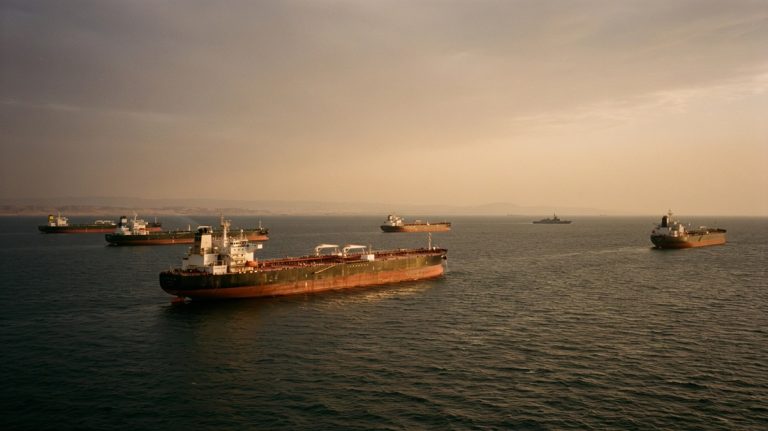
An indefinite blockade also carries acute military dangers in the Persian Gulf as Tehran’s oil revenues approach zero. Iranian forces have stepped up attacks on commercial shipping in the Strait of Hormuz, where multiple tankers recently struck naval mines and caught fire. As maritime incidents multiply across the waterway, the risk of miscalculation grows alongside Tehran’s incentive to escalate in order to break the deadlock. Economic siege can impoverish Iranian society, but it cannot manufacture an organized political movement out of sheer desperation.
Original analysis inspired by Kayhan Valadbaygi from The New Arab.
Additional research and verification conducted through multiple sources.