Economic survival and border security dominated talks in Dushanbe on November 20 as Tajik President Emomali Rahmon hosted Russian President Vladimir Putin. Their bilateral summit arrived days after Brussels imposed fresh financial penalties on a key Russian money transfer service vital to Tajik households. While Rahmon praised Moscow as a strategic ally, Dushanbe is quietly hedging its diplomatic bets by courting Washington on critical minerals and technology.
Few economies globally depend as heavily on foreign labor income as Tajikistan. According to World Bank figures, personal remittances equaled nearly fifty eight percent of Tajik gross domestic product in 2025, making household stability deeply sensitive to Russian migration rules. Over one million Tajik citizens work across Russia, yet roughly one hundred sixty thousand now appear on Moscow’s register of controlled persons lacking legal residency status.
European Sanctions Hit Migrant Lifelines
Financial pressure intensified on November 16 when the European Union froze the assets of Unistream, a Russian commercial bank operating the transfer corridor Tajik workers rely upon to send wages home. Earlier European penalties had already targeted three major Tajik lenders before regulators lifted those restrictions in April 2026 following compliance reforms. As Washington and Brussels tighten secondary enforcement, Dushanbe faces recurring shocks to the payment channels sustaining its domestic economy.
Even with strong headline growth reaching over eight percent in the first half of 2026, World Bank analysts note that construction and household consumption remain anchored to foreign earnings. During their Dushanbe talks, Putin and Rahmon acknowledged mounting friction over migrant registration and transfer limits, though neither government announced concrete relief agreements.
Afghan Border Security and Diplomatic Hedging
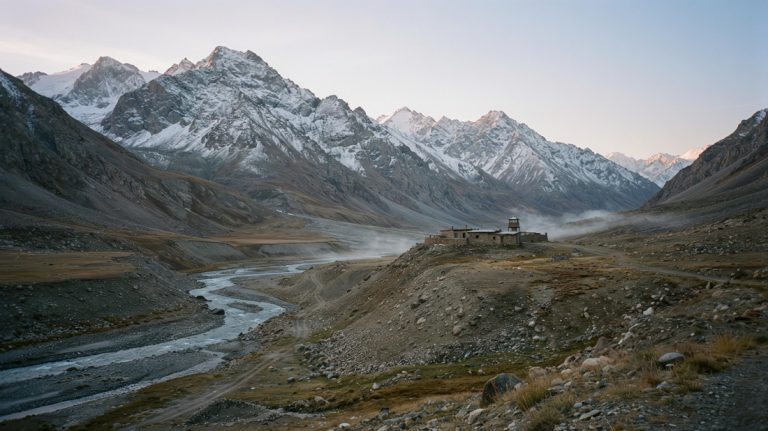
Security along Tajikistan’s rugged frontier with Afghanistan anchored the defense portion of the summit. Rahmon briefed Moscow on cross border smuggling and militant incidents while Putin shared updates from recent Russian diplomatic visits to Kabul. Both leaders reaffirmed support for Russia’s 201st Military Base in Tajikistan, Moscow’s largest foreign land installation, alongside deeper intelligence and border coordination outside formal regional blocs.
At the same time, Dushanbe is carefully widening its international partnerships to avoid total dependence on the Kremlin. Just two days before Putin’s arrival, Rahmon met with United States Deputy Secretary of State Christopher Landau to explore mining cooperation, artificial intelligence, and security ties. Bilateral trade with Russia still grew nearly nineteen percent in early 2026, proving that Dushanbe’s survival strategy relies on balancing Moscow’s military umbrella with selective Western engagement.
Original analysis inspired by Javier M. Piedra from The Times of Central Asia. Additional research and verification conducted through multiple sources.