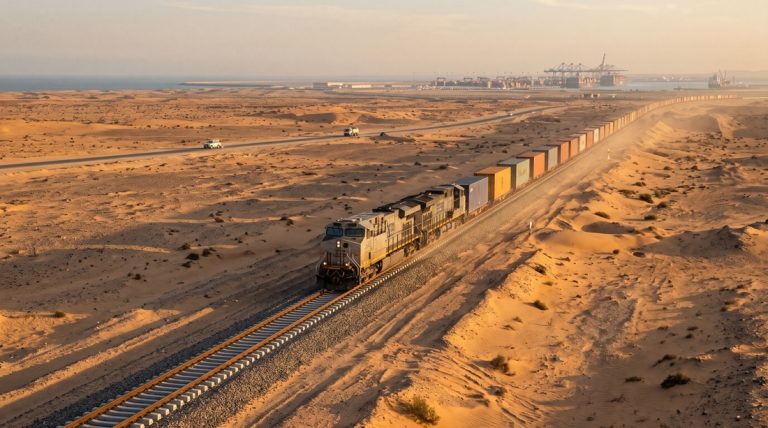
Eight months of military confrontation around the Strait of Hormuz have exposed the fragility of Gulf Arab trade routes. Higher war risk insurance premiums, delayed cargo deliveries, and soaring import costs have forced regional governments to accelerate overland transport alternatives. On November 8, transport ministers from all six Gulf Cooperation Council states signed an agreement in Manama to build a unified regional railway network by late 2030. Spanning roughly two thousand one hundred kilometers, the corridor aims to connect Kuwait, Saudi Arabia, Bahrain, Qatar, the United Arab Emirates, and Oman through shared technical standards.
Connecting National Grids Across Borders
Substantial sections of the ambitious rail grid already exist on the ground after years of delayed planning. Originally approved in 2009 for completion nearly a decade ago, the project has reached roughly half of its physical buildout as governments revive stalled segments. The United Arab Emirates recently launched construction on the Hafeet Rail line linking its domestic network to Oman’s port of Sohar, while Riyadh and Doha plan high speed electric passenger trains. Bahrain’s link hinges on the proposed King Hamad Causeway across Saudi waters, though uneven national budgets still threaten synchronized completion.
Economic diversification provides a durable commercial logic that extends well beyond immediate maritime crises. Transport and storage already rank among the fastest growing non oil sectors across Gulf economies, recording steady expansion as states seek industrial integration. Moving regional freight by rail cuts transit times compared with long distance trucking and shields domestic food and manufacturing supply chains when shipping lanes tighten. Saudi Arabia’s dual coastlines on the Persian Gulf and the Red Sea make the kingdom an indispensable overland bridge for neighboring capitals seeking wider market access.
Why Trains Cannot Replace Tankers
Despite political momentum in Manama, physical geography imposes strict limits on what steel tracks can achieve. Freight trains cannot carry anything approaching the massive crude oil and liquefied natural gas volumes moved daily by ocean supertankers. Even when cargo travels overland to Omani or Saudi ports outside the Persian Gulf, exporters still depend on maritime vessels for final delivery to Asian and European buyers. Consequently, the railway serves as a supplementary logistics buffer rather than a substitute for open sea lanes.
Operational hurdles and security vulnerabilities also complicate the dream of seamless regional transit. Customs harmonization, unified freight pricing, and cross border signaling systems must function smoothly so trains do not stall at national frontiers. Moreover, exposed bridges, rail yards, and power substations become vulnerable targets during active regional conflict, while shifting desert dunes test long term maintenance budgets. Until regional diplomacy stabilizes maritime navigation through the Strait of Hormuz, overland rail can cushion commercial shocks but cannot neutralize Tehran’s strategic leverage over global energy chokepoints.
Original analysis inspired by Sabena Siddiqui from The New Arab. Additional research and verification conducted through multiple sources.