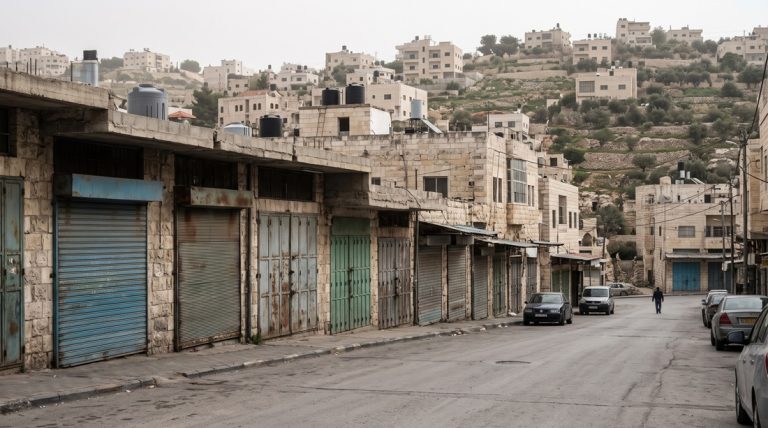
Palestinian economic life in the occupied West Bank has deteriorated into severe contraction under sustained Israeli financial and physical restrictions. Since late 2023, Israeli authorities have suspended all clearance revenue transfers that normally fund public administration, leaving the Palestinian Authority unable to pay full civil servant salaries. Caretaker Finance Minister Bezalel Smotrich has coupled these withholdings with strict caps on shekel transfers and temporary banking waivers that keep Palestinian financial institutions on edge. Coupled with revoked work permits and expanding checkpoints, these policies have crippled private commerce and deepened humanitarian distress.
Fiscal Strangulation and Settler Violence
The economic squeeze operates alongside intensifying physical barriers that fragment Palestinian markets and agricultural land. Over one hundred thousand Palestinian workers lost access to Israeli labor markets after October 2023, eliminating vital household income despite Israeli security assessments finding no link between permit holders and attacks. Simultaneously, minimally checked settler violence has displaced rural communities, destroyed property, and blocked farmers from reaching harvests. Because local banks hold unusable excess shekels without predictable correspondent banking guarantees, even routine cross border commercial transactions face constant disruption.
These compounding pressures directly undermine Washington’s stated diplomatic objectives for postwar Gaza. President Donald Trump’s twenty point Gaza roadmap relies on a functioning Palestinian economy and reformed ministerial institutions to absorb reconstruction investment and sideline Hamas. Instead, a cash strapped administration forced to shorten school weeks and accumulate massive debt loses public credibility every month. With Palestinian legislative elections postponed until late 2027 and Hamas signaling plans to compete within a broader alliance, prolonged dysfunction risks strengthening the very factions Washington seeks to contain.
Spillover Risks Facing Jordan and Israel
Instability across the West Bank carries immediate security consequences beyond Palestinian cities. More than one thousand Palestinians, dozens of Israelis, and at least six American citizens have been killed in West Bank violence since late 2023. Neighboring Jordan faces acute vulnerability if economic collapse and settler displacement trigger cross border refugee flows that strain Amman’s budget and security apparatus. Waiting for a new Israeli coalition to emerge after inconclusive elections only allows caretaker officials more time to entrench irreversible administrative changes on the ground.
Averting systemic collapse requires simultaneous policy shifts from Israel, Palestinian leaders, and Washington. Israeli authorities must restore regular tax transfers, lift banking caps permanently, and reopen crossing hours at the Allenby Bridge. At the same time, international donors should demand verifiable budget transparency and prisoner payment reforms from Ramallah while restoring diplomatic channels in Washington and Jerusalem. Without coordinated intervention to stabilize livelihoods, plans for broader regional integration will fail on the ground.
Original analysis inspired by Lucy Kurtzer-Ellenbogen from Middle East Institute. Additional research and verification conducted through multiple sources.