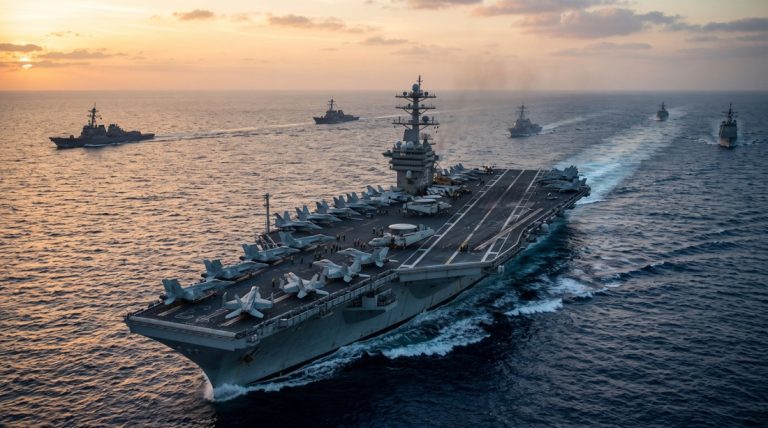
Washington has concentrated three aircraft carrier strike groups around the Middle East while diplomacy with Tehran remains frozen. The USS Theodore Roosevelt entered the Central Command theater on Sunday, joining two American carriers already operating near regional waterways. Around two hundred land based fighter aircraft, aerial tankers, and missile defense batteries now back up this naval armada. Even if the overlap partly reflects a scheduled rotation, the sheer volume of firepower leaves policymakers facing acute escalation risks across a volatile region.
Mixed Signals From Washington and Jerusalem
Israeli leaders are actively pressing the White House to authorize another round of strikes against Iranian territory. Prime Minister Benjamin Netanyahu recently accused Tehran of rebuilding nuclear infrastructure while Mossad director Roman Gofman held urgent consultations with CIA chief John Ratcliffe in Washington. Following inconclusive Israeli elections in October that left his coalition short of a parliamentary majority, Netanyahu faces intense domestic pressure from opposition rivals seeking to form a replacement cabinet. Launching a major foreign military campaign could hand the embattled premier a convenient political lifeline under the banner of national emergency.
President Donald Trump has sent contradictory messages about whether he wants renewed combat or economic coercion. After meeting Qatari officials earlier this month, Trump declared operations against Iran effectively finished and scaled back Vice President JD Vance’s diplomatic portfolio. Yet he also reposted commentary advocating sustained military campaigns and warned that leaving Iran’s government intact would constitute an American defeat. By boasting that Washington controls Iranian revenues and maritime transit, the White House signals a preference for prolonged blockade pressure that still carries dangerous triggers for open war.
Deterrence Red Lines in Tehran
Iranian officials have made clear they will not passively endure indefinite naval strangulation and economic isolation. Parliament Speaker Mohammad Bagher Ghalibaf warned Washington on Sunday that Tehran rejects a prolonged limbo of neither war nor peace while unveiling a newly constructed missile facility. Any renewed American or Israeli strike would prompt Iranian forces to determine the geographic boundaries of the battlefield rather than accepting localized limits. Meanwhile, senior security figures have threatened retaliatory strikes against American bases across Europe if hostilities resume.
Maritime incidents during the opening ten days of November already demonstrated how quickly tensions can ignite without a formal declaration of war. With at least ten commercial vessels struck in regional waters and Iranian drone attacks targeting facilities in Bahrain, miscalculation remains an immediate hazard. Concentrating three carrier groups within range of Iranian missiles may be intended to project overwhelming deterrence, yet history shows that dense military deployments often narrow diplomatic offramps when both sides believe survival is at stake.
Original analysis inspired by Sarah Khalil from The New Arab. Additional research and verification conducted through multiple sources.