Five years of frozen diplomacy, a deadly border clash, and competing strategic visions — none of it was enough to keep India and China permanently apart. Since late 2024, the two Asian giants have been slowly, cautiously rebuilding a relationship that neither side can afford to abandon, even as neither fully trusts the other. What drives New Delhi back toward Beijing is not goodwill. It is a set of hard-nosed imperatives, each more urgent than the next.
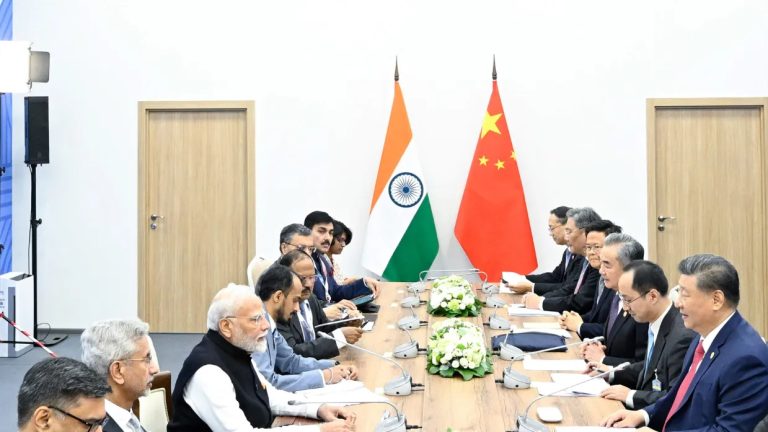
The turning point came in October 2024, when Prime Minister Narendra Modi and President Xi Jinping met in Kazan on the sidelines of the BRICS summit — their first formal engagement since 2019. That meeting, followed by Modi’s visit to Tianjin in August 2025 for the SCO summit, came after the April–May 2020 standoff in Eastern Ladakh, which resulted in the first loss of life in fighting along the India–China boundary areas since 1975, plunging the relationship to its lowest point since the 1962 war. The road back has been slow, deliberate, and defined by distrust that neither side has found a way to overcome.
The Border Remains the Bedrock
New Delhi’s foremost concern is the line of disputed territory that stretches nearly 3,500 kilometers across some of the world’s most forbidding terrain. India’s position has been consistent and unambiguous: broader ties cannot improve without border stability first. That logic held through four years of frozen relations and only began to shift when disengagement at the seven friction points in Ladakh created political space for Modi and Xi to finally sit down together.
Even now, the situation on the ground remains tense. An estimated 50,000 to 60,000 troops from each side remain deployed in forward positions along the Line of Actual Control, maintaining quasi-wartime readiness. De-escalation — the actual drawdown of those forces — has not been agreed upon, and senior Indian military officials have privately described it as hardly achievable given the current level of strategic distrust. Both sides have committed to new border management mechanisms, including expert groups on boundary delimitation and General Level military mechanisms in the Eastern and Middle Sectors, but these are frameworks, not solutions. There was no substantive progress in resolving the territorial dispute, and de-escalation on the border stalled.
Adding to India’s concerns, China’s construction of a $137 billion mega-dam on Tibet’s Yarlung Tsangpo River is stoking concern on the Indian side, with the river flowing from Tibet into the Siang River in Arunachal Pradesh before eventually forming into the Brahmaputra River, meaning any upstream activity can have significant downstream implications.
Supply Chains as a Pressure Point
India’s economic entanglement with China is deep enough to be a strategic vulnerability. The numbers tell the story plainly. Bilateral trade climbed to approximately $127.71 billion in fiscal year 2024–25, up from $118.40 billion the previous year. However, this growth masked a troubling asymmetry, with India’s trade deficit with China expanding dramatically to roughly $99.2 billion.
The structural problem goes well beyond imbalance. While China supplied sophisticated machinery, electronic components, solar equipment, and EV battery materials, India’s exports remained concentrated in raw materials and lower-value-added goods, reinforcing an unequal economic relationship that carried strategic implications beyond mere commerce.
Nowhere has this dependency proved more dangerous than in critical minerals. China accounted for around 60% of global rare earth mining output in 2024, and its share of sintered permanent magnet production has risen significantly to 94% today, making it the world’s single largest supplier of the component critical to the manufacturing of the most powerful motors used for many cutting-edge applications. When Beijing introduced export controls on rare earths in April 2025, Indian automobile companies, defense suppliers, and renewable energy manufacturers were all caught in the squeeze. China introduced stringent export controls on rare earths and related technologies, requiring foreign companies to obtain approval for exporting products containing even trace amounts of Chinese rare earths. The new rules extended to processing technologies and intellectual property, impacting global supply chains, particularly in clean tech sectors — and this could hinder India’s efforts to secure essential inputs for its EV and renewable energy industries.
India responded diplomatically, raising the issue in multiple bilateral meetings throughout 2025. Some relief came in August of that year, when Beijing partially eased restrictions on rare earth magnets, fertilizer, and tunnel boring machines — though with conditions barring re-export to the United States or use in military applications.
The Geopolitical Triangle That Shapes Everything
India’s reengagement with China does not occur in a vacuum. The Trump administration’s return to the White House and its unpredictable approach to both Beijing and New Delhi has complicated New Delhi’s strategic calculus in ways few Indian policymakers had anticipated. International uncertainty caused by the unpredictable Trump administration is likely to push both sides to keep improving relations, although it will also occasionally destabilize them.
Over the last two decades, Indian policymakers have gone from seeing China as a potential enabler to more of an obstruction in achieving Indian objectives. This change has affected India’s approach toward China, its policies in various functional domains, as well as its partnerships — and this shift toward more intensified competition has persisted despite an ongoing reengagement process.
Trump’s actions have created a chasm between Washington and New Delhi, undermining decades of painstaking diplomacy. Yet attributing the China–India thaw solely to U.S. policy is misleading. With India questioning U.S. reliability, it should come as no surprise that India is doubling down on its multi-alignment strategy, seeking to develop and elevate ties with strategic partners.
The May 2025 India–Pakistan conflict added another layer of complexity. From the perspective of the Indian security establishment, China is among the biggest security challenges confronting the country. The brief conflict between India and Pakistan in May 2025 further underscored this, given the latter’s tremendous military dependence on Beijing and perceptions of China actively aiding Pakistan during the conflict.
Strategic Breadcrumbing, Not Strategic Reset
The most honest assessment of where this relationship is heading comes from examining what Beijing actually wants. China seeks stability on its periphery while managing its escalating competition with Washington — and India’s pacification fits neatly into that goal without requiring genuine concession. These developments reflect pragmatic stabilization rather than a strategic reset. Key sources of tension such as border disputes, trade imbalances, and broader strategic mistrust remain unresolved, while external pressures reinforce incentives for limited engagement rather than durable reconciliation.
The two sides realize that the thaw, although successful, has not reset their relationship and the danger of backsliding into conflict is real. They picked some low-hanging fruit in 2024 and 2025, but there is a lot more work to do. For India, the path forward requires managing four simultaneous pressures — border security, economic resilience, political understanding, and geopolitical positioning — without sacrificing leverage in any of them. That is a needle few countries have successfully threaded with a neighbor as powerful, and as calculating, as China.
Original analysis inspired by Saheb Singh Chadha from Carnegie Endowment for International Peace. Additional research and verification conducted through multiple sources.