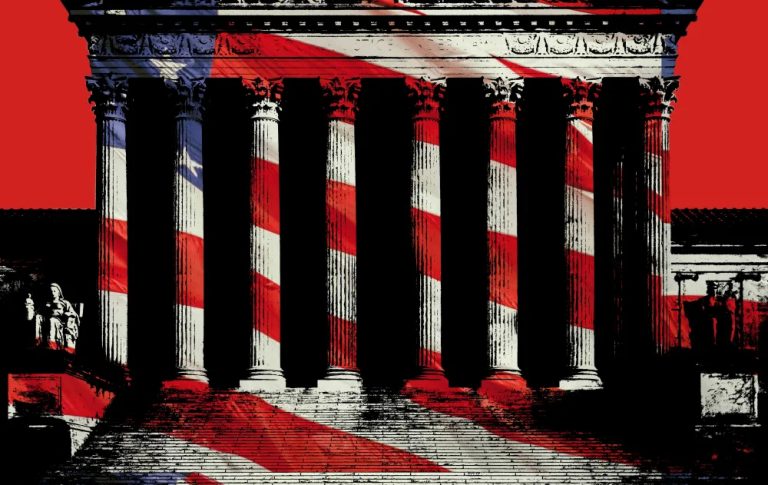
The Supreme Court’s final decisions of the 2025 term landed on June 30 with the quiet authority of a constitutional rebuke. In a sharp rebuke to President Trump, the Supreme Court ruled that the Constitution guarantees automatic birthright citizenship to virtually all children born in the United States. In its 6-to-3 decision, the court struck down the president’s 2025 executive order, which sought to strip citizenship from American children born to undocumented parents. The ruling was unambiguous: a president cannot rewrite the 14th Amendment with a pen.
What made the ruling striking was not just what it decided, but how the court framed it. Chief Justice John Roberts, calling citizenship “the right to have rights,” wrote for the court that “the Framers of the Fourteenth Amendment extended that promise to ‘every free-born person in this land.’ We keep that promise today.” That is not the language of technicality. That is the court planting a flag — deliberately, publicly, in the face of an administration that has treated constitutional guardrails as negotiating positions.
A Ruling Built on a Century of Precedent
Roberts’ opinion pointed to the court’s landmark ruling over a century ago in the 1898 case of Wong Kim Ark, born in San Francisco in 1873 to Chinese immigrants. Back then, no documentation was required for immigrants entering the United States. In 1895, Wong visited his family in China but was denied re-entry upon his return to the US, on the grounds that he was not a citizen. He challenged that denial and won in the Supreme Court.
The decision in the Wong Kim Ark case was so widely accepted that even in periods of great hostility to immigrants, the notion of birthright citizenship remained untouchable. So much so that in World War II, when Japanese citizens were held as enemy aliens in detention camps in the United States, their newborn children were automatically granted American citizenship because they were born on US soil.
Trump’s executive order — signed on his first day back in office — had attempted to end a practice grounded in that history. It never went into effect because every lower court judge who reviewed it concluded, in the words of one judge, that it was “blatantly unconstitutional.” The Supreme Court’s ruling was the final word — and it was emphatic. An estimated 255,000 children born every year to noncitizen parents would have lost legal status under the order, according to the Migration Policy Institute.
The ruling was not, however, entirely clean. Three members of the court’s conservative majority dissented from the decision, and in the end Chief Justice Roberts managed to shut down the president’s executive order with only one of the court’s conservatives — Justice Amy Coney Barrett — on board with his opinion. The court’s three liberal justices also joined that decision. In his opinion, Justice Brett Kavanaugh suggested that Congress could hold statutory power under the Constitution to limit birthright citizenship, despite his ultimate decision to rule with the majority that the president’s executive order was illegal.
The Congressional Dead End
That Kavanaugh suggestion opened a political door almost immediately. House Speaker Mike Johnson told reporters on Tuesday after the decision that Congress will deal with the idea of birthright citizenship. Trump echoed the sentiment on Truth Social, urging lawmakers to pass legislation restricting the practice. The problem is that the suggestion misreads the ruling — and misreads the institution it is asking to act.
One legal expert said Trump made a statement that suggested Congress could just respond to the decision with legislation: “He doesn’t understand how the Supreme Court works and how the Constitution works. The only way the Constitution can be changed is with a constitutional amendment.” Constitutional amendments require two-thirds approval in both chambers and ratification by three-quarters of states — a threshold that has not been met on a contested political issue since 1971.
But the deeper problem is not procedural. It is institutional. As of April 2026, only 10 percent of Americans approved of the way Congress was handling its job, just above the all-time low of 9 percent in 2013. That number reflects something real. House dysfunction peaked in 2025 when, before the government shutdown began, Speaker Mike Johnson adjourned the body and kept it out of session for 54 days. In total, the House held just 362 votes during 2025, the second-lowest number since 2001.
With fewer than 40 bills enacted last year, the 119th Congress is on pace to be among the least active in a president’s opening years. Meanwhile, an unprecedented number of House Republicans are opting to retire or pursue other offices, complicating Speaker Johnson’s bid to fend off a potential blue wave in the 2026 midterms and preserve his razor-thin majority. The body being asked to do the hard constitutional work of legislating is the same body from which members are fleeing at a record pace.
The Feedback Loop Nobody Wants to Name
Congressional dysfunction accelerates executive action, which in turn normalizes governing without Congress. Each cycle makes it harder to restore regular order, reinforcing a system in which polarization does not merely divide institutions but actively reorganizes where and how governing authority resides. The birthright citizenship case is a perfect illustration of that cycle. The executive tried to do unilaterally what it could never get through Congress. The courts blocked it. Congress was then urged to legislate — which it almost certainly cannot do. And the executive will likely try a different angle next.
Congress’s retreat from relevance in recent decades has created a vacuum filled by executive abuse and Supreme Court overreach. Its failure to advance progress has left Americans dejected about the potential for government to solve problems and address the issues they care about, from the environment to affordability, from immigration to healthcare.
The Supreme Court, in Tuesday’s ruling, essentially told Americans that the Constitution’s text means what it says — and that no president can change it by fiat. That is a meaningful holding. But it is not a substitute for a functioning legislature. Conventional wisdom holds that party polarization leads to legislative gridlock, which in turn disables congressional oversight of agencies and thus erodes their constitutional legitimacy and democratic accountability. The court can hold a line. It cannot fill the space that Congress has vacated. Telling Americans to lobby a legislature that holds 362 votes a year and cannot pass a clean spending bill is not civic empowerment. It is a way of not answering the question. The six justices who agreed on Tuesday placed their bet on the Constitution’s durability. Whether the institution designed to uphold and develop that Constitution is capable of doing its part is a separate and considerably darker question.
Original analysis inspired by Nick Catoggio from The Dispatch. Additional research and verification conducted through multiple sources.