Editorial Note: This article originates from RT (Russia Today), a Kremlin-funded state media outlet. The author is affiliated with the Valdai Discussion Club, an institution closely associated with Russian government foreign policy positions. ThinkTanksMonitor has cross-referenced the core factual claims against independent sources and presents this as one analytical perspective within a broader international debate.
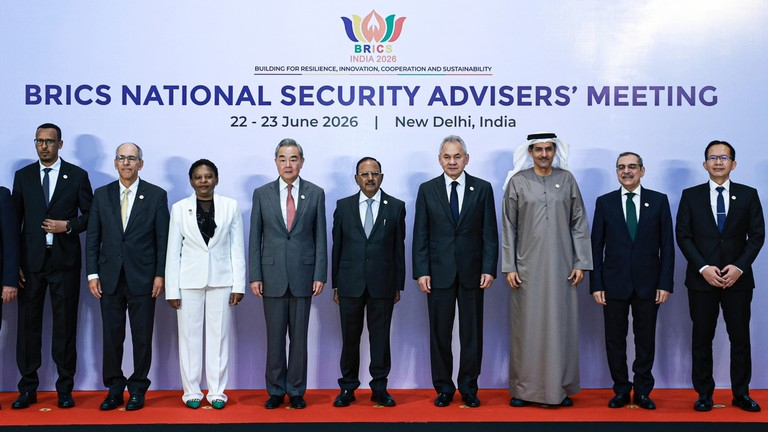
When India’s National Security Adviser Ajit Doval opened the 16th BRICS National Security Advisers’ Meeting in New Delhi on June 23, the room contained one of the more diplomatically unusual configurations in recent memory. Senior representatives present included Brazilian Secretary Carlos Marcio Bicalho Cozendey, Russian Security Council Secretary Sergey Shoigu, Chinese Foreign Minister Wang Yi, South Africa’s Minister in the Presidency Khumbudzo Ntshavheni, and the Secretary-General of the UAE Supreme National Security Council — plus Iran’s Deputy Secretary of the Supreme National Security Council. Russia and Iran, both under sweeping Western sanctions, sat across the table from Saudi Arabia and the UAE, which host American military bases that were struck by Iranian missiles just months earlier. Brazil, which has cultivated warm relations with Washington, was also present. That they all showed up — and produced a joint outcome — says something about what BRICS has become.
BRICS expanded in 2024 with Egypt, Ethiopia, Iran, Saudi Arabia, and the UAE joining as member countries, and Indonesia followed in 2025. The group now spans eleven full members and ten partner countries, representing nearly half the world’s population. What began as a dialogue among five emerging economies has now evolved into a bloc representing around 40% of global GDP and over a quarter of global trade. That scale changes what the institution can plausibly attempt.
From Finance to Security — Slowly, Deliberately
The New Delhi meeting was formally organized around the theme of “non-traditional security challenges confronting the world today.” That framing was deliberate. In the non-traditional realm, participants deliberated on challenges related to energy security, food security, supply chain security, emerging technologies utilized by terrorist networks, cybersecurity, and climate-induced instability. None of those items require a defense pact to address. All of them require sustained institutional engagement — precisely the kind BRICS is trying to build without committing to the political costs of formal alliance.
According to the official BRICS 2026 website, the grouping’s agenda has expanded significantly from its original focus on economic issues to three core pillars: political and security cooperation, economic and financial cooperation, and cultural and people-to-people exchanges. BRICS cooperation now covers a wide range of issues, including counter-terrorism, climate change, food and energy security, international financial architecture, telecommunications, agriculture, labour and employment, trade, and WTO-related matters. The security pillar is not new — it has been formally articulated for years. What is new is the urgency with which members are filling it with operational content.
The NSAs and heads of delegation reviewed the outcomes of the BRICS Joint Working Groups on Counter-Terrorism held in May 2026 and on Security in the Use of Information and Communication Technologies held in June 2026. The participants extended support to enhancing BRICS cooperation, particularly on strengthening capacities of members, enhancing information sharing, and coordinating among BRICS law enforcement agencies to counter terrorism and cyber risks collectively. These working groups represent the kind of procedural infrastructure that matters more than any declaration — the bureaucratic plumbing through which cooperation actually flows.
India’s Balancing Act at the Center
The meeting’s geopolitical subtext was managed carefully by the host. Most notably, Doval met Chinese Foreign Minister Wang Yi, with the two sides reviewing recent developments in bilateral relations and noting progress toward the “gradual normalisation” of ties. Doval underlined that stable, predictable, and constructive bilateral relations were essential for building trust and better understanding between the two countries. That language — careful, qualified, forward-looking — reflects where India-China relations actually stand: improved but still deeply complicated by border tensions, competing infrastructure projects, and divergent visions of regional order.
India’s 2026 presidency of BRICS, at a time of weakening global governance, protectionist policies, and heightened uncertainty, carries renewed hopes and expectations of collaboration, governance, and delivery. New Delhi has chosen to lead through process rather than ideology — pushing for counter-terrorism language, demanding FATF compliance standards, and insisting that security cooperation remain grounded in practical outcomes rather than geopolitical posturing. That approach suits India’s dual position as a BRICS member that also conducts more military exercises with the US than any other country, maintains deep defense ties with Russia, and is simultaneously rebuilding its relationship with China.
During the interaction, PM Modi said BRICS is a key platform for strengthening security cooperation in a time of rapid global change. The framing is inclusive rather than oppositional — a deliberate contrast with the China-Russia framing that treats BRICS primarily as a counter-Western instrument. Whether India can hold that framing as the bloc grows and geopolitical pressures intensify is an open question.
What the Meeting Did Not Resolve
The room’s diversity is both BRICS’ greatest asset and its most significant constraint. Unlike military alliances that require members to adopt common political positions, the group operates primarily through consensus-building among states with diverse interests. Agreement is therefore often narrower but potentially more durable because it emerges through negotiation rather than bloc discipline. That design philosophy produces agreements that everyone can sign — and that therefore commit no one to very much.
The Iran war’s aftermath hung over the meeting without being named in the official outcome document. The latest BRICS gathering came after a G7 summit in France and the US-Iran negotiations in Switzerland. Several member states — Russia, China, Iran — favor narratives of external intervention and sovereignty violation. Others — India, Saudi Arabia, the UAE — have more complex relationships with both Iran and the Western coalition that struck it. Analysts noted that “the old ‘center-periphery’ order monopolized by a handful of Western powers is giving way to a new model featuring extensive consultation, joint contribution and shared benefits,” while “the Global South, once the silent majority on the international stage, is moving toward the center of global governance.” That is a description of a direction, not an arrival.
September in New Delhi
The 18th BRICS Summit is scheduled for September 2026 in India. The security working groups, the NSA meeting’s outcomes, and the bilateral conversations on the margins of New Delhi all feed into that gathering. For the first time, security cooperation is expected to feature as a primary agenda item at the leaders’ level rather than as a procedural footnote.
At the 15th BRICS Summit, after its expansion, the leaders called BRICS the pillar of the “New World Order.” The challenge before India, however, is to choose between a China-centric or a West-centric world order — or to balance the two. That challenge is not unique to India — it is the central tension facing most BRICS members. The New Delhi NSA meeting demonstrated that the group can meet, deliberate, and produce institutional outcomes even when members hold fundamentally different views on the most consequential conflicts of the moment. Whether that capacity for managed disagreement can produce something durable at the leaders’ summit in September remains to be seen. The question worth asking is not whether BRICS will become a military alliance — it will not — but whether it can build enough operational substance to matter when the next crisis arrives.
Original analysis inspired by Ladislav Zemánek from RT (Russia Today). Additional research and verification conducted through multiple sources.