The handshake never happened. When Felix Tshisekedi and Paul Kagame met in Washington in December 2025 to re-sign what the Trump administration billed as a historic peace agreement ending four years of war in eastern Congo, the two presidents refused to acknowledge each other physically. Within days, Rwandan-backed M23 forces had captured Uvira, the last major urban center north of the mineral-rich Katanga region. The ceremony had barely concluded before the conflict it was meant to close had escalated again.
Seven months later, the deal that Trump called historic is visibly coming apart. The fighting has not stopped. Congo’s president is consolidating power in ways that alarm his own constitutional order. And the mineral supply chains Washington hoped to redirect away from Chinese dominance remain, overwhelmingly, in Chinese hands.
The Logic That Produced Quick Results
The Trump administration’s Congo intervention was genuinely unconventional — and in the early stages, usefully so. Previous administrations had struggled to pressure Rwanda over its backing of the M23 rebel group, partly because the Pentagon maintained strong ties with the Rwandan military and Western governments broadly admired Rwanda’s economic development record under Kagame.
Trump’s team bypassed that institutional inertia. Massad Boulos, appointed as senior adviser for Africa in April 2025, brought no prior government experience but operated with the perceived authority of someone with direct presidential access. Working across diplomatic, commercial, and political domains simultaneously, Boulos organized talks between Kinshasa and Kigali within weeks of his appointment and helped secure the withdrawal of M23 forces from the area surrounding a US-owned tin mine — a concrete early result that career diplomats had failed to achieve.
The economic architecture built alongside the diplomatic push was ambitious. The US International Development Finance Corporation backed a joint venture between Congo’s state mining company Gécamines and Swiss commodity trader Mercuria to route cobalt, copper, and other critical minerals toward the US market. New York-based consortia signed memoranda to acquire stakes in Glencore’s Congolese copper and cobalt assets. The pitch from Congolese officials, delivered privately, was direct: “Get Rwanda off our back, and we will give you minerals.”
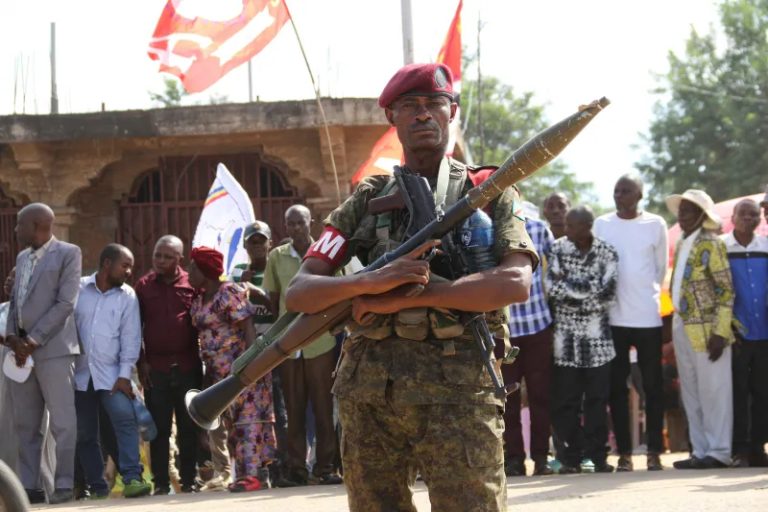
Washington levied sanctions on Rwanda’s defense forces and several senior officers, and Congo delivered its end of the bargain quickly. The problem is that Rwanda appears to have calculated it can weather the punishment. Rwanda’s withdrawals appear largely tactical, and fighting has continued between the M23 and the Congolese army, with both sides now deploying drones that are killing civilians. In March, a Kinshasa-authorized drone strike in Goma killed a UNICEF humanitarian worker.
The Authoritarian Drift Washington Is Enabling
The more immediate danger is what American pressure is doing to Congolese politics. Tshisekedi began signaling interest in revising the constitution in October 2024, potentially to allow himself a third term beyond his 2028 limit. Since Washington’s sanctions on Kigali, his coalition has accelerated that push — cracking down on opposition figures and critics with growing confidence.
Members of his administration have told researchers, without apparent concern, that they believe Trump will accept a third Tshisekedi term in exchange for continued minerals access and other concessions — including hosting migrants expelled from the United States, a first wave of whom arrived in Kinshasa in April. The Trump administration has made clear it has little interest in human rights conditions. That signal has been received precisely as intended.
The risk is structural. Congo’s security services are weak and fractured. Unaccountable governance in Kinshasa will fuel opposition, and the only message Washington is currently sending to moderate Congolese opposition figures is that extralegal means are the only way to remove an entrenched president. Pushing those figures toward armed movements is not a stability strategy. It is a slow-motion destabilization.
Washington has also sent contradictory signals to Rwanda. Since escalating sanctions on Kigali, the administration simultaneously announced $158 million in healthcare assistance to Rwanda and signed a memorandum on strategic civil nuclear cooperation — precisely the kind of mixed messaging that tells an adversary the pressure is neither serious nor sustained. Rwandan officials appear to have drawn the obvious conclusion: wait out the punishment and wait for Trump to lose interest.
The China Problem Nobody Has Solved
The minerals rationale for Washington’s engagement is real — Congo holds some of the world’s largest reserves of cobalt and copper, both critical to electric vehicle batteries and defense applications. China currently controls roughly 80% of cobalt refining capacity globally, and more than two-thirds of Congo’s copper and cobalt exports flow directly to Chinese buyers.
But the scale of Chinese industrial presence in Congo is not something US deal-making can displace quickly. Over half the continent’s bauxite, manganese, tantalum, and tungsten exports follow the same Chinese route. Because industrial refining and manufacturing capacity is overwhelmingly concentrated in China, signing memoranda with US-based consortia to acquire mining stakes does not automatically redirect the supply chain. The next stage — processing raw material into battery-grade product — still happens in China. Without massive parallel investment in refining infrastructure, “US-aligned minerals” is a political category more than an economic reality.
This is the central tension in Washington’s Congo strategy. The [suspicious link removed] — a project to modernize port infrastructure and 800 miles of Angolan railroad connecting the copper and cobalt belts to the Atlantic — is a genuinely significant infrastructure investment that could over time reduce dependence on Chinese logistics. But infrastructure of that scale takes years and decades to produce strategic results, not months. The Trump administration’s timeline is political. Congo’s geography and China’s entrenched position are not.
What a Longer Game Would Require
The State Department’s Africa Bureau was led by acting officials for the first 16 months of the Trump administration, and Washington currently has no confirmed ambassador in 39 of its 52 embassies across the continent, including in Kinshasa and Kigali. That absence compounds every other weakness in the policy. Complex sustained diplomacy — the kind that requires tracking dozens of armed groups, managing constitutional crises, and balancing sanctions pressure with economic incentives — cannot be run through a single presidential envoy, however energetic.
Breaking with previous approaches to African diplomacy was not inherently wrong. Reining in Rwanda was a necessary precondition for any genuine peace process, and on that narrow point the administration made progress that its predecessors had not. But early wins built on transactional shortcuts tend to unravel when the underlying incentives have not fundamentally changed.
For the peace process to hold, Congo needs to be pressed as hard as Rwanda — specifically to abandon its demand that M23 disarm before talks begin, a maximalist position that Rwanda has no incentive to accept. And Kinshasa needs to hear clearly that Washington opposes constitutional revision and a third presidential term. That message has not been delivered. Until it is, Tshisekedi’s government has every reason to interpret American engagement as a green light for consolidating power while the mineral deals are signed.
A transactional approach that prioritizes speed over substance, and access over accountability, may produce ceremonies. It is unlikely to produce peace.
Original analysis inspired by Joshua Z. Walker, Reagan Miviri and Jason K. Stearns from Foreign Affairs. Additional research and verification conducted through multiple sources.