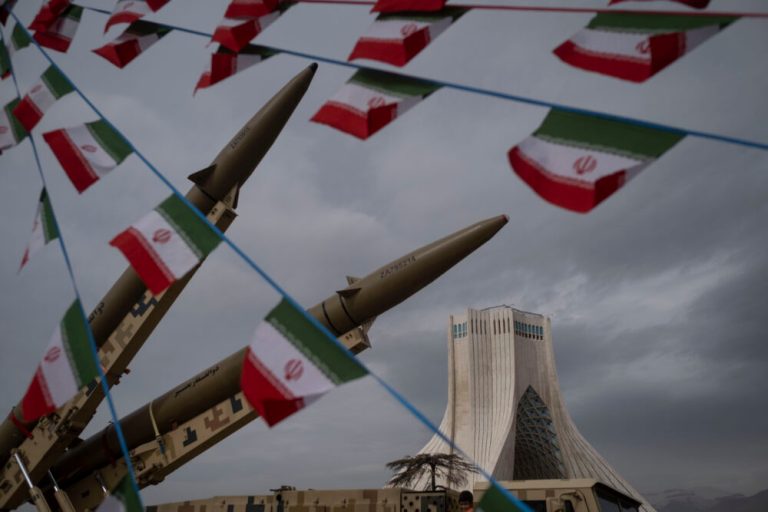
The ceasefire agreement with Iran addresses the nuclear file, sets a 60-day negotiating window, and says almost nothing about the missile program. That omission may prove to be the most consequential gap in the entire framework. Iran entered the 2026 war with the largest ballistic missile arsenal in the Middle East. The US-Israeli campaign roughly halved that inventory — but Tehran retains thousands of short-range systems capable of reaching every Gulf state, and more than a thousand medium-range missiles with the range to hit Israel and parts of central Europe. More importantly, it retains the factories, the engineers, and the institutional knowledge to rebuild. Between the June 2025 twelve-day conflict and the February 2026 war, Iran replaced approximately 1,000 missiles in roughly eight months — a production rate that startled American and Israeli intelligence analysts who had assumed the earlier strikes had set the program back further.
This is the problem that no one in the current negotiation has yet solved, and possibly has not yet seriously engaged. The MOU signed in June 2026 covers enrichment, sanctions relief, asset unfreezing, and a framework for nuclear talks. It contains no reference to ballistic missiles, no mention of Iranian proxy arms transfers, and no mechanism for constraining the reconstitution of the missile-industrial base that US and Israeli forces spent 39 days trying to destroy. Washington may have missed its only window to bring the missile file into the negotiating frame while it still had leverage — and the 60-day clock is already running.
Why Missiles Are Harder to Verify Than Bombs
The nuclear verification architecture rests on a foundation that took decades to build: the Nuclear Non-Proliferation Treaty, standardized fissile material accounting, and the IAEA as a permanent inspection body with legal standing. None of those pillars exist for ballistic missiles. The Missile Technology Control Regime and the Hague Code of Conduct are voluntary arrangements with no intrusive inspection provisions and no enforcement teeth. A state can possess and build as many missiles as it likes without violating any binding international norm.
The technical challenge compounds the political one. Nuclear verification works, in simplified terms, because fissile material is scarce, physically measurable, and difficult to conceal in large quantities. Missiles have no equivalent chokepoint. They are mobile, can be dispersed across hundreds of sites, are frequently produced in facilities that also serve civilian purposes, and can be reconstituted even after large-scale destruction. The closest functional analogue to fissile material in the missile domain is solid rocket propellant — specifically, the ammonium perchlorate and polymer binders used in Iran’s most advanced systems, which require specialized mixing and curing equipment that creates identifiable industrial signatures. But even that analogy breaks down: precursor chemicals have widespread civilian applications, can be stockpiled in dispersed locations, and represent only one component of a production chain that also includes airframes, guidance systems, and launch infrastructure.
Iran’s specific characteristics make it one of the hardest verification cases in the world. Its facilities are geographically dispersed and embedded within dual-use industrial sectors. Its fleet of solid-fuel systems — the Fateh-110, Shahab-3, and Sejjil families — can be launched with minimal preparation time, reducing the window for detection. And it has built an extensive network of underground “missile cities,” tunnel complexes explicitly designed to survive bunker-buster strikes, whose entrances were repeatedly collapsed during the 2026 campaign only to be rapidly excavated and restored.
Three Historical Warnings
The historical record on missile verification offers three cases worth examining, each pointing to a different failure mode. Iraq under UNSCOM demonstrated that even highly intrusive inspection regimes can be systematically circumvented through denial and deception — falsified records, dispersed equipment, and exploitation of political divisions within the Security Council that delayed enforcement. The lesson is that inspectors must assume concealment as a baseline condition, not an exception.
North Korea represents the collapse scenario. The absence of sustained verification after the 1994 Agreed Framework allowed Pyongyang to develop progressively more capable systems — solid-fuel missiles, road-mobile launchers, and eventually ICBMs — largely unhindered. By the time the international community recognized the scale of the program, the verification window had closed. Libya offers the only genuinely optimistic precedent: cooperative rollback in 2003, when Gaddafi’s decision to disclose and permit access enabled rapid verification and dismantlement. But Libya’s capabilities were far more limited than Iran’s, and no serious analyst expects Tehran to replicate that degree of voluntary transparency.
A Seven-Layer Architecture
A workable verification model for Iran’s missile program would need to operate on the assumption of partial non-cooperation — robust enough to detect violations even without full Iranian disclosure. The framework proposed by the Middle East Institute builds seven layers. Comprehensive baseline declarations, requiring Iran to identify every missile and launcher by serial number and location, provide the foundation. Test and launch monitoring — with mandatory advance notification and telemetry sharing — would constrain qualitative improvements in range, accuracy, and payload. Intrusive on-site inspections, including challenge inspections with a 12 to 24-hour access window rather than the CWC’s 120-hour standard, would address the gap between declared and actual capabilities. Quantitative caps based on MTCR criteria — restricting systems capable of carrying a 500-kilogram payload beyond 300 kilometers — combined with production controls focused on solid-fuel manufacturing, would limit reconstitution speed. A standing verification mechanism with pre-agreed, automatic enforcement triggers would close the political loophole that sank earlier regimes when Security Council divisions blocked responses to violations. Regional confidence-building measures — launch notification hotlines, data exchanges, incident-clarification channels — would provide early warning of breakout activity.
The honest assessment is that not all of these elements will survive negotiation with Tehran. Iran has consistently treated its missile program as a non-negotiable defensive asset and secured implicit recognition of that position in the current MOU framework. The political obstacles are larger than the technical ones. But establishing a comprehensive benchmark matters precisely because negotiators need something to measure tradeoffs against. A deal that addresses the nuclear file while leaving the missile program entirely unconstrained does not eliminate the threat that triggered the war — it defers it.
Original analysis inspired by Chuck Freilich from the Middle East Institute. Additional research and verification conducted through multiple sources.