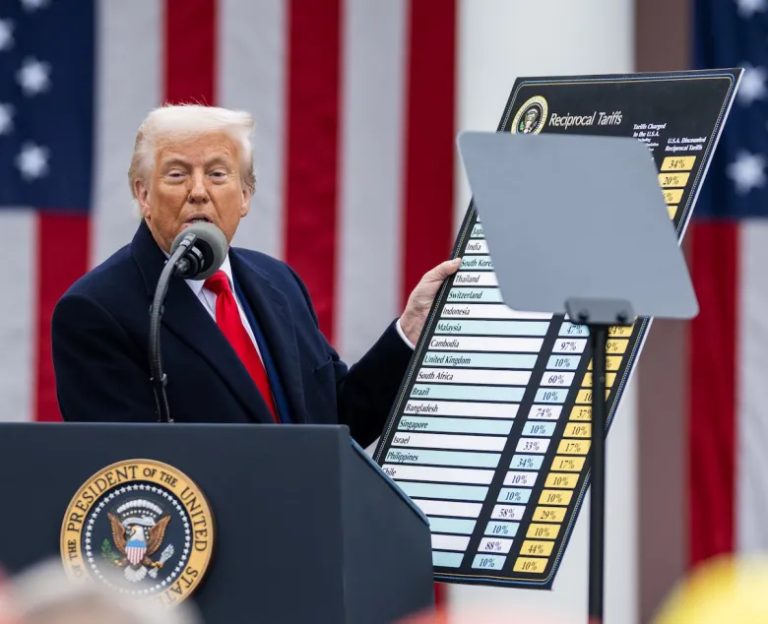
The US Supreme Court struck down Donald Trump’s “Liberation Day” tariffs in February 2026 on the grounds that the International Emergency Economic Powers Act does not authorize the imposition of tariffs. The ruling was brief, categorical, and seemingly final. Trump treated it as a logistical inconvenience. Within days, his administration had invoked Section 122 of the Trade Act of 1974 to slap a 10 percent surcharge on roughly $1.2 trillion worth of annual US imports, while simultaneously launching Section 301 investigations into 60 economies across 86 countries covering both excess manufacturing capacity and forced labor practices. The tariff wall is being rebuilt through a different legal door, and Asia is directly in its path — at precisely the moment it can least afford it.
The Trump tariffs represent the largest US tax increase as a percentage of GDP since 1993, amounting to an average tax increase per US household of $1,500 in 2026. But the numbers in Washington are almost beside the point when measured against the damage already accumulating across Asian economies. Since the US and Israel began their air campaign against Iran in late February, oil has traded stubbornly close to $100 a barrel, Asian currencies have cratered, and fertilizer costs have spiraled. The tariff announcement lands on top of all of that like a second body blow on a fighter who has not yet recovered from the first.
A Currency Rout Nobody Can Stop
The rupee hit an all-time low of 96.84 in May, the Indonesian rupiah fell below its 1998 crisis level, and the Korean won sank to a 17-year low. These are not isolated wobbles — they reflect a structural vulnerability that the Iran war has torn open. The rupee and rupiah were hit most directly through the oil bill, while the yen and won were already weak on Japan’s rate gap and Korea’s capital outflows, with oil only adding to the strain.
Japan’s situation is particularly acute. The country imports over 95 percent of its oil from the Middle East, meaning every week the strait stays disrupted translates directly into higher domestic inflation. The Bank of Japan has been mounting its most aggressive defense of the yen since 1991, and the government has publicly warned that it stands ready to intervene against speculative trading. What makes this especially painful is structural: Japan’s weak-yen policy, entrenched since the Abenomics era of the 2010s, has made the economy chronically exposed to import cost shocks. Food is heavily import-intensive — from feed grains to fertilizer to energy inputs for processing — meaning that an oil spike rapidly becomes a food price problem in a country already dealing with stubborn consumer inflation.
Indonesia’s currency crisis carries different but equally alarming characteristics. Even the rupiah, the closest thing to a 1997 echo, is falling on a loss of confidence in government policy, not a debt spiral. President Prabowo Subianto’s administration has been systematically weakening Bank Indonesia’s independence since taking office — first by removing Finance Minister Sri Mulyani Indrawati in September 2025, then by pushing parliament to amend BI’s mandate to explicitly include economic growth targets, effectively opening the door to political pressure on rate decisions. Currency markets read that as a signal that Indonesia’s monetary anchor is drifting, and they have responded accordingly.
The Section 301 Mechanism and What It Means
The Trump administration has launched multiple Section 301 investigations, each of which will likely result in tariffs to replace the Section 122 tariff regime expiring in late July. These investigations mark an unprecedented use of Section 301, as there have never been this many simultaneous investigations on this many countries.
The first investigation, announced on March 11, accused 16 global economies of maintaining excess manufacturing capacity. The majority of countries targeted are in Asia, including regional giants like Japan and China, and Southeast Asian nations like Singapore, Vietnam, Thailand, Malaysia, and Cambodia. The second probe covers forced labor — sweeping up China, India, Indonesia, South Korea, Taiwan, and dozens of others under a single investigatory framework that the International Chamber of Commerce has criticized for creating “significant compliance uncertainty for businesses operating in global supply chains.”
The first Trump administration investigated foreign trade practices under Section 301 six times, with two probes into China and the EU resulting in the imposition of tariffs. Subsequent reviews cast substantial doubt on the effectiveness of these actions. China did not fundamentally alter its industrial policies in response to first-term tariffs — it adapted its export routing, accelerated domestic substitution, and leveraged its position in rare earth supply chains to push back. There is little reason to expect a different result now, particularly when China’s negotiating posture has been strengthened by its role as a stable economic partner to the very Gulf states whose oil markets the US war just disrupted.
Allies Are Not Amused
Most Asian governments named in the Section 301 investigations have trade agreements with the Trump administration and will want to know how a Section 301 case determination might affect them. Japan faces a proposed 12.5 percent levy despite having negotiated what it believed was a capped arrangement. Australia has described any new tariffs as “unjustified and inconsistent” with its existing free trade agreement. The EU has called the measures “unjustified” and warned that its own bilateral agreement with Washington — still being ratified — could collapse if tariffs stack on top of existing most-favored-nation rates.
That stacking question is the critical unknown. If finalized as proposed, the new Section 301 tariff action would reinstitute tariffs on those countries’ goods on what the Trump administration claims to be a more durable basis, with Section 301 tariff actions subject to review every four years. If the new levies stack on top of existing duties — as they do in the China-specific regime — the EU agreement becomes unworkable and the political cost of retaliation rises sharply. Washington probably understands this, which is why analysts expect the administration to hold the effective rate at 15 percent. But the uncertainty itself is damaging: businesses in export-dependent Asian economies cannot make investment and sourcing decisions when the tariff floor could shift again within months.
At the household level, the cumulative tariff burden amounts to an average tax increase of $1,500 per US household in 2026 — a figure that will show up in grocery store receipts and gas prices, not abstract trade statistics. Trump’s own base felt this directly in late 2025, when the administration quietly backed down on tariffs covering bananas, coffee, and beef after domestic pushback. That political pressure has not disappeared. It has simply been deferred by the drama of the Iran war, and it will return the moment commodity prices stop falling. For Asian exporters watching Washington from Tokyo, Jakarta, and Mumbai, the question is not whether the tariff regime will create political backlash at home — it already has. The question is whether that backlash arrives before or after the damage to their own economies is done.
Original analysis inspired by William Pesek from Asia Times. Additional research and verification conducted through multiple sources.