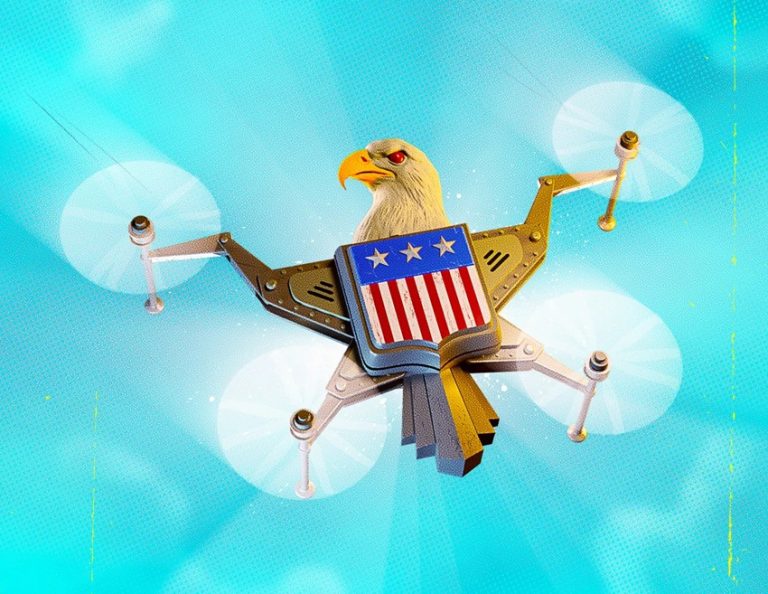
The US-Iran conflict that ran from late February to early April 2026 was supposed to showcase American military dominance. In some ways, it did — over 13,000 airstrikes, a sustained bombing campaign, unmatched logistics. But Iran hit back hard, launching more than 2,200 missiles and 4,400 drones across 39 days. At least eight US aircraft were damaged or destroyed. Seven service members were killed. The Strait of Hormuz remains effectively in Iranian hands. For the world’s most powerful military, that is not a score anyone expected.
The harder truth the conflict revealed is structural, not tactical. The United States built its military advantage on technologies it controlled — stealth aircraft, precision munitions, satellite networks. That era is ending. Drones and artificial intelligence, the two technologies now reshaping warfare, are not American monopolies. They never will be. And the Pentagon is not yet equipped to fight the war that is coming.
The Drone Gap Is Real and Widening
The numbers tell the story bluntly. Ukraine produced an estimated four million robotic and autonomous systems in 2025 and is on track to produce between five and six million in 2026. The United States, with an economy 140 times larger, cannot come close. The Pentagon’s drone dominance effort, which its test directors describe as a challenge to industry to deliver drones at scale, had shipped fewer than 3,000 of the 22,320 systems ordered as of recent reporting.
This is not a funding problem alone — it is a structural one. The Pentagon’s Replicator initiative, launched in 2023 to field thousands of low-cost autonomous systems within two years, became the clearest symptom of the dysfunction. Although Replicator was intended to field thousands of uncrewed systems by summer 2025, one former defense official noted that DoD had fielded only hundreds by that time. Persistent technical issues, including systems glitches and problems integrating Replicator systems with existing command structures, slowed the initiative’s progress, with some systems proving unreliable or too expensive to buy in the necessary quantities.
The economics of this failure are punishing. Ukrainian FPV drones often cost between $300 and $500, far below Western equivalents, while long-range strike drones are produced at a fraction of the cost of US or European systems. Meanwhile, every Patriot missile fired at an Iranian Shahed drone costs roughly $4 million to intercept a target that may have cost $35,000 or less. The United States used roughly half its Patriot stockpile and between 50 and 80 percent of its THAAD interceptors during the Iran campaign alone. Replenishing those reserves will take years and will leave forces in Asia and Europe exposed in the meantime.
The battlefield implications go well beyond cost. What the Ukraine-Russia war has shown is that the front lines of a conflict over territory are now effectively robot-on-robot. Drones have supplanted artillery as the leading cause of casualties in that war. The same dynamic — cheap, expendable systems hunting expensive ones — played out visibly in the Iran conflict. US rear bases, long considered safe, became targets. A single E-3 Sentry early warning aircraft, part of a fleet of just 15, was destroyed. That loss is irreplaceable on any short timeline.
The AI Race Is Closer Than Washington Admits
The official American narrative on artificial intelligence frames it as a race Washington is winning comfortably. The evidence is more ambiguous. While Silicon Valley retains a slight edge in developing the most advanced models, Chinese companies have “effectively closed” the AI performance gap with their US rivals, according to the Stanford AI Index 2026. According to Demis Hassabis, CEO of Google DeepMind, China’s leading AI models are now “just a matter of months” behind the top-tier Western systems.
The technique enabling this convergence is adversarial distillation — Chinese firms essentially extracting capabilities from American models and replicating them at a fraction of the cost. DeepSeek’s R1 model alarmed investors when the company revealed it had taken only two months, and less than $6 million, to build using lower-capacity chips. That process sent shockwaves through Silicon Valley in early 2025 and forced a rethink of the assumption that massive compute spending would guarantee an enduring American lead.
Export controls on advanced semiconductors remain Washington’s sharpest tool for slowing Chinese AI development. But the Trump administration’s January 2026 decision to approve Nvidia H200 chip sales to China undermined that logic significantly. Every chip sold to a strategic competitor represents a direct transfer of the capacity to train more powerful models. DeepSeek partnered with Huawei, which confirmed its AI computing cluster powered by Ascend AI processors can support the V4 model — a sign that China is actively building domestic alternatives that bypass American chip dependencies entirely.
The Human Problem Inside the Pentagon
Technology gaps can be closed with money. Cultural gaps are far harder. Each US military service approaches drones through the prism of its own identity. The Air Force long resisted treating drone operators as anything other than pilots, slowing automation in flight controls and limiting who could operate the systems. The Navy downgraded its carrier-based combat drone program to a tanker role — effectively sacrificing striking range to protect crewed aircraft jobs. These are not engineering failures. They are institutional ones.
The Pentagon’s dispute with Anthropic illustrates a parallel problem on the civilian side. The Pentagon wanted unrestricted use of AI, whereas Anthropic wanted guardrails to prevent its technology from being used for domestic mass surveillance and autonomous weapons — and because Anthropic refused, the DoD branded it a “supply chain risk,” a designation normally reserved for foreign adversaries. OpenAI’s decision to sign a Pentagon deal, coming after the company had publicly stated it supported Anthropic’s red lines, sparked employee dissent, customer boycotts, and at least one senior resignation. The US military cannot afford to alienate the engineers building the tools it needs to fight its next war.
What is emerging from the Iran conflict is a portrait of an institution that dominated the last era of warfare so thoroughly that it forgot to prepare for the next one. The corrective is not simply buying more drones or signing more AI contracts. It requires rethinking command structures built for hierarchical human control, building drone production capacity that does not yet exist at scale, and treating partnerships with the technology sector as a strategic necessity rather than a transactional convenience. The window to do this is narrowing. DeepSeek’s own technical paper concedes that its latest model trails state-of-the-art frontier models by approximately three to six months — and that actual gap may be widening as US firms use AI to accelerate next-generation model development. The lead exists. The question is whether the Pentagon can act before it disappears.
Original analysis inspired by Paul Scharre from Foreign Affairs. Additional research and verification conducted through multiple sources.
By ThinkTanksMonitor