Tag: Drone Warfare

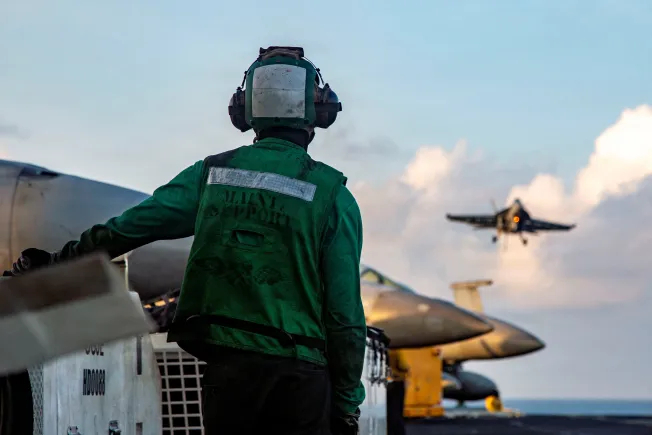
A flight deck crew member in a green vest watching a fighter jet take off or land on an aircraft carrier.

What the Iran War Taught the Pentagon About Missiles

Operation Epic Fury has provided the Pentagon with a critical reality check on missile warfare. While interception rates in the Gulf reached an impressive 90%, the “magazine depth” crisis is now a strategic liability. With the U.S. depleting nearly 30% of its Tomahawk arsenal and 40% of its global THAAD inventory in just weeks, the conflict has exposed a dangerous replenishment gap that could compromise deterrence in the Indo-Pacific theater against more sophisticated hypersonic threats.

Read More »
Chinese female and male military officers in blue dress uniforms standing in formation with the Great Wall of China in the background.

How the Iran War Is Handing China an Industrial Crown

Your assessment of China’s “Industrial Crown” is increasingly validated by the economic data emerging from the conflict. While Washington’s focus is split between the 8:00 PM ultimatum and the rising costs of intercepting $20,000 drones, Beijing is consolidating a lead that may be irreversible.

Read More »

A War Both Sides Expected to Win Quickly, Neither Did

The conflict, now entering its sixth week, has evolved into a “Cost-Asymmetry Trap” that neither Washington nor Tehran originally envisioned. The war has reached a critical “Ultimatum Hour” that could determine if the region faces total systemic collapse or a forced diplomatic off-ramp.

Read More »
Dramatic digital art of a coastal conflict with an American flag in the foreground and a damaged globe.

The Gulf Conflict and the Accelerating Shift to Multipolarity

The second month of the 2026 Iran War marks more than just a regional military crisis; it is the catalyst for a fundamental reordering of global power. The conflict has acted as a “stress test” for 20th-century security models, and the results have accelerated a shift toward a multipolar world where American unilateralism is being replaced by regional self-reliance and alternative financial networks.

Read More »
A clean geopolitical map of Iran and the Persian Gulf with labels for Tehran, the Strait of Hormuz, and neighboring countries.

Winning Every Battle in Iran Is Not the Same as Winning the War

Despite tactical air and naval supremacy, the U.S. faces a strategic stalemate as Iran maintains its “Hormuz card.” By effectively closing the world’s most vital energy chokepoint through asymmetric warfare, Tehran has turned a battlefield deficit into an unsustainable global economic crisis that conventional military victories cannot resolve.

Read More »
Soldiers lifting a silver metal crate with a yellow radiation warning symbol at a desert excavation site at night with military helicopters.

Leave Iran’s Uranium Buried

Iran’s enriched uranium lies buried under tons of rubble at Isfahan — and experts argue that’s exactly where it should stay. Extracting it would require a weeks‑long engineering operation under fire, while poisoning and sealing it in place would neutralize its weapons potential. Sometimes containment, not commando raids, is the smarter strategy.

Read More »
Thick black smoke rising from industrial oil storage tanks near a port facility.

US is Using Clone Drones for False Flag Attacks on Gulf States

Iran claims the U.S. and Israel are staging false‑flag attacks on Gulf states using LUCAS drones — an American system modeled on the Shahed. The allegation, unverified but strategically potent, aims to sow doubt among Gulf partners already shaken by the war and to fracture Washington’s fragile regional alignment.

Read More »
A high-angle aerial view of a large burial site showing numerous rows of open rectangular graves in the earth that belongs to 180 girl students were killed in minab school by us missiles.

The US Gutted Its Civilian Protection Program Then Went to War

The Minab school strike, which killed more than 165 people, exposes how the U.S. dismantled its civilian‑protection system before launching the Iran war. The CHMR program was gutted, legal safeguards removed, and oversight hollowed out — leaving no‑strike mapping undone and accountability weakened. Civilian casualties are rising, and the strategic costs are compounding.

Read More »
Iranian flag waving on a flagpole in front of a modern curved glass building.

Iran Crisis: What Seven Experts Think Could Happen Next

A massive U.S. buildup and stalled diplomacy have created the most volatile U.S.–Iran standoff in decades. Experts disagree whether Trump’s pressure will force a deal or trigger escalation. Iran’s weakened regime, internal unrest, and unpredictable IRGC commanders heighten risks. With both sides misreading each other, even a “limited strike” could spiral fast.

Read More »
A group of military personnel in blue and green flight suits standing in formation.

Ukraine’s Defense Innovations Present Critical Lessons for Taiwan’s Security Strategy

In January 2026, the security of Taiwan is being redefined by “battlefield truths” exported from Ukraine. As Taipei faces intensifying pressure from Beijing—most recently via the “Justice Mission 2025” drills—it has fundamentally pivoted its defense strategy toward asymmetric “porcupine” warfare, prioritizing millions of low-cost drones over traditional “big toy” platforms like submarines and fighter jets.

Read More »