No country has done more to shape organized crime than the one that spent a century trying to eradicate it. The United States absorbed criminal traditions from across the world through mass immigration, ran them through the pressure cooker of Prohibition, helped export the results through foreign policy and drug enforcement, and finally handed the whole mythology to Hollywood. What came out the other end was not just the American Mafia — it was a template that criminal organizations across the planet would adopt, adapt, and internalize as their own.
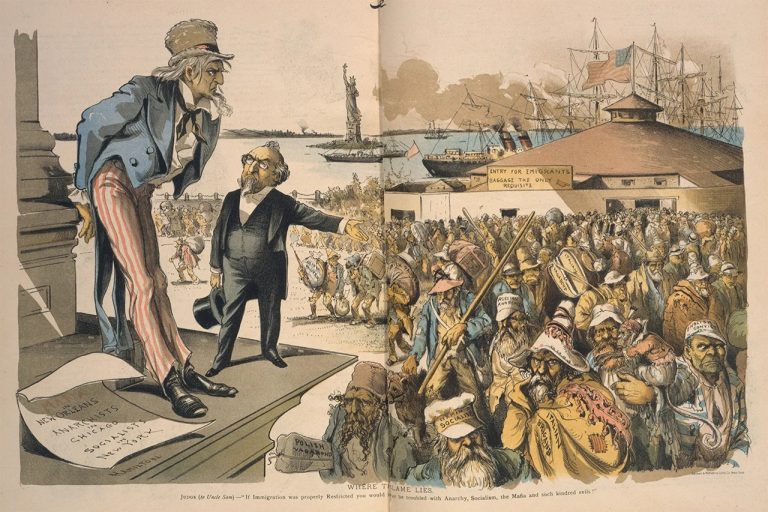
The word “mafia” itself arrived in American newspapers in the 1870s, framed as a Sicilian secret society threatening to contaminate the republic. Nativists seized on the 1891 New Orleans lynchings — where eleven Italian men were killed after being accused of murdering the city’s police chief — as proof that immigrants were importing criminal conspiracies along with their luggage. The panic generated more heat than light. Scattered Italian gangs in American cities barely resembled the Sicilian model, and the menace largely faded. Then came Prohibition.
Prohibition practically created organized crime in America, providing small-time street gangs with the greatest opportunity ever — feeding a nationwide demand for alcohol at scale. The supply chains that bootlegging required were genuinely transnational: Canadian liquor, Caribbean rum, European wine — all had to reach American consumers through coordinated networks that crossed borders and bought off officials. The Chicago Outfit rose to power in the 1920s under Johnny Torrio and Al Capone, marked by bloody gang wars for control of illegal alcohol distribution. By the time Prohibition ended in 1933, Lucky Luciano had instituted a new organization for crime family chiefs across the nation, known as the Commission, which operated like a corporate board of directors. The structure was less Sicilian secret society and more American corporation — bureaucratic, territorial, profit-driven.
The International Pipeline
The Bonanno family and their New York peers soon pushed that logic overseas. The French Connection was a scheme through which heroin was smuggled from Indochina through Turkey to France and then to the United States and Canada; the operation started in the 1930s, reached its peak in the 1960s, and was responsible for providing the vast majority of heroin used in the United States at the time. A kilogram of heroin that cost $4,500 in Marseille could be sold for $230,000 on American streets, with hundreds of kilograms flowing in monthly. Key partners included the Bonanno, Gambino, and Lucchese crime families, which controlled importation logistics and allocated territories for street-level distribution across East Coast cities. This was not a rogue operation — it was international commerce conducted with the organizational logic of a Fortune 500 company.
Washington, meanwhile, was constructing its own global infrastructure to fight back. Harry Anslinger served as Commissioner of the Federal Bureau of Narcotics from 1930 to 1962 and became a leading proponent of repressive anti-drug measures in the United States and worldwide. His approach was expansionist by design. Anslinger signed the Geneva Limitation Convention in 1931, which placed international limits on the manufacture of heroin, morphine, and cocaine, and required offices for national drug control in each signatory country. From Mexico to Turkey to Thailand, the DEA’s predecessor built a constellation of overseas offices and pressured foreign governments to adopt American-style narcotics enforcement. Anslinger is widely credited with shaping not only America’s domestic and international drug policies but influencing the drug policies of other nations, particularly those that had not debated the issues internally.
Richard Nixon later turbocharged this model. His 1971 declaration of a war on drugs gave the approach a Cold War urgency and a global mandate. The French Connection was eventually broken up by French and American authorities in the early 1970s, in the context of Nixon’s war on drugs campaign. By 2000, 120 nations had signed the UN Convention Against Transnational Organized Crime — in Corleone, Sicily, as if to close a loop that nobody had planned.
The Story That Stuck
The legal architecture mattered, but the cultural one mattered more. In October 1963, Joseph Valachi became the first member of the American Mafia to publicly acknowledge its existence and describe its inner workings to a captivated American audience during televised Senate hearings. At the hearings, Valachi is credited with popularizing the term “cosa nostra”. The book those Valachi hearings inspired — The Valachi Papers by Peter Maas — handed Mario Puzo the raw material for The Godfather. Valachi’s life and death inspired subsequent movies and novels exploring organized crime in America, and his testimony was an important source of inspiration for The Godfather by Mario Puzo.
The Godfather‘s release in 1972 set off a chain reaction with no geographic limit. Criminal bosses in France, Mexico, and Turkey stopped using their own local titles and began calling themselves godfathers — parrain, padrino, baba. Before Valachi’s testimony circulated globally, Sicilian criminals did not refer to their organization as La Cosa Nostra; after Italian papers printed his words, they adopted the name without hesitation. The Yakuza, historically Japan’s dominant criminal fraternity, embraced the look of the Hollywood gangster after World War II. Some Mexican cartels reportedly require new recruits to watch the Godfather trilogy as a form of professional orientation.
What this history shows is something rarely acknowledged in polite company: the United States did not merely react to organized crime — it helped construct the concept. It imported criminal traditions, industrialized them under Prohibition, built a global enforcement apparatus that simultaneously spread the American model of policing and the American mythology of the mob, and then watched Hollywood send that mythology everywhere else. The Mafia’s global reach today is inseparable from its American chapter. The product and the brand were made in the same place.
Original analysis inspired by Ryan Gingeras from The Washington Post (originally published via Foreign Policy). Additional research and verification conducted through multiple sources.
By ThinkTanksMonitor