The diplomatic fiction that everything is fine between Washington and New Delhi became harder to sustain after three Indian sailors died on June 9. U.S. forces struck the Palau-flagged tanker Settebello in the Gulf of Oman, killing the crew members in what the Pentagon described as enforcement of the ongoing blockade on Iranian-linked shipping. Indian External Affairs Minister S. Jaishankar called Secretary of State Marco Rubio three days later to register what New Delhi formally termed a “strong protest.” Rubio’s public response offered no apology, no regret, and no assurance that such an incident would not happen again. He told India that U.S. forces “will continue to take all necessary measures to enforce maritime security and counter hostile threats in the region.”
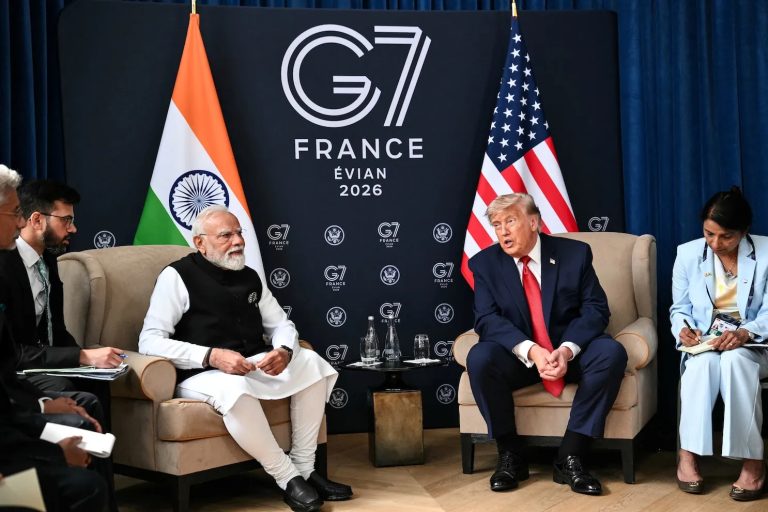
That exchange — blunt, unyielding, and framed in the language of unilateral American prerogative — revealed a deeper rupture that the warm optics of the Trump-Modi relationship have failed to conceal. The two leaders met at the G-7 summit in France on June 17, exchanged pleasantries, and avoided substance. When asked about the deaths of the Indian sailors, Trump replied, “We love all of those people.” He praised Modi but made no substantive announcements on bilateral ties and sidestepped a question about the Quadrilateral Security Dialogue. The dissonance between the relationship’s public presentation and its actual condition has rarely been clearer.
The Economic Shock India Cannot Absorb
India imports nearly 89 percent of its domestic oil consumption, a vulnerability that became acutely painful when the Strait of Hormuz closed and crude prices spiked. The resulting inflation undermined purchasing power across the Indian economy, while disruptions to fertilizer and LNG imports hit agriculture and households directly. Remittances from Indian expats working in the Middle East — a critical source of foreign exchange — declined as instability spread across Gulf economies. Export sectors contracted as freight insurance premiums surged and supply chains fragmented.
The rupee became Asia’s worst-performing currency during the conflict. Foreign investors withdrew record volumes of capital from Indian equities and debt markets, seeking safer assets in Taiwan and South Korea. India’s fiscal deficit expanded just as the government’s capacity to respond through public expenditure contracted. Two years ago, Indian officials spoke confidently about the country soon becoming the world’s third-largest economy. It has since fallen to sixth place. The economic architecture that was supposed to project national power instead became a transmission mechanism for shocks generated by Trump’s unilateral decisions.
The political cost for Modi has been equally severe. His authority rests on the image of India as a rising power capable of protecting its citizens and asserting its interests. The June 9 strike that killed three sailors brought the human cost of the war directly into Indian media and public consciousness. It followed an earlier incident in which U.S. forces torpedoed an Iranian vessel off the Indian coast — an action that challenged the idea that India functions as a net security provider in the Indian Ocean region. The gap between Modi’s rhetoric of strength and India’s demonstrated inability to protect its own sailors has created a visible domestic liability for a leader whose brand depends on projecting power.
Pakistan’s Diplomatic Resurrection
For nearly a decade, Modi pursued a policy of diplomatic isolation against Pakistan, characterizing it as a state sponsor of terrorism and an insignificant regional player. The Iran war reversed that positioning almost overnight. Washington used Pakistani channels to negotiate with Tehran when direct talks were politically untenable, rendering Islamabad indispensable to the U.S. exit strategy. On June 14, Pakistani Prime Minister Shehbaz Sharif was the first to announce the preliminary peace deal, a symbolic but significant rehabilitation of Pakistan’s international standing. For India, this represents a significant reversal — its primary adversary successfully converted a U.S. military operation into an opportunity for diplomatic turnaround, and New Delhi watched from the sidelines.
Marco Rubio’s May visit to India illustrated how far the relationship’s substance has diverged from its surface rhetoric. Washington presented the trip as routine engagement. India treated it as an effort to stabilize ties after deep strain. Rubio publicly insisted that bilateral relations remained stable and offered Modi an invitation to visit the White House. Indian readouts conspicuously ignored the invitation. When Rubio announced an ambitious target requiring India to purchase $500 billion worth of U.S. goods over the next five years — a figure that would convert India’s historical trade surplus with the United States into a structural deficit — New Delhi maintained calculated silence.
The trip yielded one formal agreement on critical minerals cooperation, a framework that largely replicated existing arrangements under the Quad and Washington’s “Pax Silica” initiative. That was the extent of concrete progress. The Quad itself has been downgraded from a leaders’ summit to a foreign ministers’ meeting. On June 16, the U.S. Defense Department reverted to the name “Pacific Command” for its combatant command in the region, quietly erasing the “Indo” that had signaled India’s centrality to American regional strategy.
Adjusting to a New Reality
The bureaucratic and military momentum between the United States and India remains substantial — joint exercises, the Initiative on Critical and Emerging Technology, and defense cooperation continue. But if the trust gap persists, all of these areas will likely be constrained by U.S. export restrictions, technology transfer barriers, and Trump’s prioritization of domestic industries. India has already begun making adjustments, most notably toward China. New Delhi has instructed domestic filmmakers to stop producing films related to the deadly 2020 Galwan Valley clash. The outgoing Indian chief of defense staff recently gave Beijing a pass for providing real-time operational support to Pakistan during last year’s military clash.
These concessions may be temporary tactical moves intended to seek an immediate thaw, but they are establishing a new normal in bilateral ties. The alignment may become institutionalized enough that a future U.S. administration finds it difficult to reengage India as a viable strategic counterweight to China — which was precisely the original logic for deepening the partnership in the first place.
The question facing Indian policymakers is whether the current disruption is an aberration linked to one presidency or a permanent structural shift in U.S. behavior driven by domestic political constraints. The material conditions underlying the partnership have fundamentally changed. India’s resilience will depend not on waiting out Trump’s second term but on building domestic strength and diversifying options in a fracturing world where the assumption of a reliable American partner no longer holds.
Original analysis inspired by Sushant Singh from Foreign Policy. Additional research and verification conducted through multiple sources.
By ThinkTanksMonitor