
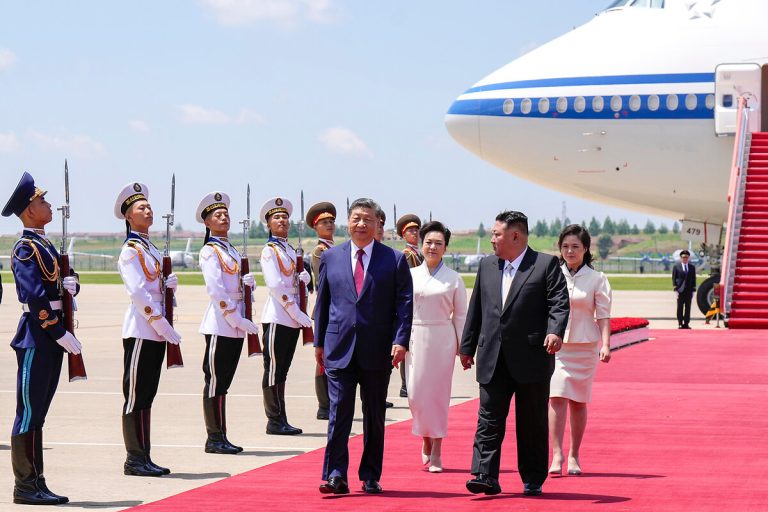
Xi Jinping’s state visit to Pyongyang this week was his first international trip of 2026 — a deliberate signal that Beijing considers the Korean Peninsula’s trajectory important enough to warrant personal diplomatic attention at a moment when China’s foreign policy bandwidth is stretched across multiple simultaneous crises. The pageantry was extravagant by any measure: rows of soldiers mounted on white horses, crowds lining streets waving flowers and flags, buildings draped with enormous portraits of both leaders. For Kim Jong Un, the optics served a specific political purpose. For Xi, the visit was less about warmth than about anxiety — specifically, anxiety over how deeply Vladimir Putin has embedded himself into the relationship that Beijing has spent decades treating as its exclusive strategic franchise.
The Russia-North Korea dynamic that has developed since the 2024 strategic pact has fundamentally altered the leverage calculus on the peninsula. North Korea deployed thousands of troops to fight for Russia in Ukraine, receiving Russian weapons technology, military expertise, and — critically — Moscow’s public acceptance of North Korea’s status as a nuclear weapons power in return. That last element has alarmed Beijing more than the troop deployments. China has spent years insisting on the formal goal of Korean Peninsula denuclearization as a framework for managing Pyongyang’s behavior. Moscow’s willingness to abandon that framework for tactical military benefit in Ukraine has left Beijing’s preferred diplomatic architecture significantly weakened.
What Each Side Is Extracting
Kim’s calculation in receiving Xi is transparent and rational. A high-profile state visit from the leader of the world’s second-largest economy — Xi’s first international trip of the year, chosen specifically for Pyongyang — confers the kind of international visibility that a sanctioned, isolated state cannot easily generate through other means. It reinforces Kim’s domestic narrative of a North Korea that is not merely surviving international pressure but attracting the personal attention of major powers. And it gives Pyongyang two significant patrons simultaneously — Russia providing military technology and international backing, China providing the economic lifeline of food, fuel, and electronics that sustains the regime at a functional level. Bilateral trade between the two countries has surged this year, a tangible expression of that dependence.
Kim also wants formal Chinese acceptance of North Korea’s nuclear status. Beijing’s quiet dropping of the word “denuclearization” from the official summary of September 2025 Kim-Xi talks in Beijing was a significant signal that Pyongyang is making incremental progress on that objective. China has not formally recognized North Korea as a nuclear state, but the gap between that position and its operational behavior is narrowing in ways that matter strategically.
Beijing’s Stability Imperative
Xi’s motivations are more defensive than Kim’s. China’s overriding interest on the Korean Peninsula has always been stability — preventing a US military presence on its border, avoiding a refugee crisis, and managing Pyongyang’s behavior within tolerable limits. The Russia-North Korea strategic pact complicates all three of those objectives. Moscow is demonstrably less concerned with Korean Peninsula stability than Beijing, and its willingness to transfer weapons technology to Pyongyang introduces variables into North Korea’s military capability that China cannot fully monitor or control.
The Xi-Trump summit last month produced a White House fact sheet claiming both leaders “confirmed their shared goal to denuclearize North Korea.” The gap between that statement and what China’s behavior actually signals about its operational priorities is precisely the space Kim is exploiting. Washington and Beijing can agree on language about denuclearization while pursuing incompatible approaches to the practical question of how much pressure to apply on Pyongyang. Xi’s Pyongyang visit maintains China’s position as the indispensable patron while offering Kim just enough diplomatic oxygen to reduce his dependence on Moscow — without actually requiring Pyongyang to change its nuclear posture in any verifiable way.
Original analysis inspired by Ann Scott Tyson from Christian Science Monitor. Additional research and verification conducted through multiple sources.


