In the four months since the United States took operational control of Venezuela’s oil exports following the January 3 military intervention that deposed Nicolás Maduro, roughly 100 million barrels of crude worth an estimated $8 billion have flowed through a financial architecture that neither the American public nor Congress can fully see. The Trump administration has characterized the arrangement as mutually beneficial for both countries. What it has not done is publicly disclose how much oil has been sold, how much revenue has been collected, where the funds are held, or how they have been spent. The absence of those answers, after four months of operations and billions of dollars in transactions, is itself the most consequential fact about the program.
Tanker-tracking data and crude pricing models suggest that monthly export volumes have climbed from approximately 380,000 barrels per day in January, generating around $600 million in revenue, to roughly 1.1 million barrels per day in April, generating an estimated $3.7 billion. The United States itself has received 43 percent of those barrels, with India accounting for another 26 percent and Spain for 8 percent. Those are large flows by any measure, and they have moved through accounts that the administration acknowledges exist but has declined to fully describe.
A Different Leader, the Same Corruption Architecture
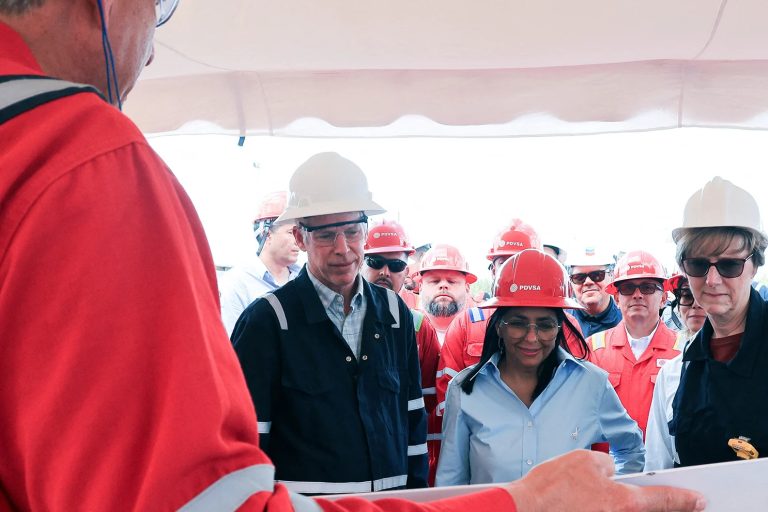
The political dimension of the arrangement is even more uncomfortable than its financial opacity. Interim President Delcy Rodríguez — long a senior figure in Maduro’s government and one of the architects of the system Secretary Rubio himself described to Congress in January as held together by “corruption and graft” — has retained control over the Chavista factions that backed Maduro. The same elite network remains in power. The only change is the leader at the top and the recipient of the export revenue.
Rodríguez has received substantial benefits from the arrangement: full diplomatic recognition, sanctions relief through Treasury-issued waivers covering oil, mining, and financial sector transactions, and Trump’s public praise for what he called her “great job.” Unlike the first Trump administration, which published a framework specifying the conditions Venezuela would need to meet for lasting sanctions relief, the current administration has issued no equivalent roadmap. The waivers exist in what analysts have described as a policy vacuum, and they can be revoked at any time — a structure that gives Washington maximum leverage over Rodríguez while providing almost no leverage to the Venezuelan opposition or civil society over the trajectory of their own country.
More than 400 political prisoners remain detained in Venezuela. No election date has been set. The legislature, judiciary, and electoral authority remain under the control of the same governing apparatus that operated them under Maduro. The democratic transition the administration cited as a justification for the original intervention has produced no measurable democratic outcomes after four months.
The Trader Question and the $5 Billion Lever
The administration’s choice of commercial partners has raised particularly difficult questions. Commodities trading firms Trafigura and Vitol — both of which have paid substantial settlements over historical bribery schemes related to oil sales — were described by Rubio in January as a “short-term fix” to quickly move the first tranche of barrels. Five months later, both companies remain involved, and a third trader, GE Warren, has joined the operation without public explanation. Trafigura also brokered a deal to purchase up to 1,000 kilograms of Venezuelan gold following Interior Secretary Doug Burgum’s March mining delegation to Caracas. Accounting firm KPMG was reportedly engaged to conduct quarterly audits including a retrospective review, but no audit reports have been released and the State Department acknowledged it does not know when they will be available.
Rodríguez wants something the administration has not yet delivered: access to approximately $5 billion in Special Drawing Rights at the International Monetary Fund that Venezuela has been unable to draw since 2019. That access represents the most consequential lever Washington still holds. Conditioning it on concrete democratic concessions — release of political prisoners, a verifiable election timetable, restoration of independent institutions — would provide the kind of structured pressure that the current arrangement lacks. The Venezuelan opposition’s May 29 “Panama Manifesto” endorsed the administration’s three-phase transition framework while explicitly calling for elections, political negotiations, and broader national dialogue — providing Washington with an opposition position it could engage with substantively if it chose to.
Congressional pressure is beginning to build. House Democrats have formally requested that the Government Accountability Office audit the system Treasury has established for managing Venezuelan oil revenues. Several Republicans have pressed the administration on election timing and pushed back on Trump’s dismissal of opposition leader María Corina Machado’s popular support. Whether that bipartisan pressure produces transparency — or whether the arrangement continues quietly enriching the same governing apparatus that produced Venezuela’s humanitarian collapse in the first place — depends on choices the administration has not yet signaled it intends to make.
Original analysis inspired by Roxanna Vigil from Council on Foreign Relations. Additional research and verification conducted through multiple sources.