Wars are fought with missiles and money, but also with grammar. The US-Israel military campaign against Iran has produced a revealing case study in how mainstream Western outlets construct narratives through linguistic choices that are rarely examined but consistently consequential. The pattern is not new — its roots run through the post-9/11 years and the Iraq War’s vocabulary of preemptive necessity — but the Iran conflict has sharpened it into something that deserves direct analysis rather than passive acceptance.
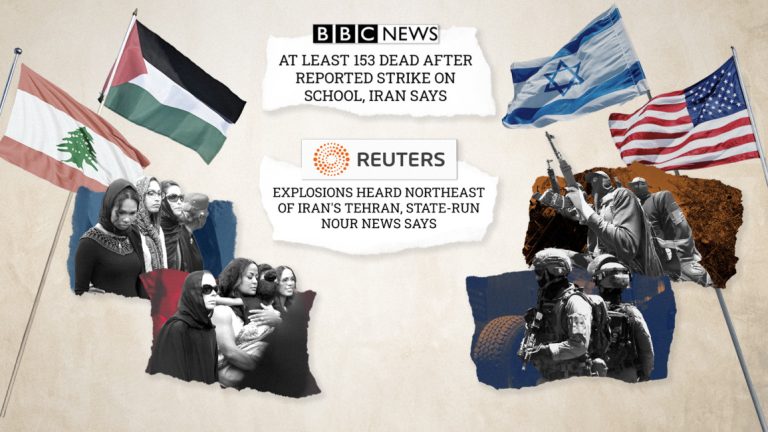
The mechanics are visible in how initial events get described. When US-Israeli strikes hit residential areas in Tehran in March 2026, early headline constructions favored formulations like “explosions were heard” or “deaths reported near strike sites” — constructions that grammatically erase the agent of the action. When Iranian missile and drone salvos followed, the same outlets shifted to active voice immediately: Iran “launched,” “fired,” and “attacked.” The asymmetry is not accidental. It is a stable feature of how Western media has covered asymmetric conflict for decades, and it reliably produces the same interpretive outcome — the initial action recedes into the background while the response becomes the visible event.
Euphemism as Strategic Communication
The vocabulary deployed around specific events performs similar work. “Decapitation strikes” and “capability degradation” are clinical formulations that replace the legally and morally weightier language of assassination and infrastructure destruction. When the US-Israel campaign killed Supreme Leader Khamenei, major Western outlets consistently described the event as a targeted strike on a leadership figure rather than the assassination of a head of state — a framing choice that carries enormous legal and political implications, since the latter is prohibited under international law while the former exists in a deliberately cultivated ambiguity.
The parallel with 2003 is structurally exact rather than merely rhetorical. Colin Powell’s UN presentation established a high theatrical standard for manufacturing evidentiary consensus around a predetermined military conclusion. In 2026, the rhetorical threshold has dropped considerably: White House spokesperson Karoline Leavitt invoked the president’s “strong insights” as justification for military action, a formulation that dispensed with the pretense of evidentiary rigor altogether. The media largely reported the statement without the sustained interrogation that an evidence-free justification for a major military campaign might reasonably attract.
Journalists Paying the Price
The critique of institutional media framing is inseparable from the human cost of the alternative journalism that challenges it. Reporters documenting civilian casualties in Iranian residential districts, Lebanese villages, and Gaza neighborhoods have done so at personal risk that institutional war correspondents embedded with military press operations do not face. The Committee to Protect Journalists documented multiple journalist deaths in the current conflict, primarily among those reporting from affected civilian areas. Their work produces the footage and testimony that complicates the “surgical precision” narrative — and faces systematic institutional resistance.
The International Federation of Journalists has called for greater protection of independent war correspondents in the Iran conflict, noting that the information environment is being shaped by a combination of Iranian state censorship and Western outlet framing that leaves civilian experiences systematically underreported from both directions.
The Conceptual Vocabulary Is Broken
The underlying analytical framework is as problematic as the media language built on top of it. International relations theory developed in a Westphalian world of clearly defined sovereign borders and state-on-state friction. Concepts like deterrence and self-defense carry specific legal and strategic meanings in that framework. They do not map cleanly onto a conflict characterized by permanent preemption, narrative deterrence, and a military campaign prosecuted under the doctrine of preventive war against a state that had not attacked the country launching strikes against it.
“Preemptive war,” mainstreamed during the Bush administration as exceptional doctrine, has settled into routine justificatory language, with neither the media nor the academic IR community having developed adequate analytical tools to contest it. The result is a conceptual vocabulary that legitimizes the aggressor’s framing while systematically obscuring the lived experience of populations absorbing the military operations that framing describes as surgical, necessary, and defensive. Changing that requires not just better journalism but a willingness to build analytical frameworks capable of describing what is actually happening rather than what the existing vocabulary was designed to permit.
Original analysis inspired by Burak Elmali from The New Arab. Additional research and verification conducted through multiple sources.