For three decades, Benjamin Netanyahu has built his political career on a single foundational claim: that he alone possesses the experience, the toughness, and the strategic acumen to keep Israel safe. That claim is now facing its most sustained challenge since the prime minister first took office in 1996. Hamas remains in Gaza. Hezbollah is reconstituting in Lebanon. Iran survived the war with its regime intact. And Israeli soldiers are dying weekly in a ceasefire that has not produced the silence it promised. With elections legally required by October 27, the voters who made Netanyahu “Mr. Security” are asking whether the brand still matches the product.
The political damage is visible in survey data that would have been unthinkable a year ago. A Channel 12 poll published this week found that former army chief Gadi Eisenkot had surpassed Netanyahu as the public’s preferred candidate for prime minister, with Eisenkot drawing 38 percent to Netanyahu’s 35 percent. Naftali Bennett has also outpaced the incumbent in several recent polls. Meanwhile, 53 percent of respondents in the same Channel 12 survey said Netanyahu should not even run in the upcoming election — a figure that reflects not just opposition intensity but erosion within his own traditional constituency.
The Security Brand Under Attack
The most politically damaging dimension of Netanyahu’s predicament is that the attacks are coming from the right, not the left. Eisenkot’s Yashar party, Bennett’s New Right, and Lieberman’s Yisrael Beiteinu are all competing for the same voter base that Netanyahu has held for decades — Israelis who prioritize security above all other considerations and who feel that the prime minister has failed on the only metric they care about. An opposition campaign ad released this week — a tracking shot of an abandoned, bullet-riddled home with a food-laden dinner table and no family — invokes October 7 without words, placing the responsibility squarely on the prime minister who was in office when it happened.
Residents of northern Israeli communities, which resumed taking fire from Hezbollah after the ceasefire collapsed in March, represent a particularly acute electoral liability. These communities returned home at the IDF’s encouragement, only to find themselves running to shelters again. Netanyahu’s vow of “total victory” against Hezbollah carries obvious credibility problems in towns where Hezbollah drones are killing soldiers weekly despite a declared ceasefire.
The Coalition Arithmetic That Keeps Him Standing
Netanyahu’s political longevity has never rested primarily on popularity. It has rested on his unmatched ability to construct and maintain governing coalitions in a fragmented parliamentary system where no party can govern alone. That skill — described by Anshel Pfeffer, The Economist’s Israel correspondent, as bending and rewriting the rules of Israeli politics — means that the relevant question is not whether Netanyahu is popular but whether his bloc can assemble sixty-one seats. His base, consistently measured at around 47 percent in recent polling, remains remarkably stable despite three years of continuous warfare, corruption charges, and strategic setbacks.
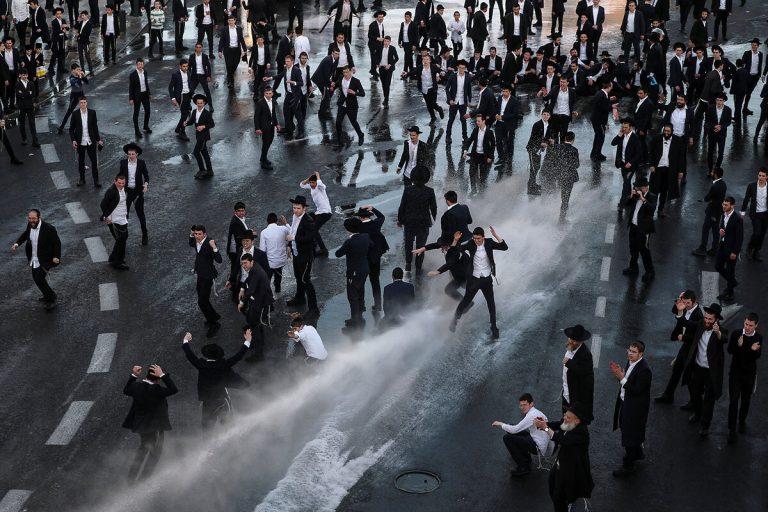
The ultra-Orthodox exemption from military service has become the most socially combustible element of Netanyahu’s coalition maintenance strategy. With secular and traditional Israeli families watching their sons serve extended tours while ultra-Orthodox young men remain legally exempt, the arrangement has generated street protests and deepened the social fracture between secular and religious Israel. Netanyahu preserves the exemption because the ultra-Orthodox parties are indispensable to his coalition. The political cost is borne by conscript families who resent the arrangement and increasingly express that resentment at the ballot box.
Trump’s Shadow Over the Campaign
Trump’s reported phone call to Netanyahu this week — characterized by White House sources in language that included explicit profanity and a reminder that Trump was “saving” Netanyahu from prison — has landed in the Israeli political landscape as a campaign liability disguised as alliance management. For voters who supported Netanyahu precisely because of his relationship with Washington, the image of a prime minister being publicly overruled and cursed out by the American president undermines the core electoral argument that only he can manage the alliance.
Netanyahu’s core supporters frame Washington’s pressure as external interference by enemies who cannot tolerate Israeli strength. That framing resonates with a base that has spent years believing their leader is persecuted by domestic and international forces aligned against him. Whether it resonates beyond that base — to the voters in northern border towns and military families who want results rather than explanations — is what October’s vote will determine.
Original analysis inspired by Shoshanna Solomon and Dina Kraft from Christian Science Monitor. Additional research and verification conducted through multiple sources.