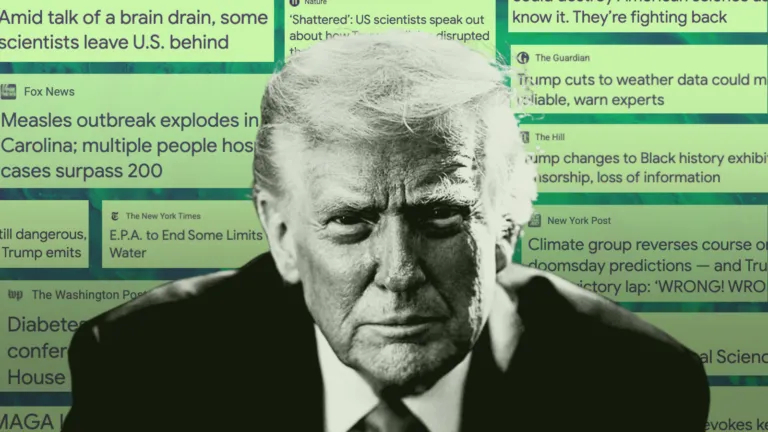
Governments that want to avoid accountability have a reliable first move: eliminate the evidence. The Trump administration has been executing that playbook with systematic thoroughness since January 2025, dismantling federal databases, firing the scientists who maintain them, and in some cases actively purging historical records that document trends the White House finds politically inconvenient. The immediate casualties are specific datasets. The long-term casualty is the government’s capacity to make decisions grounded in what is actually happening to the country.
The scope of what has been eliminated or degraded is striking when listed consecutively. Infant mortality tracking has been curtailed. Food insecurity figures are no longer being systematically compiled. Hazardous chemical exposure rates have lost their federal monitoring infrastructure. Teen suicide data collection has been scaled back. The clean-up cost accounting for climate disasters — data essential for federal emergency planning and insurance market stability — has been defunded. The National Center for Atmospheric Research, which supplies the weather data that airlines depend on for storm avoidance and that agricultural planners use for seasonal forecasting, is in the process of being dismantled. A decade-old ocean observation system funded by the National Science Foundation to monitor marine ecosystems affecting global climate is being shut down.
The Historical Record Under Attack
The destruction is not limited to future data collection, which would be damaging enough. An equally deliberate effort is targeting historical databases that scientists and policymakers use to identify long-term trends. Erasing past data does not merely leave gaps in current knowledge — it destroys the baseline against which future changes are measured, making it structurally impossible to detect emerging crises before they become catastrophes. The administration has removed historical climate data that documents the rise in global temperatures, and has eliminated health-related databases tracking disease prevalence and treatment effectiveness that took decades to build and are irreplaceable once gone.
The Department of Agriculture’s National Plant Germplasm System — a repository founded in the late nineteenth century to ensure that every plant species relevant to the food supply is preserved against crop failures, disease, and climate disruption — has been threatened by DOGE-driven budget cuts. The logic of that particular target is hard to understand on any grounds other than indifference to consequences: seed banks are among the cheapest insurance policies a government can maintain against civilizational-scale agricultural risk.
Selective Blindness Has a Political Logic
The administration’s data policy is not uniformly destructive — which is what makes the pattern revealing. The Department of Homeland Security has consolidated personal data from Social Security, Medicare, and Medicaid records to identify undocumented immigrants. RFK Jr. is expanding the FDA’s Adverse Events Reporting System specifically to generate data about vaccine side effects. The administration is not philosophically opposed to data collection. It is opposed to data collection that might constrain its policy choices or document the consequences of its decisions.
This is a pattern with precedent. The Dickey Amendment of 1996 prevented the CDC from collecting gun violence data for twenty-two years, leaving a generation-long gap in the research base that would have informed legislative responses to mass shootings. The precedent matters because it demonstrates that politically motivated data suppression outlasts the administrations that impose it. Databases rebuilt after the Dickey Amendment’s partial repeal in 2018 could not recover the two decades of missing data. Historical records deleted from federal servers cannot be reconstructed from memory.
The Bureau of Labor Statistics lost its commissioner last August after a jobs report produced numbers the White House did not like. The message that sent to career statisticians — that accurate data carries professional consequences — is more damaging to the integrity of federal economic reporting than any single dataset deletion. Investors and businesses making capital allocation decisions depend on the credibility of BLS numbers precisely because those numbers were, until recently, produced without political interference. Once that credibility erodes, it does not return quickly.
A government that cannot see what is happening to its citizens’ health, food security, and climate exposure cannot govern effectively even when it wants to. What is being dismantled is not just datasets — it is the institutional capacity for evidence-based governance itself.
Original analysis inspired by Richard Aslin, Nigel Goldenfeld, Daniel M. Kammen, and Lynn Nadel from Bulletin of the Atomic Scientists. Additional research and verification conducted through multiple sources.