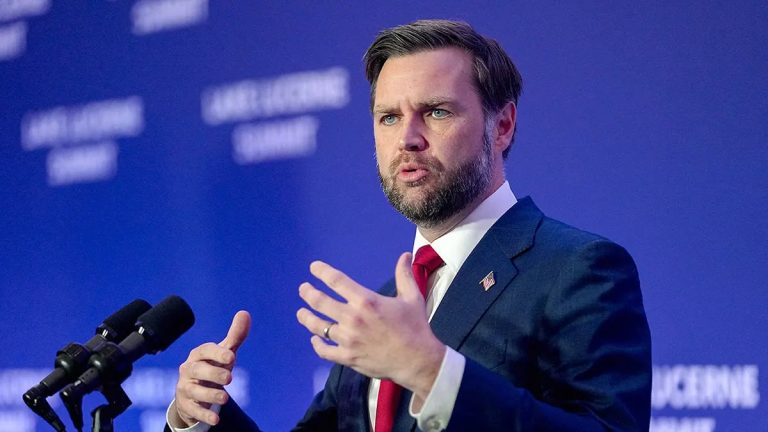
When a vice president speaks, the words travel far beyond the briefing room. They pass through embassies, intelligence assessments, war rooms, and royal courts. They either reinforce American credibility or quietly chip away at it. JD Vance’s recent public lashing of Israeli officials — claiming that Israel is deeply isolated and that its leaders have failed to appreciate American diplomatic and military support — did the latter. His comments were politically convenient and strategically reckless.
The comments deepened a rift that has emerged between the two allies over the interim deal reached by the United States and Iran to end their war, with Vance declaring that Donald Trump is “the only head of state in the entire world who is sympathetic to the nation of Israel.” That framing gets the relationship exactly backwards. Israel is not a supplicant surviving on American generosity. It is one of Washington’s most productive strategic partners — and treating it otherwise weakens American power, not just Israeli morale.
More Than a Client State
The US-Israel relationship is often described in terms of aid figures and UN vetoes. Those numbers matter, but they tell only half the story. The two countries’ security partnership is anchored in a recurring ten-year foreign military financing memorandum of understanding, which has helped Israel acquire the capabilities to defend itself while providing the United States with a key regional military, security, and intelligence partner. That is not charity — it is an exchange with concrete returns.
Since Israel’s integration into US Central Command in 2021, the security partnership has evolved from bilateral cooperation into regional operational integration that enhances American capabilities across the Middle East without requiring US ground force deployments. Think about what that means in practice: Washington gets force projection, early warning, and regional reach without stationing additional troops. Israel’s operations against Hezbollah’s command structure in Lebanon and Iranian military leadership and weapons facilities demonstrate the quality of this intelligence and its strategic value, as these strikes degraded threats to US forces and interests without requiring American military action.
The technological dimension adds another layer. The Iron Dome missile defense system, developed by Israel’s Rafael Advanced Defense Systems with American funding, has fundamentally changed how nations defend against rocket and artillery threats, achieving interception rates exceeding 90 percent since becoming operational in 2011. In January 2026, Washington and Jerusalem formalized a [suspicious link removed] covering artificial intelligence, semiconductors, and critical technologies — a partnership that serves American competitive interests against China as much as it serves Israeli security.
The Gulf Is Watching, Too
Vance’s frustration is not only directed at Jerusalem. It lands in Abu Dhabi, Manama, and Kuwait City as well. These capitals did not sign the Abraham Accords as a favor to Washington — they took a political risk grounded in a calculation that American-backed normalization could deliver security and prosperity. The Abraham Accords marked a strategic realignment in the Middle East between Israel and several Gulf states, driven in part by their shared perception of Iran as a regional threat.
That calculation is now under pressure. The shared Israeli-Gulf perception of the Iranian threat that undergirded the Abraham Accords has come under increasing stress, with Israel taking a maximalist military approach toward Iran and its allies, while the Gulf states have prioritized stability and sought to normalize ties with Tehran. The Iran war did not bring these partners closer together — it exposed how differently they read the same threat. The consequences of the latest Iran war have “eroded confidence in the traditional US-led security architecture” in the region.
Into that vacuum of confidence, Vance chose to scold. The message heard in Gulf capitals was not one of American firmness — it was one of American irritability. And irritable great powers are the ones allies quietly begin to hedge against. A lack of real resolution to the conflict would likely see greater security diversification, with relationships deepened with actors such as China and Turkey, while countries outside the Middle East would also reconsider excessive dependence on the United States as their sole security guarantor.
The Asymmetry Vance Got Wrong
There is a glaring contradiction at the center of Vance’s posture. He treated an ally’s public dissent — from cabinet members like Itamar Ben-Gvir and Bezalel Smotrich, not from Netanyahu himself, who stayed disciplined — as a strategic affront. Yet the same administration spent weeks negotiating with the Iranian regime, which arms proxies across four countries, fires missiles at US bases, and openly calls for Israel’s destruction. The asymmetry is hard to miss: patience for adversaries, impatience for allies.
The US Defense Department reportedly raised its assessment of the espionage threat posed by Israel to the highest category of “critical,” a development that came while Washington was pursuing diplomatic engagement with Iran and Israel remained opposed to those talks. That tension is real and worth discussing through proper channels. But handling it through public humiliation is a different matter entirely — one that signals to every other American ally that Washington reserves its sharpest words for friends, not enemies.
Only consistent US involvement in the region — combining diplomatic leadership with credible security partnerships and reassurance to Gulf states — can keep the Abraham Accords strategic rather than symbolic. The war confirmed that security remains the threshold precondition for the survival and expansion of the Accords. Vance’s remarks pushed in precisely the opposite direction.
America’s alliances are not a burden to be managed. They are instruments of power — the kind that cannot be rebuilt overnight once trust erodes. The Vice President can disagree with Israeli policy, defend American diplomatic choices, and insist that another Middle Eastern war serves no one. All of that is legitimate. What is not legitimate is confusing performance with strategy, or treating the anxieties of front-line states as political inconveniences rather than the strategic signals they actually are.
Original analysis inspired by Ahmed Charai from The National Interest. Additional research and verification conducted through multiple sources.
By ThinkTanksMonitor