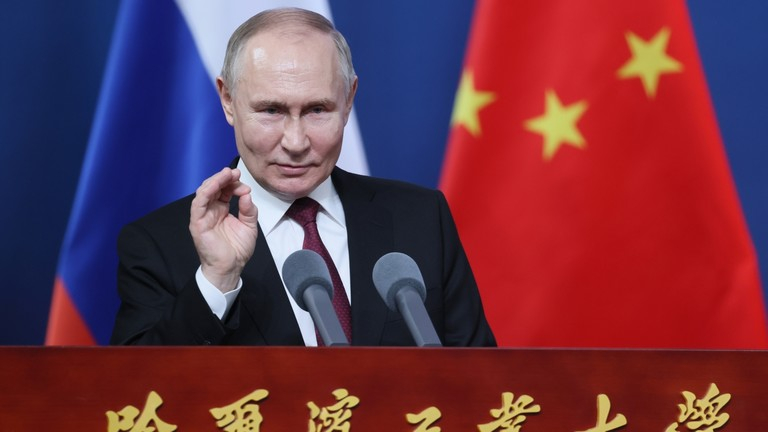
The timing was planned months in advance. But the optics were a gift. Vladimir Putin touched down in Beijing on Tuesday — four days after Donald Trump departed the same city — and stepped into a partnership that Washington has spent years trying to fracture. Every American attempt to drive a wedge between Moscow and Beijing has, so far, produced the opposite result: a deeper, more institutionalized, and increasingly military alignment between the two Eurasian powers.
The back-to-back summits crystallized a pattern that analysts have tracked since 2022. China and Russia insist their relationship is “not directed against any third party.” NATO and the EU say the opposite. The 2024 NATO summit communiqué labeled Beijing a “decisive enabler” of Russia’s war in Ukraine. And a Reuters investigation published on the very day Putin arrived in Beijing reported that China’s armed forces secretly trained roughly 200 Russian troops late last year — focusing on drones, counter-drone warfare, and demining — some of whom have since returned to the frontlines in Ukraine. The revelation undermines Beijing’s carefully cultivated neutrality and suggests the military dimension of the partnership has crossed a line that Western governments had been watching for.
A Partnership Built on Shared Threat, Not Shared Values
What binds Moscow and Beijing is not ideology. Russia is a capitalist state with institutions modeled on Western examples; China is a single-party socialist system. Their political economies share little structural DNA. What they do share is a conviction that the United States poses a permanent structural threat to both — and that conviction has proven far more durable than any ideological affinity could.
Since Xi Jinping took office in 2013, the two leaders have met more than 40 times. Their partnership has been upgraded repeatedly: from “strategic partnership of coordination” in 2014, to “comprehensive strategic partnership for a new era” in 2019, to the famous “no limits” declaration signed just days before Russia’s 2022 invasion of Ukraine. Each escalation in Western pressure — sanctions on Russian banks, export controls on Chinese semiconductors, expanded NATO deployments — has been followed by a corresponding deepening of the Sino-Russian embrace.
The military track tells the story most clearly. Through mid-2025, Beijing and Moscow had conducted at least 113 joint exercises, covering ground, naval, aerial, and multi-domain operations. In 2024 alone, they held 11 — a record — including drills in strategically sensitive waters near Alaska, the East China Sea, and the South China Sea. The covert training revealed by Reuters goes a step beyond exercises: it involves operational instruction directly applicable to an active war, delivered by Chinese PLA instructors at facilities in Shijiazhuang, Zhengzhou, Nanjing, and Yibin.
Washington’s Wedge Strategy Keeps Failing
American strategists have long argued that splitting Russia from China is essential to preserving U.S. primacy. The logic echoes Kissinger’s Cold War playbook — exploit the gap between Moscow and Beijing, court the weaker partner, and prevent a durable alignment. Trump’s first-term National Security Strategy in 2017 grouped China and Russia together as “revisionist powers.” His second-term NSS, released in December 2025, took a softer tone — treating them separately, dropping the threat language on China, and signaling a willingness to engage Moscow independently.
A peer-reviewed analysis published in Comparative Strategy argues that Trump’s concessions to Moscow on Ukraine were “motivated in large part by the desire to drive a wedge between Russia and China.” But the same paper concludes the strategy “stands very little chance to succeed,” not least because it has damaged trans-Atlantic trust without delivering any visible Russian pivot away from Beijing.
The economic data supports that pessimism. China-Russia trade hit $228 billion in 2025 and grew nearly 15% in the first quarter of 2026. Yuan-denominated transactions now account for roughly a third of Russia’s total trade. Russia’s oil exports to China surged 35% in Q1, and the Power of Siberia 2 gas pipeline — which would deliver 50 billion cubic meters annually — moved closer to finalization during this week’s summit. The Iran war has only accelerated the trend: with the Strait of Hormuz disrupted, Beijing’s incentive to lock in overland energy routes from Russia has never been stronger.
Friction Without Fracture
None of this means the partnership is frictionless. The asymmetry is real and growing. China’s economy dwarfs Russia’s. Beijing holds leverage Moscow cannot reciprocate — Chinese banks process Russian transactions that no Western institution will touch, and Chinese firms supply components Russia’s defense industry can no longer source from Europe. The relationship, as one analyst put it, increasingly resembles a senior-junior dynamic dressed up in the language of equality.
Trade disputes simmer beneath the surface. Moscow raised tariffs on Chinese car imports in 2025 to protect its domestic auto sector, cutting Chinese passenger vehicle exports to Russia by 46%. Negotiations on Power of Siberia 2 pricing have dragged on for years, with Beijing pushing for rates near Russia’s domestic price — a demand Moscow resists. And in space, technology, and nuclear doctrine, the two countries maintain distinctly different postures and guard their most sensitive capabilities jealously.
But the critical distinction is that none of these frictions are existential. They irritate, delay, and complicate — they don’t threaten the partnership itself. Unlike U.S.-China relations, where competition increasingly revolves around constraining the other side’s rise, Moscow and Beijing view their disagreements as manageable costs of a relationship both consider strategically indispensable.
That stability is precisely what makes the partnership so difficult for Washington to disrupt. Predictability has become rare in international affairs, and the Sino-Russian relationship now offers both sides exactly that. Whether the alignment eventually hardens into something more formal — or whether internal tensions accumulate enough to create real openings for American diplomacy — remains the defining strategic question of this decade. For now, every pressure Washington applies seems to tighten the very bond it hopes to break.
Original analysis inspired by Fyodor Lukyanov from RT. Additional research and verification conducted through multiple sources.