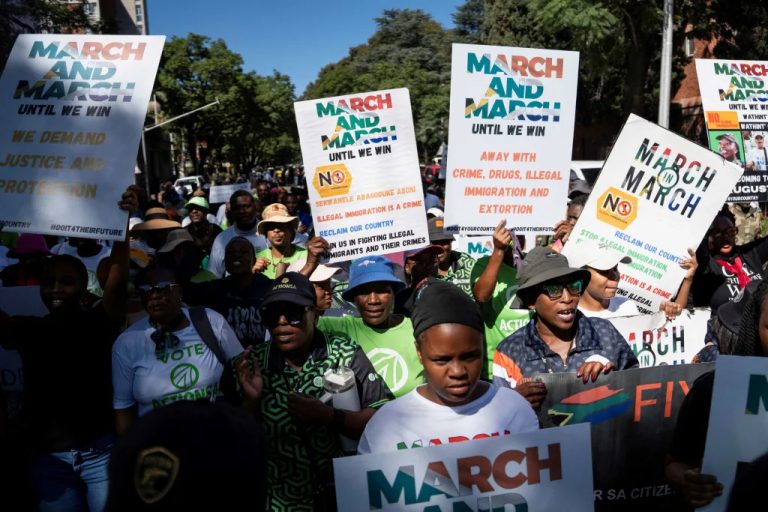
When Julius Malema — the firebrand leader of the Economic Freedom Fighters, recently sentenced to five years in prison for a firearms charge — emerges as the voice of restraint in a national crisis, something has gone badly wrong. Yet that is exactly where South Africa finds itself in May 2026. Malema has criticized xenophobic attacks while warning that violence against migrants damages African unity and South Africa’s image across the continent. The ruling African National Congress, meanwhile, has offered little more than cautious platitudes, afraid to confront a voter base increasingly hostile to foreigners.
The latest wave of anti-immigrant violence has torn through Johannesburg, Pretoria, and Durban since April. Nigeria’s foreign minister called her South African counterpart to discuss accusations of xenophobic violence against Nigerians, including the deaths of two nationals. Ghana and Mozambique have also formally raised the issue with Pretoria, turning what was once a domestic shame into a full-blown diplomatic crisis. The African Commission on Human and Peoples’ Rights expressed grave concern over the incidents, describing them as part of a longstanding pattern.
Economics, Not Identity, Drives the Rage
The uncomfortable truth is that South Africa’s xenophobia has always been rooted less in ethnic hatred than in economic despair. Unemployment surged to 32.7% in the first quarter of 2026, with 8.137 million people out of work and employment falling by 345,000. Youth bore the heaviest burden — those aged 15 to 24 faced a staggering 60.9% jobless rate. Labour federation Cosatu called the figures a “ticking time bomb.” The official rate has stayed above 30% for over five years, among the highest in the world.
Against that backdrop, around 26.5 million people receive social grants — roughly 40% of the population — a figure that has ballooned since the pandemic-era Social Relief of Distress grant became semi-permanent. The coalition government formed in 2024 has struggled to meaningfully boost job creation despite investor optimism about reforms. Infrastructure crumbles, corruption persists, and the state’s capacity to deliver basic services erodes year by year.
Into that vacuum step groups like Operation Dudula — meaning “force out” in isiZulu — widely recognized as xenophobic, blaming South Africa’s porous borders and the presence of migrants for many of the country’s social failures. Alongside a newer movement called March and March, these groups have organized city-by-city demonstrations using aggressive anti-migrant rhetoric. A Gauteng High Court ruling banned Operation Dudula’s leaders from demanding identity documents or blocking access to hospitals, setting a precedent that only immigration officers or police can ask someone to prove their right to be in the country. But enforcement has been patchy at best.
The Hollow Promise of Ubuntu
For decades, South Africa’s intellectual and political elite championed two ideas as pillars of the post-apartheid identity: ubuntu — the philosophy of shared African humanity — and decoloniality, the imperative to purge colonial frameworks from African life. Both attracted enormous prestige in universities and political speeches. Neither prepared the country for this moment.
Ubuntu celebrates an idealized communal bond among Africans, yet the mobs attacking Nigerians and Mozambicans in Johannesburg are the same citizens who grew up hearing that philosophy extolled as a national creed. The gap between the rhetoric and reality is not new — South Africa has experienced coordinated waves of anti-immigrant violence in 1998, 2000, 2008, 2015, and 2019 — but each cycle deepens the contradiction. Researchers argue that the scapegoating of migrants is mainly driven by the government’s failure to deliver on promises to the electorate.
What the crisis reveals is that identity-based frameworks, however intellectually popular, cannot substitute for material improvement in people’s lives. Scapegoating immigrants does nothing to resolve South Africa’s structural challenges; it merely shifts blame away from governance failures. The philosophy of ubuntu rings hollow to a 24-year-old in Soweto who has never held a formal job. Decolonial theory offers nothing to a mother waiting eight hours at a collapsing clinic. These are elite discourses disconnected from the lived reality of millions.
South Africa’s leadership faces a choice it has dodged for years. It can continue investing political capital in symbolic international causes and academic theories while the economic foundations rot, or it can confront the structural crisis — inequality, corruption, failing infrastructure, a jobs market that excludes a third of its adults — that turns ordinary frustration into murderous rage against fellow Africans. The evidence from every previous cycle of violence suggests that without serious economic reform, the next eruption is not a question of if, but when.
Original analysis inspired by Ebenezer Obadare from Council on Foreign Relations. Additional research and verification conducted through multiple sources.