When Javier Milei stood before students at Yeshiva University in March and declared himself “the most Zionist president in the world,” he wasn’t just making a personal statement of faith. He was codifying a foreign policy that has placed Argentina squarely inside the strategic orbit of Benjamin Netanyahu and Donald Trump — a position that most Argentines, according to every available poll, do not want their country to occupy.
The remark came weeks after the United States and Israel launched coordinated strikes on Iran in late February. Milei told the Yeshiva audience he was proud of the label and added, “we are going to win this war.” Days later, Buenos Aires announced it would grant military support to the United States in the Persian Gulf if Washington requested it. For a South American country with no strategic footprint in the Middle East and a military starved of investment for decades, the pledge was less a security commitment than a rhetorical offering — loud, symbolic, and aimed squarely at an audience of two: Trump and Netanyahu.
The Isaac Accords and Jerusalem
The symbolism escalated further in April. During his third visit to Israel in two years, Milei signed the Isaac Accords alongside Netanyahu — a series of strategic deals covering security cooperation and artificial intelligence. The framework aims to strengthen cooperation between Argentina, Israel, and like-minded partners in the Western Hemisphere in what the two governments described as the defense of freedom, democracy, and the fight against terrorism. Ecuador and Paraguay are expected to join, and Israeli media have reported interest from Costa Rica, Panama, and Uruguay.
Milei also reiterated his promise to move Argentina’s embassy to Jerusalem, a pledge first made during a 2024 solidarity visit to Israel. Only six countries currently maintain embassies in West Jerusalem — Guatemala, Honduras, Kosovo, Papua New Guinea, Paraguay, and the United States. Argentina would be the seventh. The move breaks with decades of Buenos Aires’ diplomatic tradition, which recognized the contested status of the city and supported a negotiated framework for its future.
Beyond Jerusalem, Milei’s government has reversed Argentina’s long-standing posture at the United Nations. Buenos Aires voted against a General Assembly resolution supporting Palestine’s bid for full UN membership in May 2024 and against a resolution demanding an end to Israel’s occupation of Palestinian territories in September 2024 — votes that broke with Argentina’s earlier recognition of Palestine as a state.
The Economic Glue Behind the Alliance
This ideological alignment sits on top of a financial relationship with Washington that Buenos Aires cannot afford to jeopardize. In October 2025, the U.S. Treasury announced a $20 billion currency swap with Argentina’s central bank, with the Treasury agreeing to purchase up to $20 billion worth of pesos in exchange for dollars using the Exchange Stabilization Fund. The administration also pursued a separate lending facility worth another $20 billion through banks and sovereign wealth funds, though that figure was later scaled back to around $5 billion.
The timing was not subtle. The support came shortly before Argentina’s midterm elections, and Trump explicitly tied continued American generosity to Milei’s electoral performance. “If he does win, we’re going to be very helpful,” Trump said. “And if he doesn’t win, we’re not going to waste our time.” The rescue provided dollar liquidity ahead of the crucial October vote, and Milei’s party won a major victory, cementing support for his austerity program.
That economic dependence creates a dynamic where Milei’s foreign policy enthusiasm is not purely ideological — it is also transactional. Remaining in Trump’s good graces means maintaining access to the financial lifelines that keep Argentina’s fragile stabilization on track.
Argentines Want Distance, Not Wars
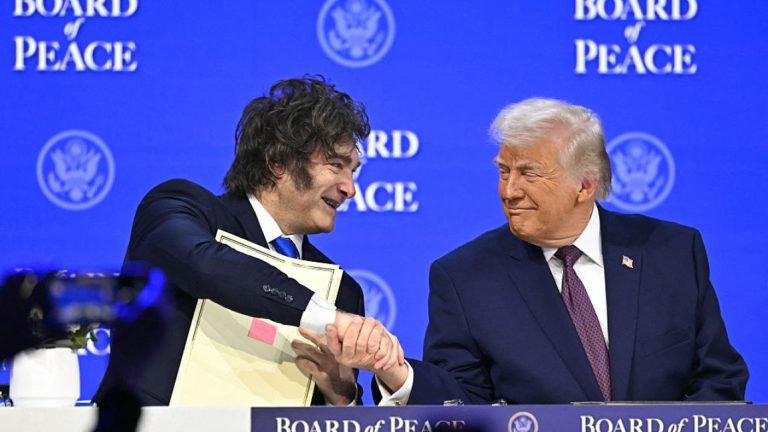
The problem for Milei is that his public doesn’t share the enthusiasm. A March AtlasIntel/Bloomberg poll found that 64% of Argentines described his Yeshiva remarks — including calling Iran an enemy and declaring “we are going to win” — as “very negative” because they committed Argentina to a foreign conflict. Only 19.9% viewed them positively. Asked about joining Trump’s “Board of Peace” for Gaza, 57.5% said they were totally opposed.
A separate Zuban Córdoba survey reinforced the pattern: opposition lawmakers brought a congressional resolution declaring Argentina’s neutrality in the war, and leaders of leftist parties said Milei “does not represent Argentines” while condemning the alignment with Israel and the United States.
Even among Milei’s own voters, a majority opposed involvement in a war featuring Israel, the United States, and Iran. The data doesn’t show sympathy for Tehran or hostility toward Israel. It shows a deeply rooted preference for non-alignment — a tradition that runs across Peronism, the left, and parts of the nationalist right. Argentina’s political culture has long resisted automatic alignment with Washington, and Milei’s enthusiastic embrace of Trump and Netanyahu has collided directly with that instinct.
It is not expected that Argentina will actively participate in the war, not least due to its military infrastructure, which has become technically obsolete due to a lack of investment over the past decades. Iran’s own chargé d’affaires in Buenos Aires dismissed Milei’s posture, saying he “wants to capitalise on what he imagines will be a US victory” but that “Argentina does not have the military or economic capacity to influence our region.”
That gap between rhetoric and capacity is the heart of the problem. Argentina cannot alter the balance of power in the Middle East, determine the future of Gaza, or shape Iran’s calculations. What it can do is expose itself to diplomatic blowback, import external polarization into an already fractured domestic politics, and blur the line between legitimate counterterrorism cooperation and ideological enlistment in someone else’s wars. Milei frames all of this as moral clarity. The polls suggest most Argentines see it as recklessness dressed in conviction.
Original analysis inspired by Luciano Zaccara from The New Arab. Additional research and verification conducted through multiple sources.