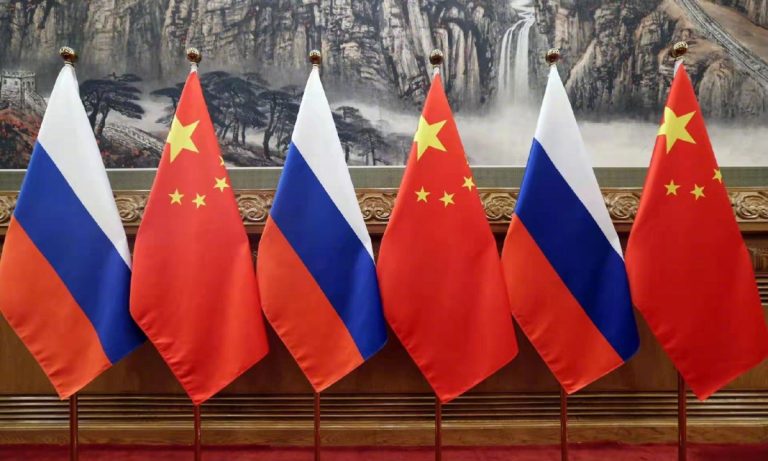
Vladimir Putin arrived in Beijing on Tuesday evening and was greeted by Xi Jinping with a 21-gun salute, an honor guard, and children waving Russian and Chinese flags at the Great Hall of the People. The ceremony mirrored the one Trump received just days earlier — same red carpet, same venue, same choreography. The message was unmistakable: China treats both powers as equals, and it intends to keep both close.
The two leaders used their roughly 24-hour summit to sign a joint statement extending the 2001 Treaty of Good-Neighborliness and Friendly Cooperation and to announce around 40 bilateral agreements spanning energy, education, technology, and trade. But the sharpest moment came when Beijing and Moscow turned their fire on Washington. In the joint statement, Xi and Putin denounced Trump’s planned $175 billion Golden Dome missile defense system as an “obvious threat to strategic stability,” arguing it would undermine the relationship between offensive and defensive nuclear weapons. They also criticized the expiration of the New START arms control treaty in February, calling Washington’s failure to negotiate a replacement “irresponsible.”
Energy Drives the Agenda
Behind the diplomatic ceremony, energy dominated the real business. Putin called the sector “the driving force” of bilateral economic cooperation. Russia’s oil exports to China surged 35% in the first quarter of 2026, and Moscow is now one of the largest exporters of natural gas, LNG, and coal to the Chinese market. The Iran war — which has effectively shut the Strait of Hormuz since late February — has disrupted roughly half of China’s oil imports and nearly a third of its LNG supply, giving Moscow fresh leverage in energy negotiations.
The long-stalled Power of Siberia 2 gas pipeline sat at the center of those talks. The proposed 2,600-kilometer line would carry 50 billion cubic meters of gas annually from Russia’s Yamal fields to China via Mongolia, complementing the existing Power of Siberia 1, which delivered approximately 38 billion cubic meters last year. Gazprom and CNPC signed a legally binding memorandum in September 2025, but pricing and contract terms remain unresolved. Beijing reportedly wants gas priced near Russia’s domestic rate of $120–130 per thousand cubic meters, while Moscow is pushing for terms closer to its existing pipeline. Kremlin spokesman Dmitry Peskov said Wednesday that both sides had “reached an understanding on the project’s main parameters,” though he acknowledged “some nuances remain to be ironed out” — and offered no timeline.
Analysts are divided on whether the Iran war will fundamentally shift Beijing’s calculus. Michal Meidan of the Oxford Institute for Energy Studies told The Moscow Times that while the current “international context and volatility” make the project more likely, Power of Siberia 2 probably won’t begin operating before 2030. China is also hedging — the same week Lavrov was in Beijing pitching the pipeline in April, a senior Chinese delegation signed deals to expand gas imports from Turkmenistan, its second-largest pipeline supplier.
A Lopsided Partnership?
The trade numbers tell their own story. Bilateral commerce surpassed $200 billion for three consecutive years but dipped 6.9% in 2025 to $228 billion, largely because falling oil prices dragged down the value of Russian mineral exports. The first quarter of 2026 showed a strong rebound — trade grew 14.8% year-on-year to over $61 billion — with gold and silver exports quadrupling and online retail parcels from Chinese shops tripling.
Yet the asymmetry between the two economies is hard to ignore. China-U.S. trade reached $414.7 billion in 2025 — nearly double the Russia-China figure. Beijing holds some $700 billion in U.S. Treasury bonds. And with major Russian banks cut off from Western payment systems, yuan-denominated trade has exploded from under 2% in 2022 to roughly 30–40% of Russia’s total commerce, deepening Moscow’s structural dependence on Chinese financial infrastructure.
Putin’s delegation reflected the depth of that dependence — five deputy prime ministers, eight ministers, regional governors, and Central Bank governor Elvira Nabiullina, a signal that the visit was about far more than symbolic friendship. “Putin needs this more than Xi,” Timothy Ash of Chatham House told Al Jazeera. “China has all the cards.”
Xi, for his part, spoke of the relationship as “calm amid chaos” — a phrase that simultaneously praised Sino-Russian stability and took a veiled jab at Washington. He warned that “unilateral hegemonic currents are running rampant” and called for an early end to the Iran war, saying its continuation disrupts energy supplies, supply chains, and global trade. Putin responded with a Chinese idiom — “one day apart feels like three autumns” — a rare bit of personal warmth on a stage usually reserved for strategic calculation.
This visit marks Putin’s 25th trip to China across more than two decades and falls within a remarkable six-month stretch during which all four other permanent members of the UN Security Council — France, Britain, the United States, and now Russia — have visited Beijing. That fact alone captures the gravitational pull China now exerts on global diplomacy. Whether the partnership with Moscow remains “strategically independent” — as both capitals insist — or quietly deepens into the kind of co-dependency that constrains both, will depend less on joint statements than on the energy deals, financial arrangements, and military technology transfers negotiated behind the Great Hall’s closed doors.
Original analysis inspired by Global Times Editorial Board from Global Times. Additional research and verification conducted through multiple sources.