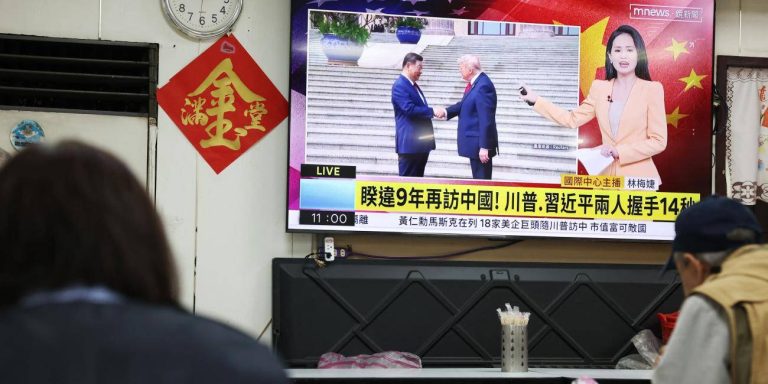
The Trump-Xi summit ended without a grand bargain on Taiwan. Secretary of State Marco Rubio told reporters afterward that U.S. policy remained unchanged. But the anxiety that preceded the meeting — and the president’s own words in its aftermath — exposed something deeper than any single diplomatic exchange could resolve: a growing crisis of confidence among America’s Indo-Pacific allies in the reliability of the security commitments that have kept the region stable for decades.
Three things Trump said in his Fox News interview after leaving Beijing on May 15 alarmed capitals from Taipei to Tokyo to Seoul. He described a pending $14 billion arms package for Taiwan as “a very good negotiating chip” with China. He said he was “not looking to fight a war 9,500 miles away.” And he echoed Beijing’s framing of the Taiwan Strait tensions, suggesting the island should not “go independent because the United States is backing us.” Taken individually, each remark could be spun as consistent with existing policy. Taken together, they undermined the precarious balance of deterrence that has kept the strait peaceful since 1979.
Deterrence Relies on Credibility
Strategic ambiguity — Washington’s decades-old refusal to say explicitly whether it would defend Taiwan against a Chinese attack — only works when backed by credible resolve. Trump’s comments injected doubt into precisely that credibility at a moment when the material foundations of American deterrence are already under strain. A May 2026 CSIS report found that the U.S. military would face serious challenges fighting a protracted war with China because of a lack of long-range munitions, air defense systems, and unmanned platforms, along with vulnerable bases in the Indo-Pacific. The Iran war has only accelerated the problem, depleting thousands of critical munitions and pulling carrier groups from the Pacific to the Persian Gulf.
Trump’s decision to consult with Xi on the pending Taiwan arms sale also crossed a line that previous administrations carefully avoided. One of the 1982 Six Assurances to Taipei states explicitly that the United States will not consult with China on arms transfers to Taiwan. Trump told Fox News he had discussed the matter “in great detail” with Xi — a statement that, if accurate, directly violates a commitment that has anchored U.S.-Taiwan security relations for over four decades.
With Trump and Xi reportedly set to meet at least three more times this year — including Xi’s September visit to Washington — the temptation to hold back arms transfers to preserve the summit rhythm will only grow. Beijing could read this pattern as an invitation to demand further concessions: restrictions on cabinet visits to Taipei, curtailment of Taiwanese presidential transits through the U.S., or deeper limitations on military cooperation.
Allies Are Not Waiting
The ripple effects extend far beyond the Taiwan Strait. Japan, South Korea, and Australia all depend on treaty commitments that ultimately rest on the willingness of an American president to honor them. All three are now hedging. Japan’s Prime Minister Sanae Takaichi, who has publicly stated that a Chinese invasion of Taiwan would justify Japanese military intervention, has accelerated the country’s defense transformation at a pace unseen since 1945. In April, her cabinet scrapped Japan’s post-war ban on lethal weapons exports, opening the door to overseas sales of warships, missiles, and fighters for the first time in eight decades. Japan’s defense budget will exceed $60 billion in fiscal year 2026, reaching the 2% GDP target two years ahead of schedule.
South Korea faces an even more complex predicament. The Trump administration is pressing Seoul to allow U.S. Forces Korea to be reoriented away from North Korea and toward China — including potential Taiwan contingencies. In February, U.S. F-16s launched from Osan Air Base and approached China’s air defense identification zone over the Yellow Sea without consulting Seoul, prompting South Korean defense officials to formally protest. President Lee Jae Myung, who campaigned on avoiding “unnecessarily antagonizing” Beijing, faces the impossible task of satisfying Washington’s demands for flexibility while managing Chinese retaliation that has included nearly 500 aerial incursions annually near South Korean airspace.
The Nuclear Shadow
Perhaps most troubling is the nuclear dimension. A Council on Foreign Relations report noted that both South Korea and Japan are moving beyond civilian nuclear energy toward “nuclear latency” — the technical capacity to develop weapons if necessary. An Asan Institute survey found that roughly 76% of South Koreans now support developing nuclear weapons domestically. Japan holds about 45 tons of plutonium and could assemble a uranium device within six months to a year, according to nuclear experts. The IAEA director general has sounded the alarm.
A recent Foreign Affairs study surveying strategic elites in both countries found that majorities still oppose going nuclear — for now. But that restraint is conditional on the continued credibility of American extended deterrence. Every signal that Washington might trade allied security for bilateral deals with Beijing erodes the foundation on which non-proliferation in East Asia rests.
The irony is that Trump’s stated goal — avoiding war with China — is shared by every capital in the region. Nobody wants a conflict over the Taiwan Strait. But the path to peace runs through credible deterrence, not through treating allies’ defensive weapons as bargaining chips in a bilateral negotiation with the power threatening them. The region’s governments are drawing their own conclusions. Some are spending more. Some are diversifying partnerships. And some, quietly, are reconsidering assumptions about nuclear restraint that have held for three generations. The longer Washington treats its security commitments as negotiable, the faster that restraint will erode.
Original analysis inspired by Kanishkh Kanodia from Chatham House. Additional research and verification conducted through multiple sources.