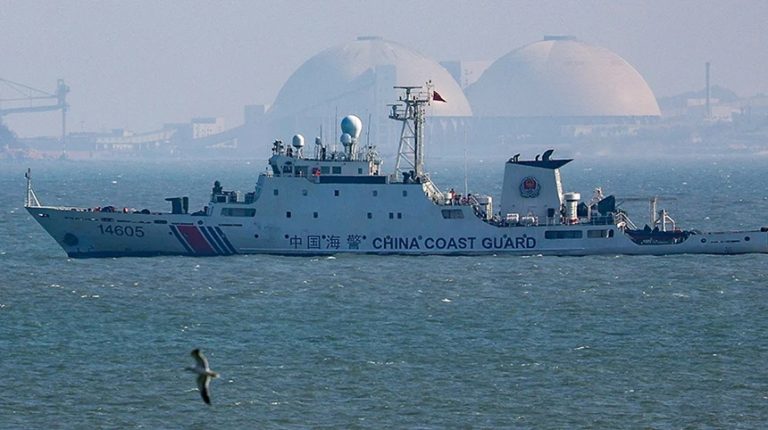
Chinese vessels from multiple agencies have expanded operations in waters east of Taiwan since June, marking a quieter but potentially more durable shift in Beijing’s approach to the island. While large-scale military exercises have been absent this year and aircraft entries into Taiwan’s air defense identification zone have fallen to multiyear lows, the maritime picture has grown busier. Coast Guard ships, fisheries survey vessels, and hydrographic teams now appear more frequently on the eastern approaches, testing how far civilian and paramilitary actors can normalize a Chinese presence without crossing into open conflict.
The June joint operation coordinated by the Ministry of Transport stood out for its scope. Ships from the China Coast Guard, Maritime Safety Administration, and rescue services operated farther east than prior efforts and hailed nearly 200 commercial vessels for remote inspections. Three ships flagged in Benin, Liberia, and Singapore were questioned about ports and crew numbers. Subsequent months saw separate surveys by the Ministry of Natural Resources and the East China Sea Fisheries Research Institute, alongside continued Coast Guard patrols. Tracking data and Taiwanese reports indicate that the combined naval and coast guard presence around the island reached elevated levels in July and August.
State media have framed these activities as the start of a broader near-shore governance system in which law enforcement, scientific surveys, and support vessels form interlocking layers of control. Official coverage describes the effort as extending substantive jurisdiction into waters Beijing claims, with Coast Guard ships as only one element. This differs from patterns around Kinmen, where multi-agency exercises have not produced lasting coordination beyond the Coast Guard. Chinese commentary has also linked the eastern patrols to recent talks between Japan and the Philippines on maritime boundaries, portraying them as a direct response rather than solely an internal evolution of capabilities.
Commercial shipping faces practical questions as these operations continue. If hailing and inspection of foreign-flagged vessels become routine, operators will weigh delays against the risk of noncompliance. Regional governments that share overlapping claims or rely on the Pacific approaches east of Taiwan may need to decide how to treat repeated Chinese presence as a new baseline. Taiwan’s defense ministry continues to monitor the activity and has noted the contrast with reduced aerial pressure, yet the proliferation of nonmilitary actors complicates responses that rely on traditional military deterrence.
The longer-term effect depends on whether individual agencies increase independent patrols or continue joint efforts. Either path could gradually alter expectations about who controls access and information in these waters. Diplomatic messaging that treats the eastern approaches as Chinese jurisdictional space may follow, testing reactions from partners in the region. For now, the shift underscores how gray-zone pressure can advance through administrative and scientific means even when high-profile military drills remain limited.
Original analysis inspired by Erik Green from International Institute for Strategic Studies. Additional research and verification conducted through multiple sources.