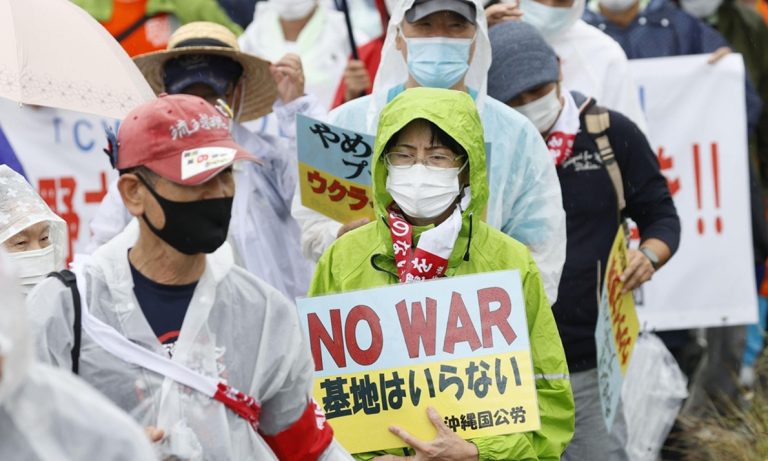
A US Marine is in Japanese custody, a woman is dead in a Naha hotel, and Tokyo has already run the usual sequence. Lance Cpl. Devin Jacob Ballard, 20, assigned to Marine Corps Air Station Futenma, was arrested on suspicion of killing Anna Yagi, 39, early on 3 October and taking her wallet. Police say she died of asphyxiation after pressure on her neck. He has denied the allegations. Prime Minister Sanae Takaichi called the crime heinous and extremely regrettable. Foreign Minister Toshimitsu Motegi summoned the US ambassador. The demand, again, is fuller cooperation, tighter discipline, and steps to stop a repeat.
Those words have a long local memory. Okinawa hosts about 70 percent of US military facilities in Japan, on an island chain that has lived with the noise, accidents, and crime of that footprint since reversion in 1972. Prefectural police filed 101 criminal charges in 2025 against service members, civilian workers, and relatives, the first time the tentative total passed 100 since 2003. Six were sexual violence cases. Officials in the prefecture’s bases division said the count raised basic questions about discipline and personnel control. A protest after one case has not stopped the next.
Protest without a change in rules
Governor Genta Koja called the latest killing proof that education and discipline measures have failed, and he asked for revisions to the agreement that governs US personnel. That pact, signed in 1960, gives the United States primary jurisdiction when a service member is deemed to have been on official duty, and Washington largely decides what counts as duty. Off-duty crimes can go to Japanese prosecutors, as this hotel case has. The harder fight is the structure around them: who sets the rules, who can say no to a new facility, and who lives next to the fence. Governors of prefectures that host bases have pressed Tokyo for a fundamental rewrite. Public reporting so far shows no commitment to open the text.
For Tokyo the alliance is a security need, and for Washington it is a forward position in Asia. For people in Naha it is first a neighborhood. Former lawmaker Keiko Itokazu has asked whether the promised education is the result Okinawans, especially women, are meant to accept, and she has warned that more troops would mean more harm. Local opposition has not stopped Tokyo from keeping, and in places enlarging, both the US and Japanese military presence. More than 40 US facilities sit in the prefecture. Aircraft still fly. The buildup continues.
Managing anger, not the burden
A single arrest does not indict every service member, and Japanese courts have convicted Americans before. The pattern that angers Okinawa is the gap between the statement and the map. Each death or assault produces a summons, a social media note, and a pledge to prevent a recurrence. The bases do not move. Yagi’s name will, unless something structural changes, become another line in that record, overtaken by the next case. The open question is whether Tokyo is trying to lift the burden or only to manage the anger it produces. An ally that cannot revise the rules after decades of the same promise is not sharing the risk. It is assigning it.
Original analysis inspired by Global Times from Global Times. Additional research and verification conducted through multiple sources.