Oil is moving again out of the Gulf, and Washington has treated the rebound as proof that Iran is close to breaking. The numbers do not support that reading. Private trackers estimated that September crude flows from major allied producers reached about 13 million barrels a day, the best month since the war began on 28 February, but still far below the roughly 19 million barrels a day those states shipped before the fighting. Iran has not moved its own crude through the Strait of Hormuz since the US Navy restored a blockade in July. President Donald Trump then claimed almost total control of the waterway and a victory very soon. The same boast has been heard for seven months.
If the route were truly open, prices would show it. Brent settled back above $100 a barrel in September, about 40 percent higher than the day before the war. US gasoline has climbed from $2.98 a gallon to well above $4, and diesel has risen even faster, from $3.75 toward $6.50, a jump of nearly 75 percent. That pressure pushed Group of Seven governments to announce a release of 100 million barrels of diesel and crude from strategic stocks over four months. US inflation, 2.4 percent annualized in February, was running at 3.4 percent by August.
A strait that is still a war zone
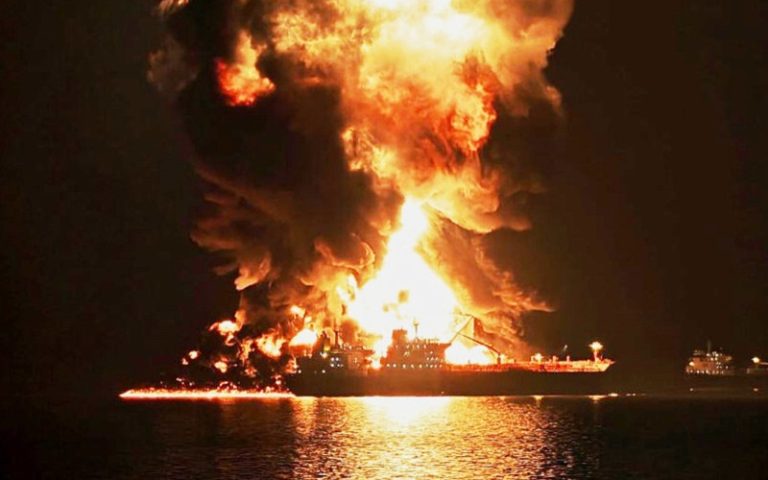
Most of the extra oil is not coming through Hormuz under escort. It is taking longer bypasses by the Red Sea, the Suez Canal, and the Arabian Sea. The Wall Street Journal reports that moving a barrel from the Middle East to China now costs about $35, up from $7 before the war. Two US carriers and a large escort screen can wave some ships through. That deployment is not a peacetime schedule. Iran has also stepped up strikes on shipping since 28 September, with maritime monitors counting at least seven. Houthi forces hold the Bab al Mandab, so the Red Sea bypass is itself a choke point. Iranian-backed units have already hit Saudi Arabia’s east-west pipeline.
Refined fuel and gas are in worse shape than crude. Iranian missiles knocked out 17 percent of export capacity at Qatar’s Ras Laffan hub. Restoring the two damaged liquefied natural gas trains could take three to five years. The economic shock is easing only at the margin.
Pain without surrender
Iran is suffering more than its customers. Inflation there is averaging above 80 percent a year, and the currency is at all-time lows against the dollar. That has not produced a political break. Tehran has lived under US sanctions for decades, in the company of states that learned how to endure scarcity. In June its leaders walked away from a deal that would have released tens of billions, perhaps hundreds of billions, in frozen funds in exchange for reopening the strait. Hardliners in the Revolutionary Guard then attacked tankers hugging the Oman coast and read the draft as a grant of control over all traffic. Without that bargain, Iran still has missiles and drones for ships and oil plants.
Trump is signaling a harder campaign after the midterm elections. The Navy is preparing another carrier and a Marine unit to join two carriers and about 50,000 troops already in the region. More strikes are unlikely to finish a war that months of bombing have not finished. The exit is a negotiation that will look a great deal like the June text: sanctions relief and unfrozen assets, not the end of Iran’s nuclear work, its missiles, its proxies, or the regime itself.
By ThinkTanksMonitor Editorial