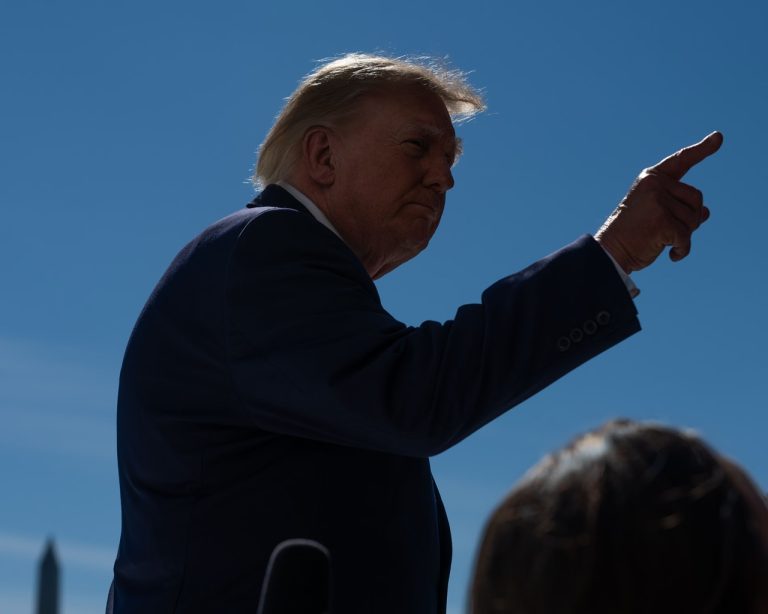
Donald Trump has spent the past week treating the trade ledger as a personal loss column and the Federal Reserve as a switch he can throw. On Truth Social, he wrote that he would stop trading with any country that runs a deficit with the United States if the Fed does not cut rates, and that ending those flows would yield at least $1.5 trillion a year. The list covers China, Mexico, Taiwan, and the European Union. A college course in trade is enough to see the problem. A country that imports chips, rare earths, auto parts, aluminum, fertilizer, and lumber cannot switch those supplies off and call the missing bill a profit.
The arithmetic treats a deficit as money handed away. It is not. If Americans buy $2 billion of French wine and France buys $1 billion of Kentucky bourbon, the $1 billion gap is wine on American tables, not a gift to Paris. Ending the exchange would remove the wine, the bourbon market, and the jobs tied to both. Factories that cannot get parts would idle. Farmers short of fertilizer and builders short of lumber would stop work. Trump has already shown he will turn a notion into policy: the tariff fight with Canada did not stay on social media.
A rate cut that would feed prices
The monetary claim is no steadier. Two days before the Fed raised its benchmark to a range of 3.75 to 4 percent, the first increase since 2023, Trump said rates should be at 1 percent or half a percent. The hike was unanimous, including Chair Kevin Warsh, whom Trump chose, and officials tied it to inflation still nearer 4 percent than the 2 percent goal. A cut to 1 percent would do the opposite of what households were promised on day one. Very low rates heat spending, and hotter spending lifts prices that the Iran war and tariffs have already pushed up. University of Michigan economist Justin Wolfers called the 1 percent demand the most foolish line he had heard from a president.
Trump then said a compliant Fed could deliver growth of 14, 15, 16, or 20 percent. The economy expanded at about 2.2 percent in the second quarter and rarely clears 5 percent. Since the Second World War, a 20 percent quarter has happened once, in the third quarter of 2020, when businesses reopened after a pandemic collapse that had cut output at a 28 percent rate. That rebound is not a model for a peacetime year.
What voters are left holding
A Wall Street Journal poll cited in recent coverage found only 7 percent of Americans want Trump leading on artificial intelligence rules, days after he wrote that the only guardrail AI needs is a high-IQ president. The economic statements matter more. Advisers have not stopped them. Republican leaders in Congress have mostly cheered or stayed quiet. Tariffs and the Iran war are already in wallets. If the deficit threat becomes an order, the damage will not stay on a post. Voters can price that in November.
Original analysis inspired by Steven Greenhouse from The Guardian. Additional research and verification conducted through multiple sources.